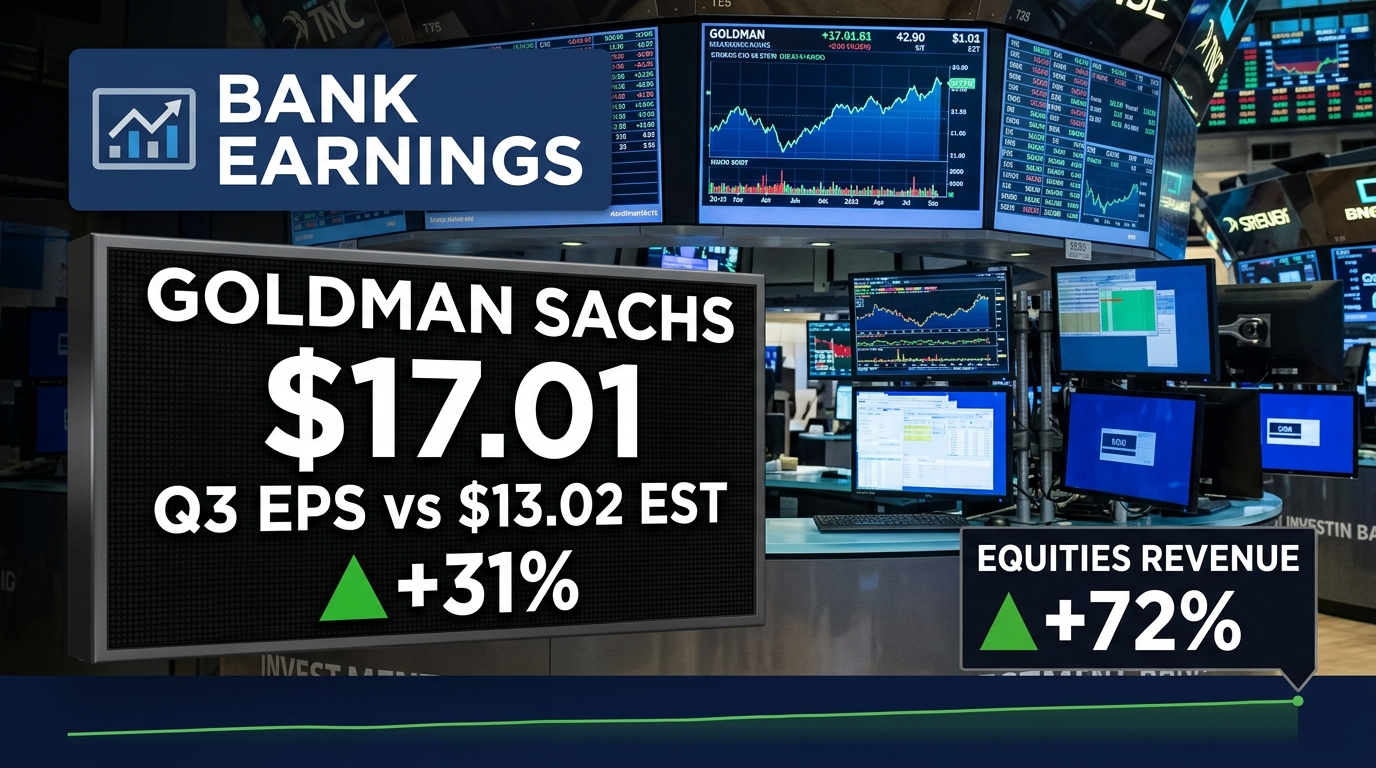
Goldman Sachs delivered a sharp earnings beat for the third quarter of 2026, reporting diluted earnings of $17.01 per share on net revenue of $18.68 billion. Analysts surveyed by LSEG had expected $13.02 per share and $16.71 billion in revenue, making it one of the larger upside surprises among the big banks reporting Tuesday.
The per-share figure compares with $12.25 in the third quarter of 2025 and $20.98 in the record second quarter of 2026. Revenue rose 23% from a year earlier but slipped 8% from the prior quarter, consistent with the seasonal cooling that analysts had anticipated after an exceptional spring and early summer. Earnings for the first nine months of 2026 reached $55.56 per share, versus $37.33 in the same period last year.
Global Banking & Markets was again the engine, generating net revenue of $13.46 billion, up 32% from a year ago and down 13% sequentially. Equities contributed $6.44 billion, a 72% increase from the third quarter of 2025, as equities financing produced about $3.4 billion and equities intermediation about $3.1 billion. The firm attributed the gain to significantly higher prime financing and portfolio financing revenue, along with stronger derivatives activity.
The equities result stands out against expectations. A pre-earnings consensus cited by IG pointed to equities revenue of about $4.68 billion, and Bloomberg consensus had the five largest investment banks generating roughly $38 billion in combined equities and fixed-income trading in the quarter, about 19% below the second quarter's $47 billion. Management had also signaled that fixed-income trading would be softer and that non-compensation expenses would run higher.
Investors entered the report with mixed signals. Estimates had drifted lower, with 17 downward EPS revisions and no upgrades in the 30 days before the print, and options markets implied a move of about 4.7% in either direction. The shares closed at $895.32 on October 9. A beat of this magnitude against lowered expectations typically resets sentiment, though the market's reaction will depend on forward commentary about the deal pipeline and the durability of prime-brokerage balances.
The readthrough extends beyond one firm. Goldman's report arrived alongside results from JPMorgan, Wells Fargo and Citigroup. Strong trading and financing revenue would suggest the largest capital-markets franchises are still benefiting from elevated market activity, even as Treasury yields near 5.2% on the 10-year weigh on fixed-income desks and parts of the lending business.
Risks remain. Wednesday's September CPI report could shift rate expectations, and the sharp semiconductor selloff shows how quickly the equity volatility that supports trading revenue can turn into broader risk aversion. Investors will also watch whether equities financing, a more recurring revenue line, can hold up if clients reduce leverage. A pullback would test Goldman's valuation after a strong run.
For portfolio positioning, the quarter reinforces a barbell in financials: capital-markets franchises with strong equities financing and derivatives desks are outrunning traditional lenders, which face margin and funding pressure. Whether that leadership persists depends on volatility staying high enough to drive client activity without tipping into a drawdown that forces deleveraging. The remaining bank reports and the inflation print should clarify that balance.