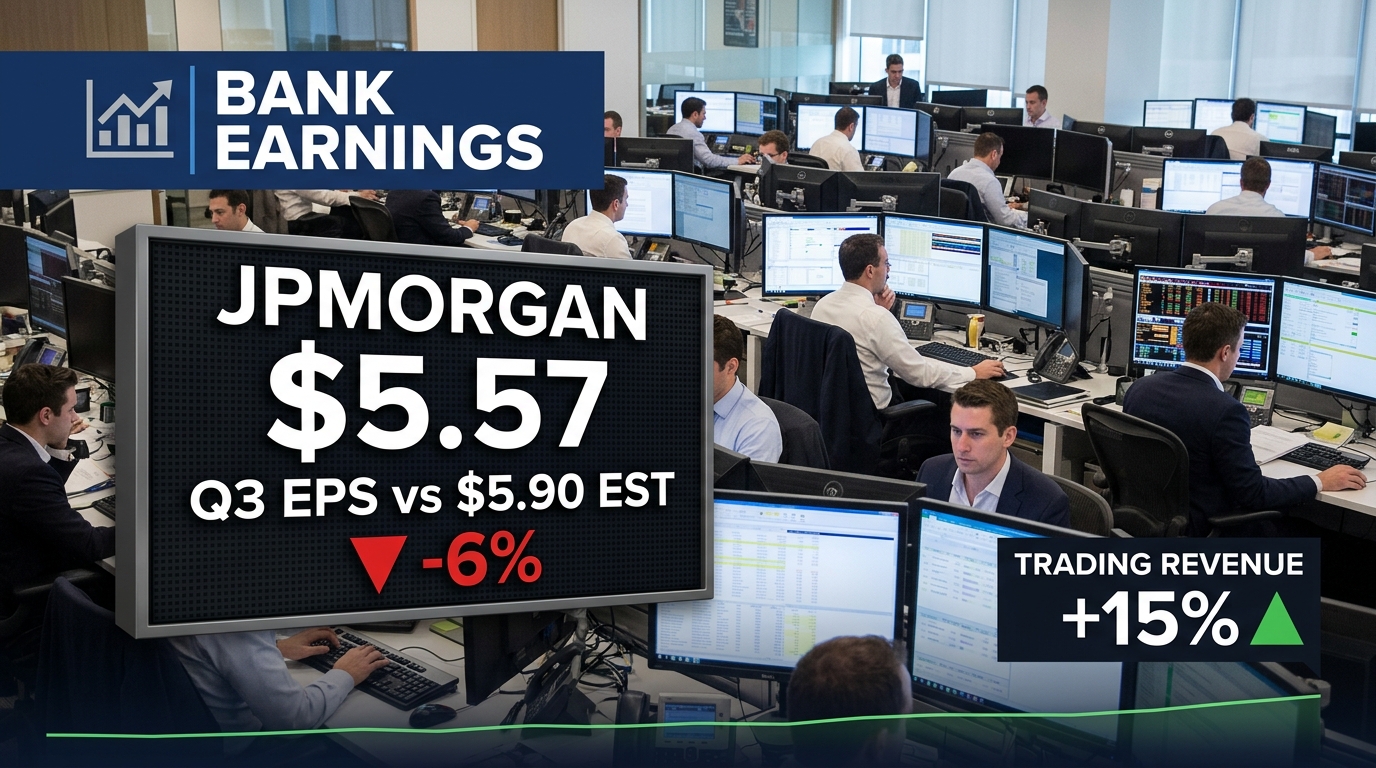
JPMorgan Chase opened the third-quarter earnings season with profit growth but a rare miss on per-share earnings. The largest U.S. bank reported net income of $15.3 billion, or $5.57 per share, up about 6% from $14.4 billion a year earlier. Analysts had expected roughly $5.90 per share.
Excluding $658 million of paper losses on securities, the bank said it earned $5.75 per share. Net revenue rose 8% to $50.2 billion from $46.4 billion a year ago, below the roughly $51 billion analysts had forecast.
Trading and investment banking again supplied the momentum. Revenue in the markets division climbed 15% to $10.3 billion, slightly short of analyst expectations, and investment banking fees rose 14%. JPMorgan kept its position as the top earner of investment banking revenue, according to Dealogic data. Debt capital markets were a notable bright spot as large technology companies raised billions of dollars to fund AI ambitions, even as broader deal-making slowed amid uncertainty over the Federal Reserve's rate path.
CEO Jamie Dimon used the release to caution that economic forces are shifting beneath the surface, a message that resonates with a market contending with a 10-year Treasury yield above 5%, Brent crude near $105 a barrel and a September inflation report due Wednesday. The bank's results came against a backdrop of yields near 24-year highs, which raise questions about deposit costs and the value of securities portfolios.
Wells Fargo also reported before the open, earning $1.87 per share against the $1.85 consensus on revenue of $21.87 billion, below the roughly $22.3 billion analysts expected. Net income was $6.0 billion, return on tangible common equity reached 16.3%, and average loans and deposits each posted double-digit growth from a year earlier. The bank repurchased $2.5 billion of stock during the quarter. Shares were indicated about 1% lower in extended trading before the bell, and the stock has a history of slipping after earnings releases despite a long streak of bottom-line beats.
Goldman Sachs reported a much larger beat the same morning, while Citigroup was due to report later. The divergence points to a quarter in which trading-heavy franchises outperformed balance-sheet lenders, with elevated yields complicating funding costs and securities valuations. Analysts had expected the five largest investment banks to produce about $38 billion of combined trading revenue, well below the record $47 billion of the second quarter.
JPMorgan's miss is narrow and partly driven by non-operating securities marks, but the reaction of bank stocks to beats shows how high the bar has become. Investors will focus on net interest income guidance, credit costs and consumer commentary on the conference calls. Bank of America and Morgan Stanley report Wednesday alongside the CPI release, making the next 48 hours pivotal for financials.
The practical takeaway is selectivity. Revenue growth across the group remains solid and credit has not yet shown stress, but earnings quality, rate sensitivity and exposure to market-driven fees now separate winners from laggards. Traders may see opportunity in post-earnings dislocations, while longer-term holders will want to see whether guidance for 2027 net interest income holds up if yields stay elevated.