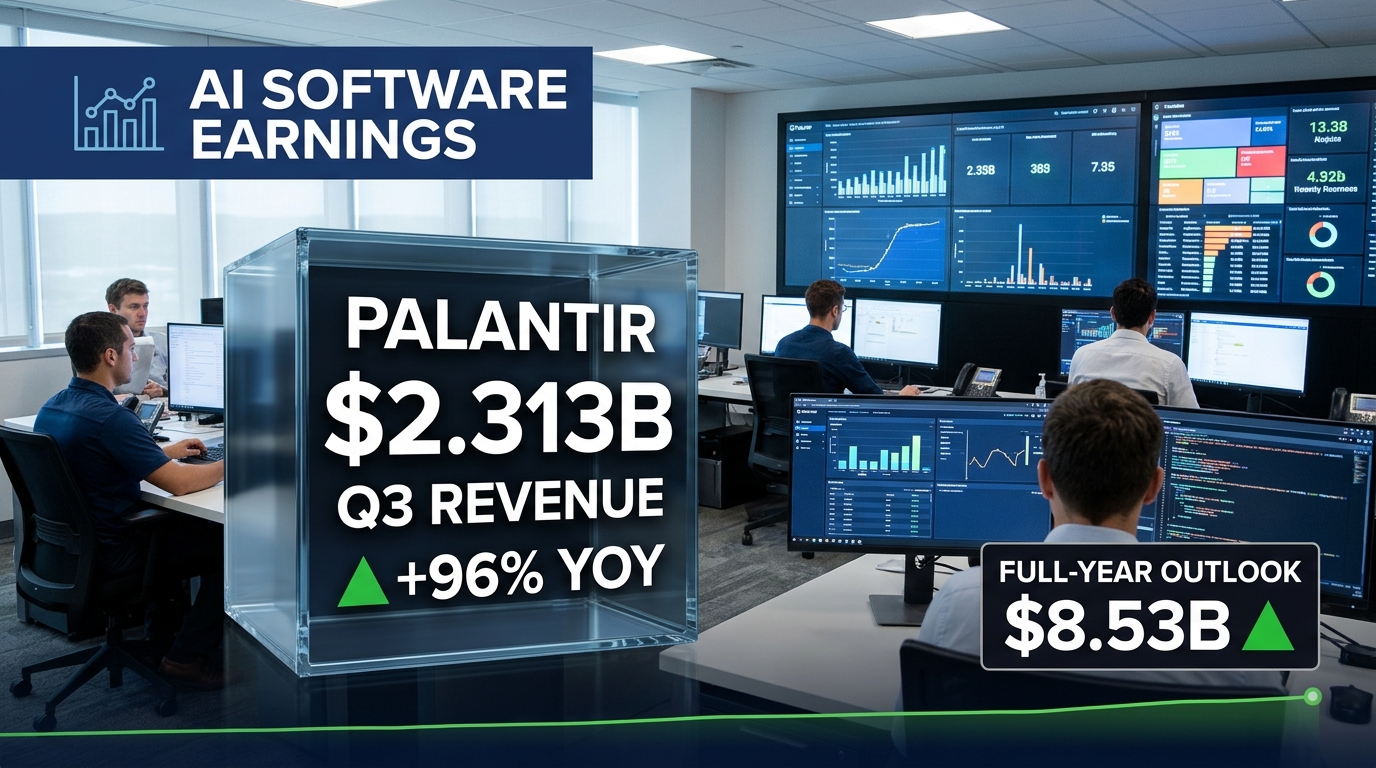
Palantir beat Wall Street estimates for the third quarter and raised its full-year revenue outlook after the close on Monday, but the stock slipped in after-hours trading as investors weighed the results against a punishing tech sell-off. Revenue rose 96% year over year to $2.313 billion, ahead of the $2.17 billion expected by analysts surveyed by Bloomberg. Adjusted earnings per share of $0.44 topped the $0.40 consensus.
The company now sees full-year revenue between $8.530 billion and $8.534 billion, well above the $8.2 billion analysts had modeled. It also lifted its U.S. commercial revenue target to more than $3.559 billion. In a notable milestone, U.S. commercial sales exceeded U.S. government revenue for the first time, evidence that the company's artificial intelligence platform is broadening beyond its historic defense and intelligence base.
CEO Alex Karp used the earnings call to describe the shift in how the market views the company, joking that it has moved from the physics department to captain of the football team. Palantir has also argued that the enterprise AI market is splitting into two camps: companies spending heavily on model tokens with little to show for it, and those building on its underlying infrastructure layer.
Palantir shares closed Monday at $178.34, down 3.13%, and traded at $172.73 after hours, another decline of about 3.1%. The stock is up only about 2% year to date, having been caught in the recent tech sell-off and in earlier fears that AI would disrupt the software industry. Wall Street remains largely constructive, with 30 Buy ratings, nine Holds and two Sells, and a consensus price target of $216, roughly 21% above Monday's close.
Government exposure remains a core part of the story. Earlier this year the Pentagon made Palantir's Maven Smart System an official program, cementing a multiyear role across U.S. military AI projects. The faster growth in commercial sales suggests the company is diversifying even as it benefits from that defense base.
The market backdrop is challenging. The Nasdaq fell 1.07% on Monday, chip and memory stocks have lost about $3.7 trillion since October 6, and the VIX closed at 21.15. Tonight brings another major AI chip earnings report and the midterm election results, which could keep AI-linked names volatile. Investors weighing Palantir will need to balance 96% growth and rising guidance against the stock's sensitivity to risk appetite and rates.
A decline after a beat-and-raise report often signals that expectations and positioning were already stretched, and Monday's move fits that pattern. Volume and the first hour of trading on Tuesday will show whether buyers step in at lower prices or whether the stock keeps tracking the broader Nasdaq lower.
Key questions ahead include whether U.S. commercial growth can hold its current trajectory, how quickly government contracts convert to revenue, and whether software sentiment stabilizes. This article is for informational purposes only and is not investment advice.