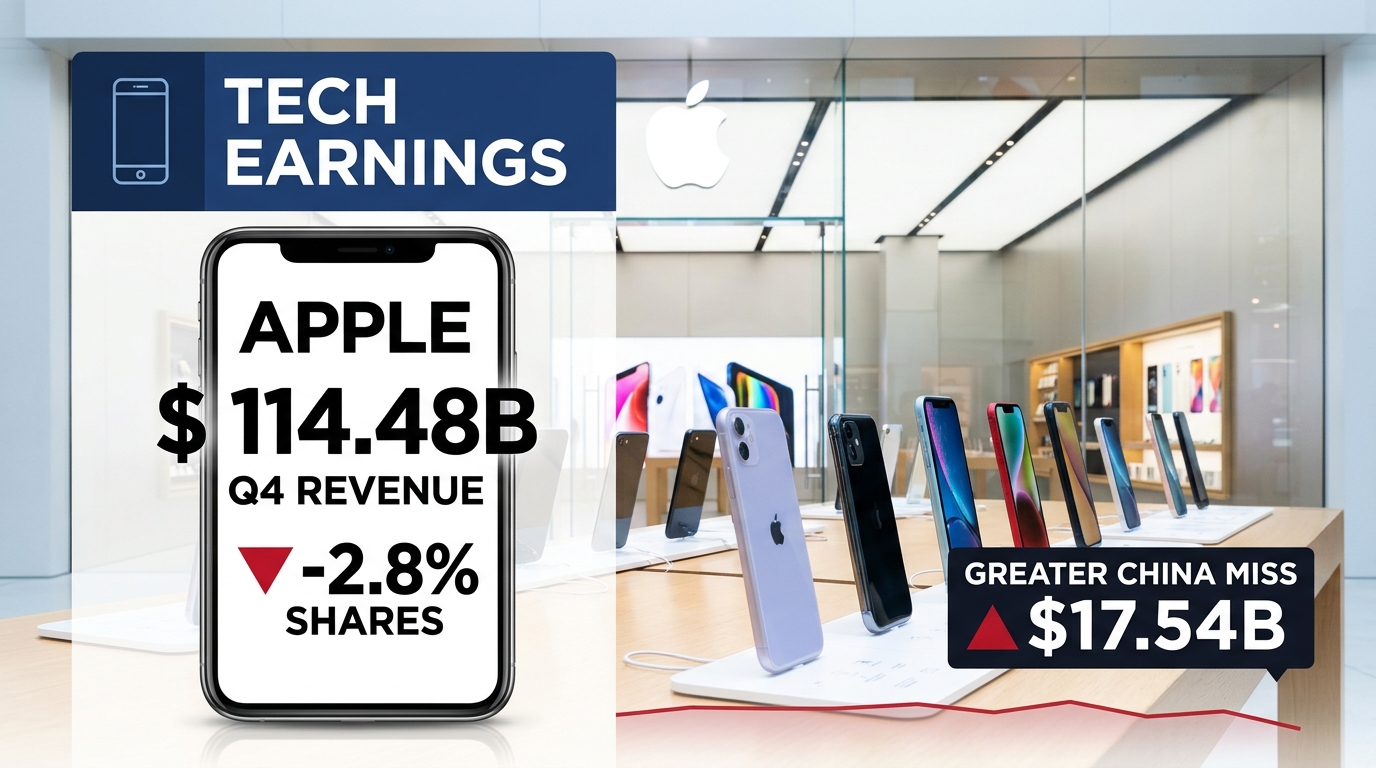
Apple reported fiscal fourth-quarter results after the close on Monday, beating Wall Street on both revenue and earnings in its first earnings call under CEO John Ternus, who succeeded Tim Cook on September 1. Revenue reached $114.48 billion against a $113.46 billion consensus and $102.46 billion a year earlier, while earnings per share were $2.10 versus $2.00 expected and $1.85 in the year-ago quarter.
Strength was concentrated in hardware. iPhone revenue came in at $57.58 billion versus an estimate of $56.48 billion, and Mac revenue of $10.79 billion topped the $9.69 billion forecast. Services revenue of $31.57 billion was essentially in line with the $31.58 billion estimate, while wearables generated $8.3 billion and iPad $6.23 billion. Greater China was the soft spot at $17.54 billion, short of the $18.75 billion analysts projected. CFO Kevan Parekh said fiscal 2026 delivered all-time record revenue of $479 billion, along with record September-quarter net income and earnings per share.
The outlook drew more scrutiny than the quarter. Parekh guided December-quarter revenue growth of 7% to 10% year over year and said he expects it to be the best quarter in the company's history. Services growth is forecast at 8% to 9%, with headwinds from third-party licensing and foreign exchange, and gross margin is expected between 45% and 46%, primarily because of higher memory costs associated with the ramp of Siri AI. Operating expenses are projected at $20.4 billion to $20.8 billion.
Memory dominated the discussion. Ternus said memory pricing is unprecedented because of the AI buildout, and he expects costs to rise further in the December quarter, with the benefit from carry-in inventory fading afterward. Apple raised its purchase obligations by $33 billion sequentially to secure supply, and management warned that Mac and iPad will be supply constrained in the December quarter. COO Sabih Khan said it is hard to predict when supply of the new iPhone Duo will match demand. Parekh added that without tariff refunds, gross margin would have been roughly one percentage point lower sequentially, and that Apple has now received the majority of those refunds.
Shares closed Monday at $338.32, down 1.83%, and traded near $328.93 in overnight activity, a decline of about 2.8%. D.A. Davidson analyst Gil Luria told Yahoo Finance that Wall Street has a big concern about Apple's next quarter. The reaction came as the Nasdaq fell 1.07% on Monday and the VIX rose to 21.15, leaving the stock exposed to the same AI-driven volatility that has hit the chip complex.
The debate is straightforward. Bulls point to an installed base above 2.5 billion active devices, record numbers of upgraders and new Mac customers, and a record fiscal year. Bears focus on margin compression from memory inflation, the China shortfall against expectations and supply limits that could cap holiday-quarter sales. For traders, the read-through to memory-sensitive hardware names is as important as the Apple-specific numbers, because the same component inflation that is lifting the memory sector is now a direct cost for device makers.
Investors will also watch whether management's confidence in a record December quarter holds as the holiday season approaches and memory costs climb. This article is for informational purposes only and is not investment advice.