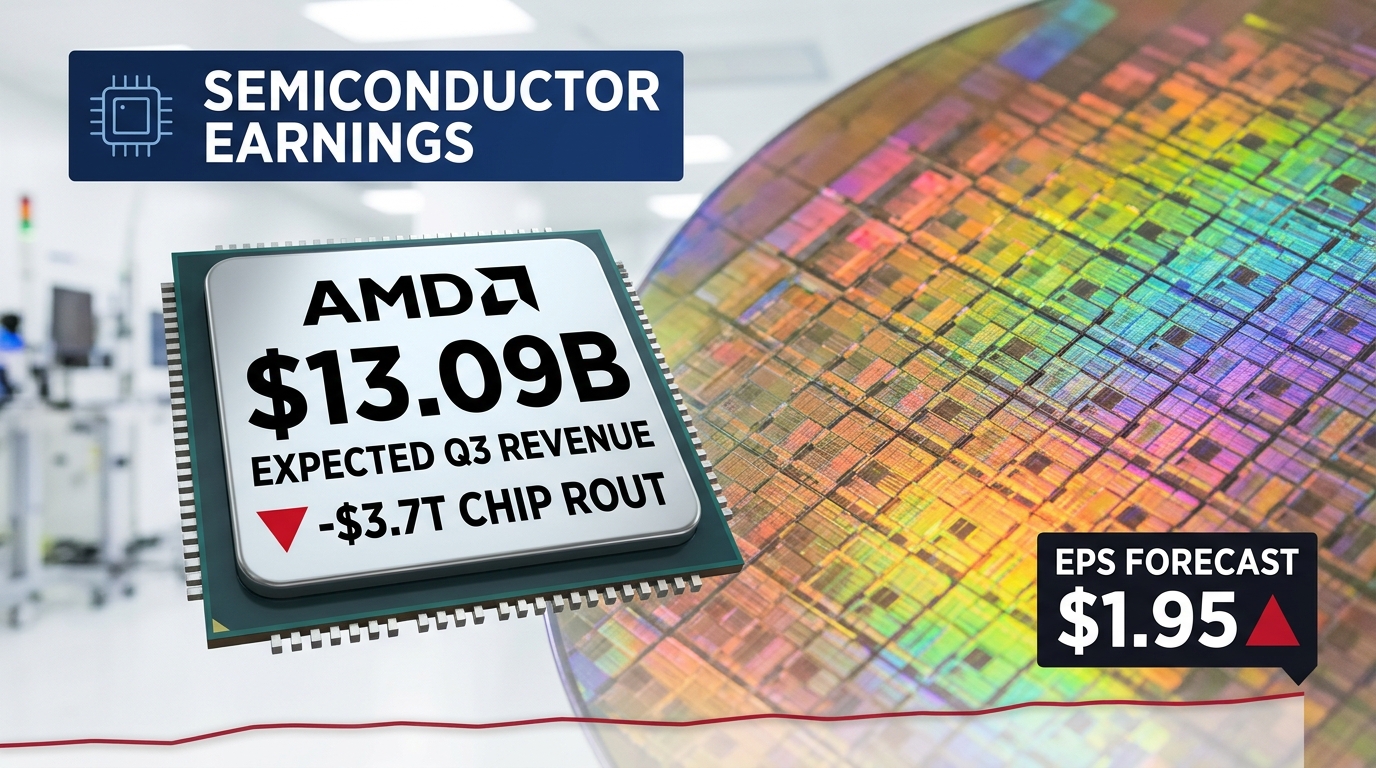
AMD will report third-quarter results after the closing bell on Tuesday, November 3, with analysts expecting earnings of $1.95 per share on revenue of $13.09 billion, according to consensus figures cited by Benzinga. The report lands at a precarious moment for the artificial intelligence trade, with futures mixed ahead of the open and investors braced for further volatility in semiconductor shares.
The backdrop is a sector-wide rout. Chip and memory stocks have lost roughly $3.7 trillion in market value since October 6, by Yahoo Finance calculations. Nvidia has shed about $896 billion, TSMC roughly $435 billion, AMD about $298 billion and Intel about $279 billion. On Monday alone the group gave up more than $400 billion even as roughly seven in ten S&P 500 stocks rose, and the Nasdaq 100 slid into correction territory, around 10% below its peak.
Intel set the tone. The company reported third-quarter earnings of 52 cents per share on $16.51 billion in revenue, both ahead of estimates, but guided fourth-quarter earnings to 25 cents against a 43-cent consensus and revenue of $15 billion to $16 billion versus $17.05 billion expected. The stock fell nearly 29% on October 30, its worst session since 1974, and dropped about another 9% on Monday to near $60, leaving it worth less than half its end-of-September value. AMD fell roughly 8% in premarket trading on October 30 as investors read Intel's warning across to the broader group.
The damage has since spread. Micron and other memory and storage names fell roughly 6% to 8% on Monday. Marvell Technology dropped almost 13% after agreeing to acquire Lumentum in an all-stock deal with an implied enterprise value of $115 billion, while Lumentum fell about 18%. Oracle slid around 8% after announcing plans to sell $10 billion of common stock and $10 billion of bonds to fund its AI buildout. Nvidia was little changed and some analog chipmakers rose, a sign that investors are discriminating among chip exposures rather than abandoning the sector wholesale.
For AMD, the focus will be on data center revenue and the fourth-quarter outlook. In its prior report the company posted revenue of $11.54 billion, up 50%, with data center sales more than doubling to $6.7 billion. Intel's reaction showed that guidance can matter more than the quarter just reported, and because AMD and Intel compete in PC processors and server CPUs, Intel's soft outlook and its warning about memory and substrate shortages bear directly on AMD's own demand and supply picture.
Seasonality offers some counterweight. Jeff Hirsch of the Stock Trader's Almanac, who bought Friday's sell-off, has noted that chip stocks rose from the October close to the following June in all eight midterm cycles since 1994, although they first fell about another 11% in 2002 and 2018. Tonight's midterm election results add another layer of event risk for a market already carrying a VIX above 21.
Bulls argue last week's selling already discounts the worst and that AI infrastructure demand remains intact. Bears point to Intel's guidance miss, mounting financing needs across the sector and a Nasdaq 100 in correction. Either way, traders should expect wide gaps in AMD and its peers at Wednesday's open. This article is for informational purposes only and is not investment advice.