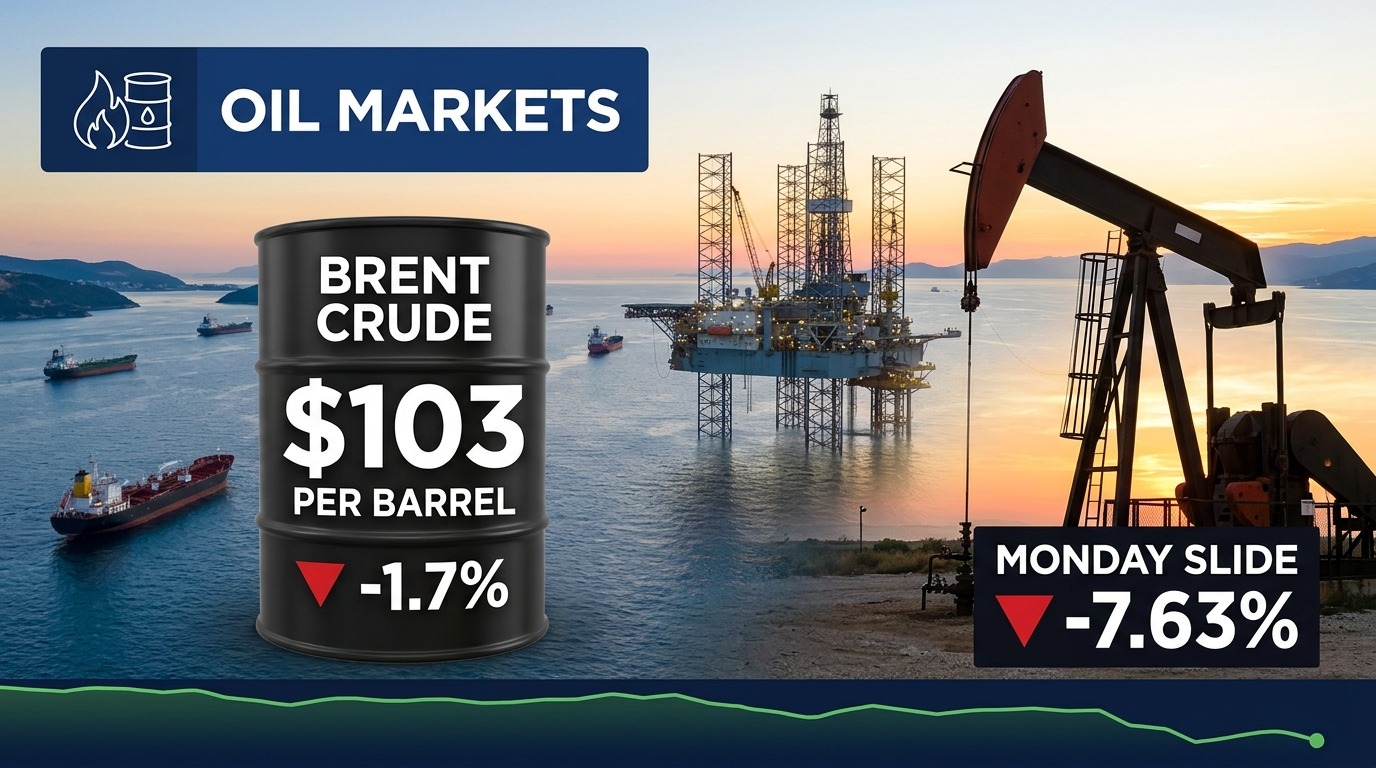
Oil prices extended their retreat on Wednesday as traders bet that diplomacy could ease the U.S.-Israel-Iran conflict and restore disrupted Gulf supplies. As of 8:09 a.m. in Tokyo, Brent crude traded at $103.00, down 1.68%, while Murban crude was at $102.20, down 2.98%, according to OilPrice.com data cited by Gulf News. Natural gas moved the other way, rising 1.16% to 2.889.
The latest leg lower follows a steep drop at the start of the week. Brent settled 7.63% lower at $104.77 on Monday, and West Texas Intermediate fell 7.36% to $96.46. Reuters reported further losses on Tuesday, with Brent near $103.14 and WTI near $95.79. The decline came after Iran’s president said the supreme leader had granted the government certain authorities regarding peace talks, and after Iranian negotiators held days of discussions with Qatari mediators.
The main driver is a retreat in the geopolitical risk premium, the extra amount buyers pay when war threatens future supply. Qatar said both countries remain committed to mediation, but a senior Iranian official said they were still far from an agreement. A draft proposal to end the war circulated on Monday, according to OilPrice.com, and that helped push prices lower even as attacks and unresolved differences kept the market exposed to reversals.
Analysts urged caution about reading too much into the move. One energy analyst noted that skepticism is warranted after many false dawns over the past several months. The war, which began at the end of February, has depleted oil inventories, and forecasts for the longer term remain wide. One bank projected on Sunday that Brent could jump to $140 in 2027 if Gulf oil output stays about 3.5 million barrels per day below its 2025 average.
The price path has been dramatic. Brent reached a post-war peak above $126 a barrel on April 30, according to Al Jazeera, and later fell back toward pre-war levels in the summer when talks appeared to be progressing. Its return above $100 this autumn shows how quickly sentiment has swung with each diplomatic headline. Lower prices also do not establish that shipping routes are safe, and a failed negotiation or renewed escalation could restore the premium quickly.
For U.S. markets, the link runs through inflation and rates. Crude above $100 keeps energy costs elevated for consumers and businesses, complicating the outlook for Treasury yields that have been near their highest levels since 2002. The 10-year yield eased to 4.92% on Wednesday, a move that coincided with falling oil and a post-election bid for risk assets. A sustained slide in crude would add to that relief, while a rebound would tighten financial conditions again.
The practical takeaway is to treat oil as a headline-driven variable. Traders should watch Qatar’s mediation updates, official statements from Washington and Tehran, and verified shipping developments before assuming that lower prices are durable. Position sizing in energy-sensitive and rate-sensitive sectors should reflect the possibility of sharp reversals. This article is informational and does not constitute investment advice.