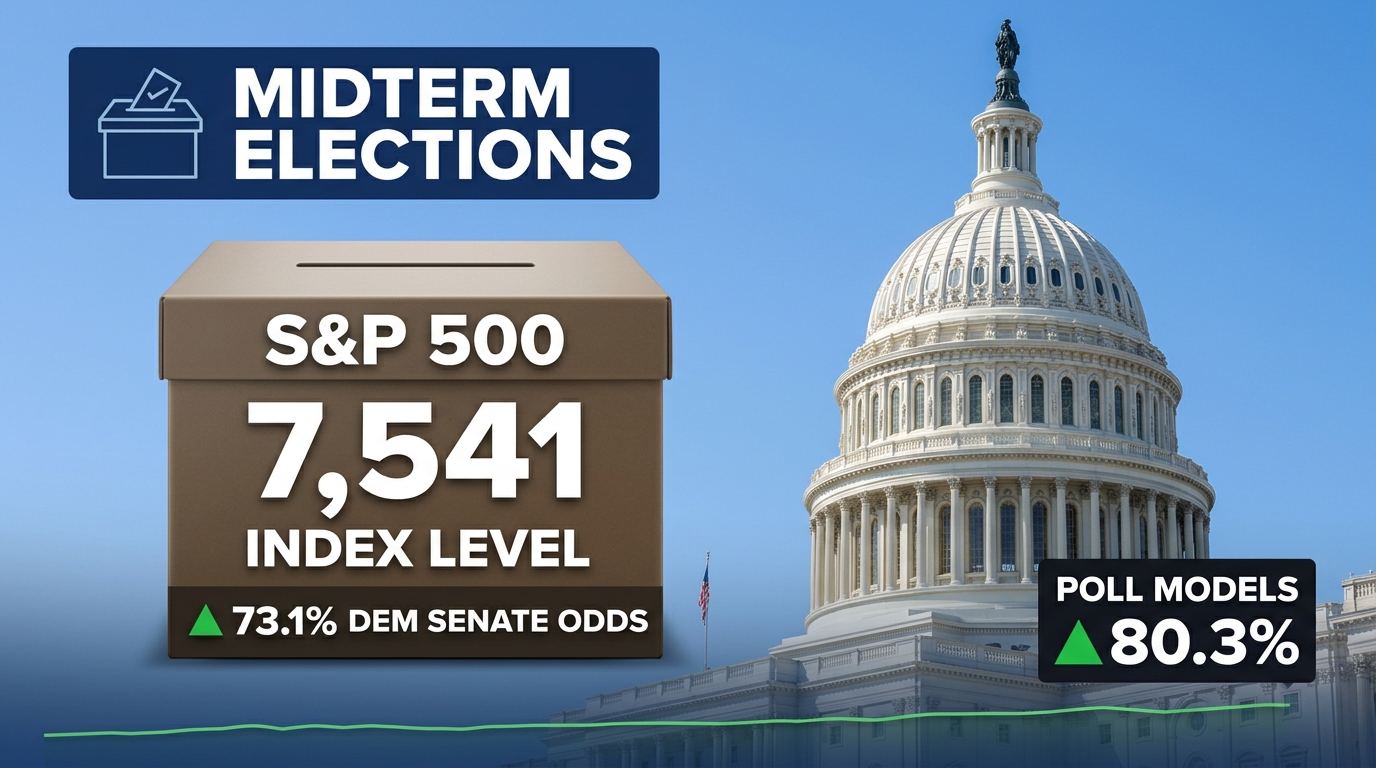
American voters are casting ballots in the 2026 midterm elections on Tuesday, and Wall Street is positioning for results that could shape policy for pharmaceuticals, housing and artificial intelligence data centers. Yahoo Finance reports that prediction markets and pollsters both favor Democrats to win the House and the Senate, though prediction markets are somewhat less certain, especially in the upper chamber.
The gap between the two forecasting approaches is a story of its own. Three prediction markets put the chance of a Democratic Senate at 73.1% on Monday, while two polling-based models showed 80.3%, a difference of 7.2 percentage points that compares with an average gap of about 7.4 points since September 1. The contest is another test of the rivalry between prediction markets and traditional polls that emerged after the 2024 election.
Equity futures were mixed before the opening bell. Contracts on the Dow fell about 0.7%, S&P 500 futures slipped roughly 0.1% and Nasdaq-100 futures rose about 0.2%. The S&P 500 closed Monday at 7,541.40, down 0.51%, while the Dow rose 0.41% to 51,983.98 and the Nasdaq Composite fell 1.07% to 25,164.36. Trading Economics data show the S&P 500 about 3.9% below its October record of 7,844.67 and down roughly 3% over the past month.
Timing matters for traders. Polls close in the evening, after U.S. cash markets have shut, so the first full market reaction to the results will come in overnight futures and in Wednesday's session. That leaves little room to adjust positions on new information, and investors appear aware of the risk: the VIX closed Monday at 21.15, up 8.9%, a sign that participants are already paying for protection.
The sectors in focus are those with direct policy exposure. Yahoo Finance has identified pharmaceuticals, the housing market and AI data centers as areas where the outcome could matter for potential policy changes. Each could see shifts in regulation or priorities depending on which party controls Congress and what ballot initiatives pass, though the market impact of any change would likely unfold over months rather than a single session.
The AI trade is a particular sensitivity. Chip and memory stocks have lost about $3.7 trillion in value since October 6, and a major AI chip earnings report arrives after the close today. Stock Trader's Almanac editor Jeff Hirsch has noted that chip stocks rose from the October close to the following June in all eight midterm cycles since 1994, though in 2002 and 2018 they first fell about another 11%.
Other data compete for attention. The Labor Department releases its JOLTS job openings report today, the 10-year Treasury yield sits near 4.89% and crude oil is trading near $98 a barrel. Investors will have to separate election-driven moves from macro and earnings signals when sessions resume. This article takes no position on any candidate or party, is for informational purposes only and is not investment advice.