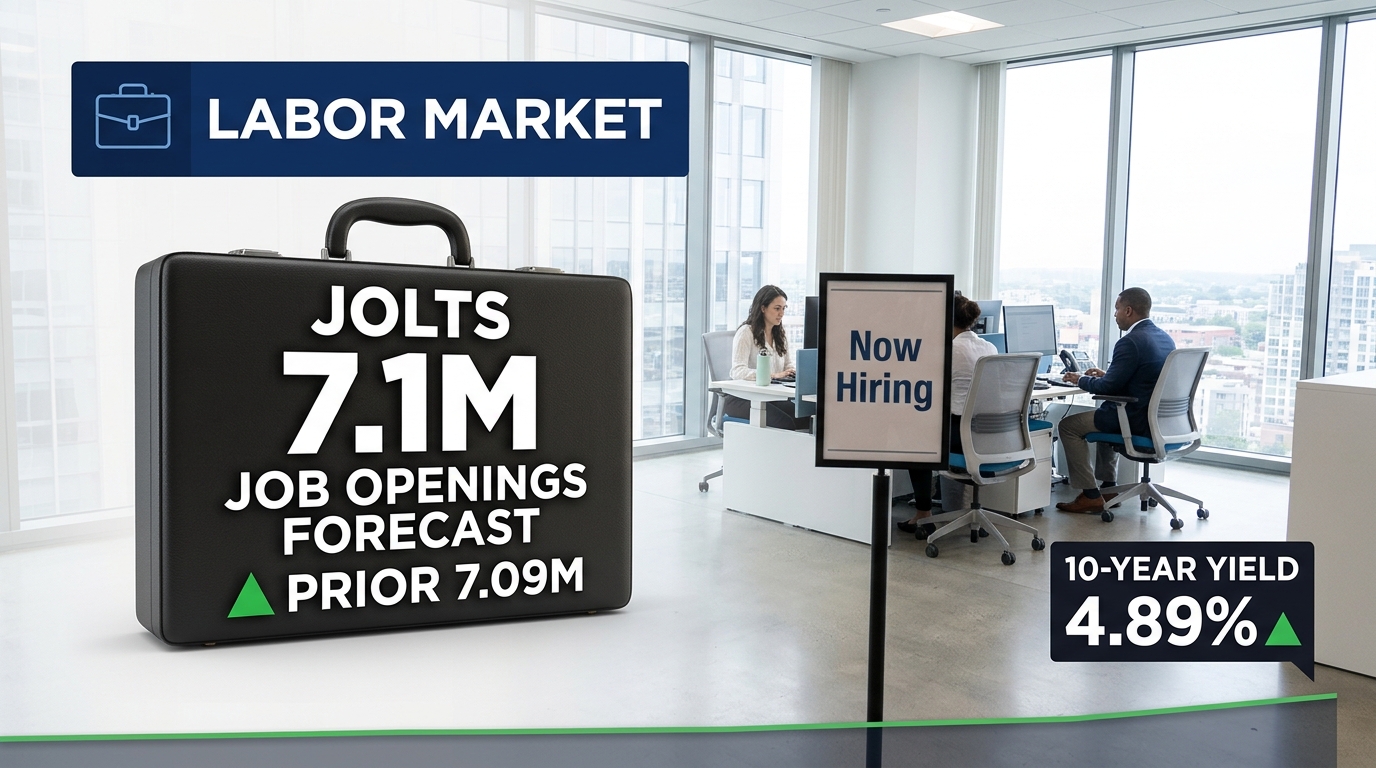
The Labor Department releases its September Job Openings and Labor Turnover Survey on Tuesday, a data point arriving alongside elevated Treasury yields, near-$100 crude oil and rising equity volatility. Economists expect 7.1 million job openings versus 7.09 million previously, a quits level of 3.09 million versus 3.06 million, and a layoffs level of 1.66 million versus 1.64 million. September factory orders are also due, forecast to rise 1.1% after a 0.1% gain.
The market backdrop is tense. The 10-year Treasury yield stood at 4.894% after a slight decline on Monday, keeping borrowing costs high for companies and households. The VIX closed at 21.15, up 8.91%, and pre-market futures pointed to a mixed open, with Dow futures down about 0.9%, S&P 500 futures down roughly 0.2% and Nasdaq futures slightly higher.
Energy prices add another variable. December West Texas Intermediate crude settled at $96.31 on Monday and traded near $98.59 in early indications, up more than 2%. Oil near $100 raises the risk that inflation pressures linger, which in turn complicates the outlook for interest rates and equity multiples. Gold closed at $3,956.30 and was trading around $3,912 pre-market, while Bitcoin fell about 2% to near $76,700.
Why does JOLTS matter now? The report measures labor demand, and with yields close to 4.9%, investors are sensitive to any sign that the job market is either cooling enough to ease pressure on rates or staying firm enough to keep it in place. A small rise in layoffs alongside steady openings, as economists forecast, would suggest a labor market that is stable but not accelerating. A large deviation in either direction could move yields and, by extension, rate-sensitive and growth-oriented stocks.
Equity markets entered the session with a split personality. The S&P 500 fell 0.51% to 7,541.40 and the Nasdaq dropped 1.07% to 25,164.36 on Monday, led lower by chip and memory stocks that have lost about $3.7 trillion in value since October 6. The Dow Jones Industrial Average rose 0.41% to 51,983.98 and the Russell 2000 slipped 0.21% to 2,805.88, a pattern that points to rotation away from AI-linked shares rather than a uniform sell-off.
The calendar is crowded. Sixteen companies spanning technology, health care, energy, consumer and financial sectors report earnings today, including a closely watched AI chipmaker after the close, and U.S. midterm election results arrive this evening. That combination of macro data, corporate results and political risk raises the odds of sharp intraday reversals and overnight gaps.
For portfolio positioning, the data argues for smaller sizes and clear risk limits until the cluster of events has passed. Bond-sensitive assets will react first to JOLTS, while equities may take cues from earnings and election headlines later in the day. This article is for informational purposes only and is not investment advice.