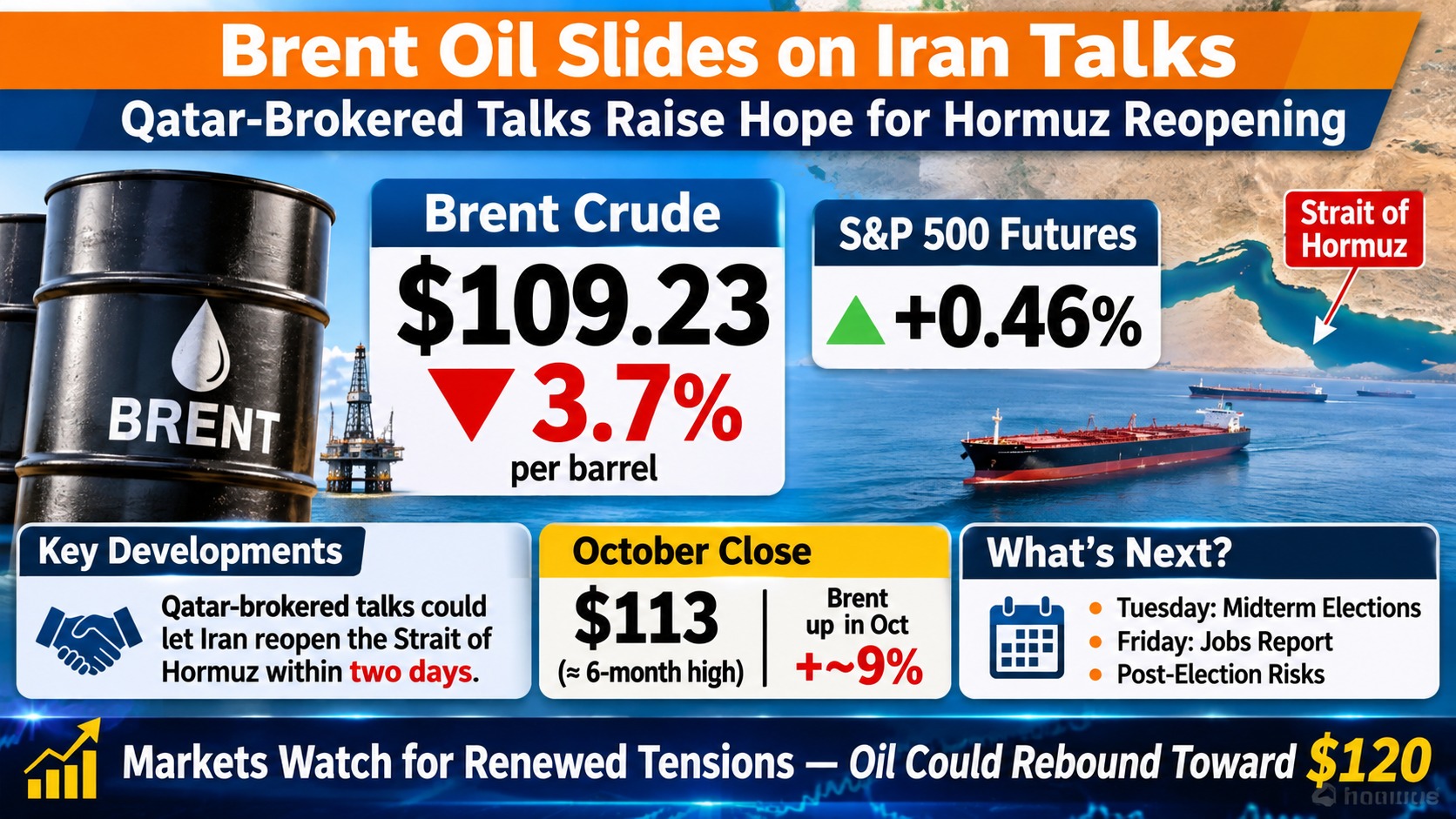
Brent crude futures fell 3.7%, or $4.20, to $109.23 a barrel by 09:00 GMT on Monday as Qatar-mediated talks to end the US-Israeli war with Iran entered a third consecutive day. The pullback gave equity futures a lift at the start of a crowded week. West Texas Intermediate traded near $100 a barrel, with the December contract at $99.61, down 4.33% according to Yahoo Finance quote data.
Iran's foreign minister said Qatar persuaded Tehran to compress an original seven-day plan into two days: US measures on day one and a reopening of the Strait of Hormuz on day two. Tehran's conditions include lifting recent US sanctions, restoring June oil waivers, a smaller US military presence, recognition of new shipping routes and an end to fighting on all fronts. Washington has not responded publicly. Secretary of State Marco Rubio confirmed the talks are continuing but gave no timeframe, while President Donald Trump said negotiations were going fine and that he was in no great hurry.
Brent had ended October at a six-month high, touching roughly $113 to $114 after strikes around Hormuz and a US threat to hit Iran. Trump said over the weekend that he expected the war to end soon, either through a deal or further military action, according to CBS News. OPEC+ also agreed to keep December production quotas unchanged, a decision analysts described as largely symbolic while fighting and Red Sea attacks continue to threaten regional exports.
Equity futures rebounded alongside the drop in crude. S&P 500 futures rose 0.46% to 7,649, Dow futures gained 0.50% to 52,179 and Nasdaq futures advanced 0.75% to 28,748.5, while Russell 2000 futures added 0.67%. The bounce follows a rough Friday in which the S&P 500 fell 1.82% to 7,580.07, the Nasdaq Composite dropped 2.86% and the Dow lost 1.09% to 51,770.31 on a technology-led selloff. The 10-year Treasury yield eased to about 4.93%, the VIX sat near 19.1 and gold traded around $3,911 an ounce.
The data calendar adds another layer of risk. The ISM manufacturing index for October is expected at 54.7 versus 54.5 previously, and the prices-paid gauge, forecast at 77.5, will show how much energy costs are feeding into input inflation. Employment and new-orders components are also due. Later this week investors face Tuesday's US midterm elections and Friday's October jobs report, along with earnings from Apple, Palantir, AMD, Pfizer and McDonald's.
Analysts cautioned that the oil move is headline-driven. Tim Waterer, chief market analyst at KCM Trade, called it a technical pullback after last week's strong gains and said rhetoric could intensify after the midterms, potentially pushing Brent toward $120. Energy was the weakest sector in premarket trading on Monday, according to a morning market brief, as lower crude weighed on producers.
For portfolio positioning, the setup is two-sided. Falling crude eases fuel and input costs for consumers, transport and industrial users and supports the case for a relief rally in cyclicals and small caps. But a failed negotiation or a post-election escalation could reverse the move quickly, and a sustained drop would pressure energy producers' earnings outlooks. With a binary geopolitical catalyst, an election and a jobs report all inside five sessions, risk sizing matters more than direction.