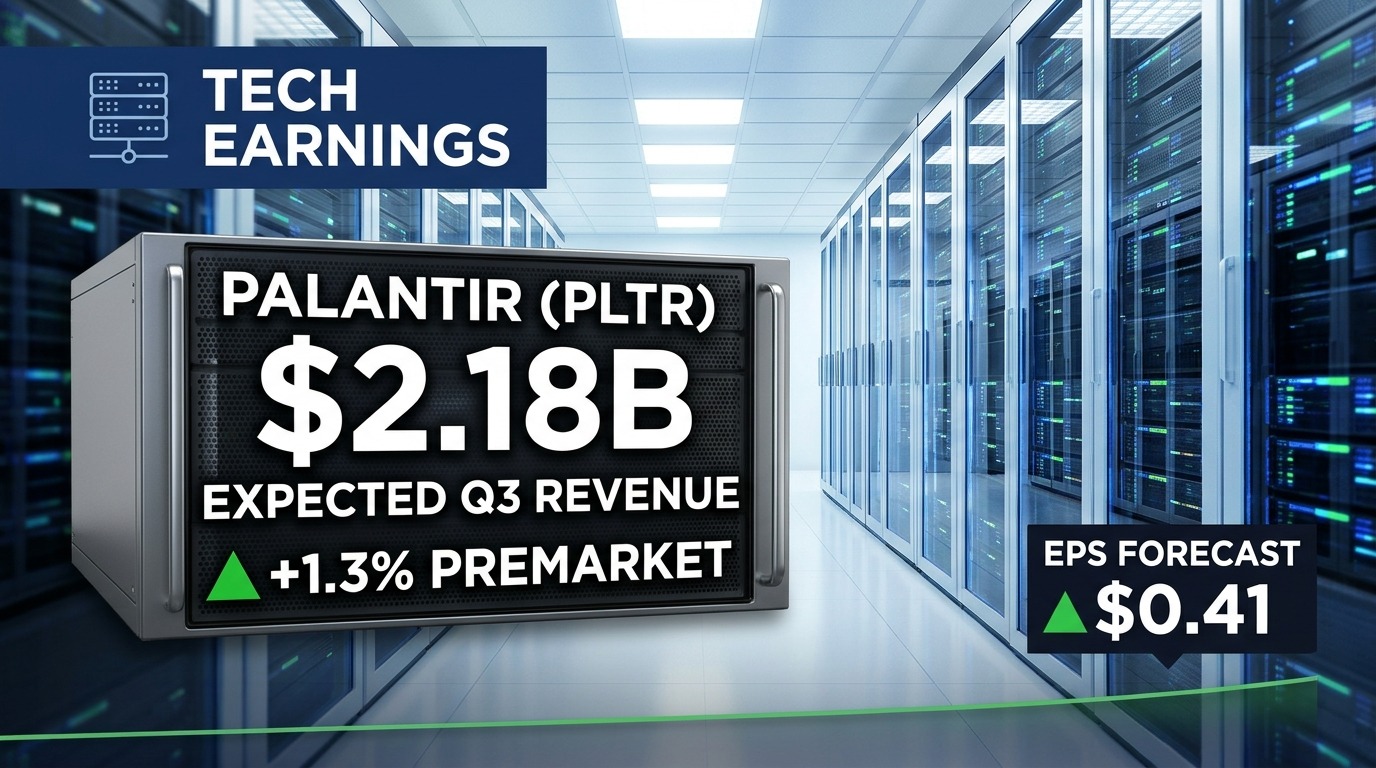
Palantir Technologies reports third-quarter 2026 results after the closing bell on Monday, with analysts expecting earnings of $0.41 per share on revenue of $2.18 billion. The shares rose roughly 1.3% to 1.5% in premarket trading, according to Benzinga and Yahoo Finance reports, after falling about 6.3% in the previous session as technology and AI-linked stocks sold off.
The report is widely viewed as a test of the durability of AI-driven growth. Palantir has been one of the market's most closely watched software names, and its valuation leaves little room for disappointment. After last week's harsh reactions to Alphabet and Intel, investors are scrutinizing every large technology report for signs that AI spending is converting into revenue and cash flow.
Several lines of the release will draw attention. Investors typically focus on the pace of US commercial customer growth, government revenue trends, remaining deal value and net revenue retention, as well as management's fourth-quarter and full-year guidance. A revenue and earnings beat accompanied by a raised outlook would support the case that enterprise AI platform demand remains strong, while any hint of deceleration could be punished given the stock's recent weakness.
The macro backdrop adds volatility. Nasdaq-100 futures were up about 0.75% on Monday after the index briefly entered correction, and the Nasdaq Composite lost 5.2% in October. Falling oil prices on US-Iran diplomacy hopes are helping risk appetite, but the 10-year Treasury yield near 4.93% remains a headwind for high-multiple software shares.
Policy risk is also in focus. A Yahoo Finance analysis noted that pharmaceuticals, housing and AI data centers are likely to draw attention in Washington after Tuesday's midterm elections regardless of which party wins, with Democrats seen as likely to take at least one chamber. For companies selling AI and data tools to government and enterprise customers, shifts in oversight, procurement priorities and data-center policy could matter in 2027.
Options and short-term positioning may amplify the reaction. Large post-earnings gaps are common for the stock, and the after-hours move will set the tone for Tuesday's open, which coincides with election-day uncertainty. Traders often reduce size ahead of such binary events or use defined-risk structures rather than holding unhedged positions through the print.
Palantir's report arrives alongside Apple's results, giving the market two read-throughs on technology demand in a single evening. Together with AMD's report later this week and Friday's jobs data, the results will help determine whether Monday's rebound in chip and software shares extends or fades.
Risk management matters here. Because the report lands after the close, the first price discovery happens in thin after-hours trading, and the move can change materially once the earnings call begins and management elaborates on guidance. Investors who do not want overnight exposure to a binary event may prefer to wait for the regular-session reaction on Tuesday, when volumes normalize.
Finally, the report will be read alongside Apple's, since both companies are being used as barometers for whether large technology spending and consumer hardware demand can hold up as the AI trade is re-priced.