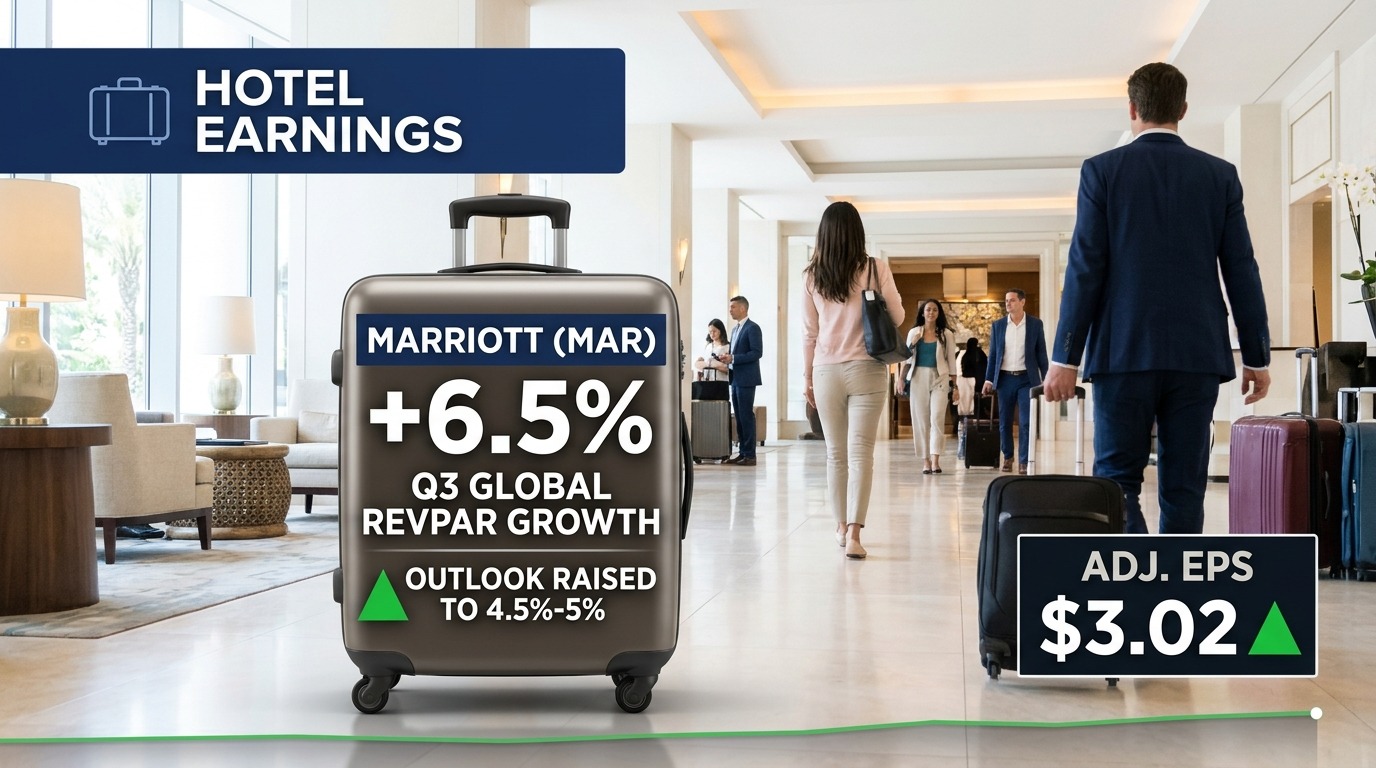
Marriott International reported third-quarter 2026 global RevPAR growth of 6.5% and raised its full-year outlook, pointing to broad strength in US and international travel demand. Adjusted earnings came in at $3.02 per share, according to premarket market summaries, ahead of the roughly $2.86 analyst consensus and above the company's own $2.74 to $2.82 guidance range.
The company now expects full-year 2026 global RevPAR growth of 4.5% to 5%, a sharp increase from the 3% to 3.5% range it set after the second quarter. In the United States and Canada, RevPAR rose more than 7% with growth across customer segments and chain scales. International RevPAR increased more than 4%, led by Asia Pacific excluding China, which delivered growth of more than 9%.
Chief Executive Anthony Capuano said the results reflected momentum across the business, the benefit of global scale and the strength of the company's brands and revenue engines. Higher average daily rates and occupancy both contributed. The company said the ongoing Middle East conflict continued to affect results in that region, but trends improved meaningfully from the second quarter.
The report beat a management guide for third-quarter global RevPAR growth of 3.5% to 4%, a wide margin. That matters because the stock had been under pressure heading into the report, with an earlier preview noting that shares had slid for several sessions and that investors wanted evidence that demand was broadening beyond select-service hotels in the US.
Development figures were also strong. Marriott said it had record global organic signings through September, with conversions of existing hotels representing more than a third of signings and over 40% of openings during the first nine months of the year. Through October 28, the company had returned approximately $4.0 billion to shareholders through dividends and share repurchases.
The upgraded outlook arrives against a complicated macro backdrop. Oil prices were falling on Monday on hopes for US-Iran diplomacy, which could ease travel costs, while the October jobs report on Friday and Tuesday's midterm elections are the next major catalysts. Marriott had previously flagged that the fourth quarter could see a small negative impact from the election and tougher Middle East comparisons, so investors will likely scrutinize guidance details for any caution on the final quarter.
For equity investors, the quarter supports the view that US leisure and business travel remain resilient despite high fuel prices and an uneven global picture. The shares were trading higher in premarket action on the report, in a market that has otherwise punished technology and AI-linked names. A beat-and-raise from a consumer-facing company can act as a rotation signal, though the stock's reaction during regular trading will show how much of the improvement is already priced in.
The details of fourth-quarter guidance will be the next focus. With the Middle East entering its peak tourism season in October, the region's performance will carry more weight in the final quarter, and comparisons are tougher, so management's tone on that region will shape expectations for 2027.