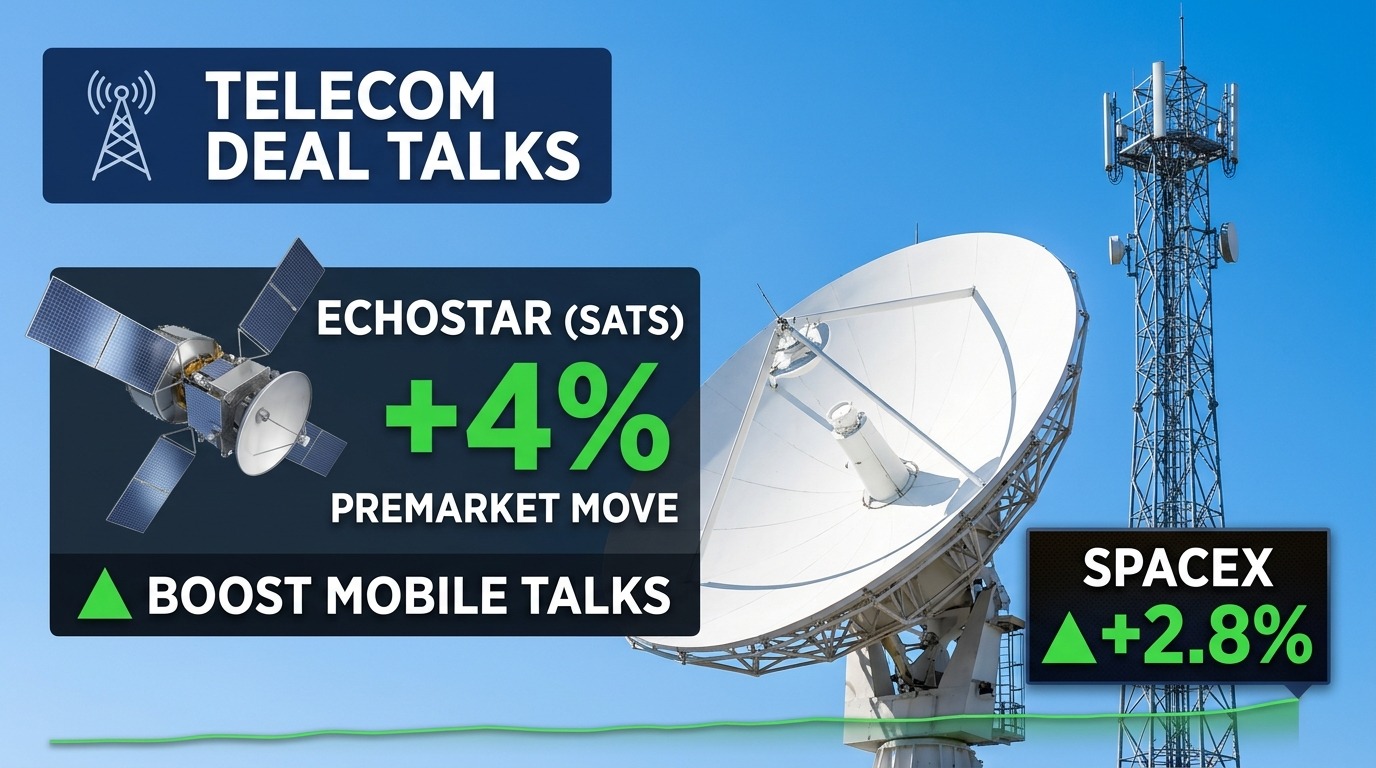
EchoStar shares rose about 4% in premarket trading on Monday and SpaceX gained 2.8% after the Washington Post reported that Elon Musk's rocket and satellite company has been in talks to acquire EchoStar's Boost Mobile business or gain access to its wireless network. The report, citing people familiar with the matter, said SpaceX has held discussions with EchoStar in recent months about launching its own branded wireless service.
According to the report, Musk has been personally involved in the discussions and met EchoStar Chairman Charlie Ergen last month. No deal has been announced, and neither company's terms are known. The talks would deepen a relationship that began in September 2025, when EchoStar agreed to sell spectrum licenses to SpaceX in a roughly $17 billion transaction and signed a commercial agreement giving Boost Mobile subscribers access to Starlink's direct-to-cell service.
EchoStar has since reshaped itself. It sold spectrum to both SpaceX and AT&T, and Boost now operates primarily as a hybrid mobile virtual network operator on AT&T's network while running its own core. Boost had about 7.36 million subscribers as of late June. EchoStar received SpaceX stock as part of the transactions and, according to Fortune, holds a stake of nearly 3% in the company.
Timing adds intrigue. EchoStar reports third-quarter results on November 5, and market commentary on Monday pointed to a November 4 deadline for mediation tied to the strategic spectrum arrangement with SpaceX. Investors are treating the Washington Post story as a possible sign that the relationship is moving beyond spectrum sales toward direct retail wireless competition.
For SpaceX, owning or tightly integrating a consumer wireless brand could shorten the path from satellite capacity to paying subscribers, and would give Starlink's direct-to-cell service a ready-made customer base in the United States. For EchoStar, a sale or deeper partnership could crystallize value in Boost, which has been a capital-intensive business, and further simplify a company that has been restructuring around its asset sales.
Competitive implications extend to the large carriers. A satellite-linked, Musk-backed wireless brand would add a new price and coverage competitor in a market dominated by AT&T, T-Mobile and Verizon, even if scale would take years to build. Regulatory review would also matter, since the Federal Communications Commission has been closely involved in EchoStar's spectrum transactions.
The market backdrop is supportive for risk appetite, with futures rising and oil falling, but the story is still a press report rather than a company announcement. Traders should watch for any confirmation or denial from either company, the November 4 mediation date and the third-quarter earnings call on November 5 for details on Boost's strategic direction and balance sheet.
Investors should also remember that EchoStar shares have already moved sharply on spectrum headlines over the past year, so reports of this kind can fade quickly if no confirmation follows. The stock's reaction to the November 5 earnings call will likely show whether the market is pricing a transaction or simply trading the headline.