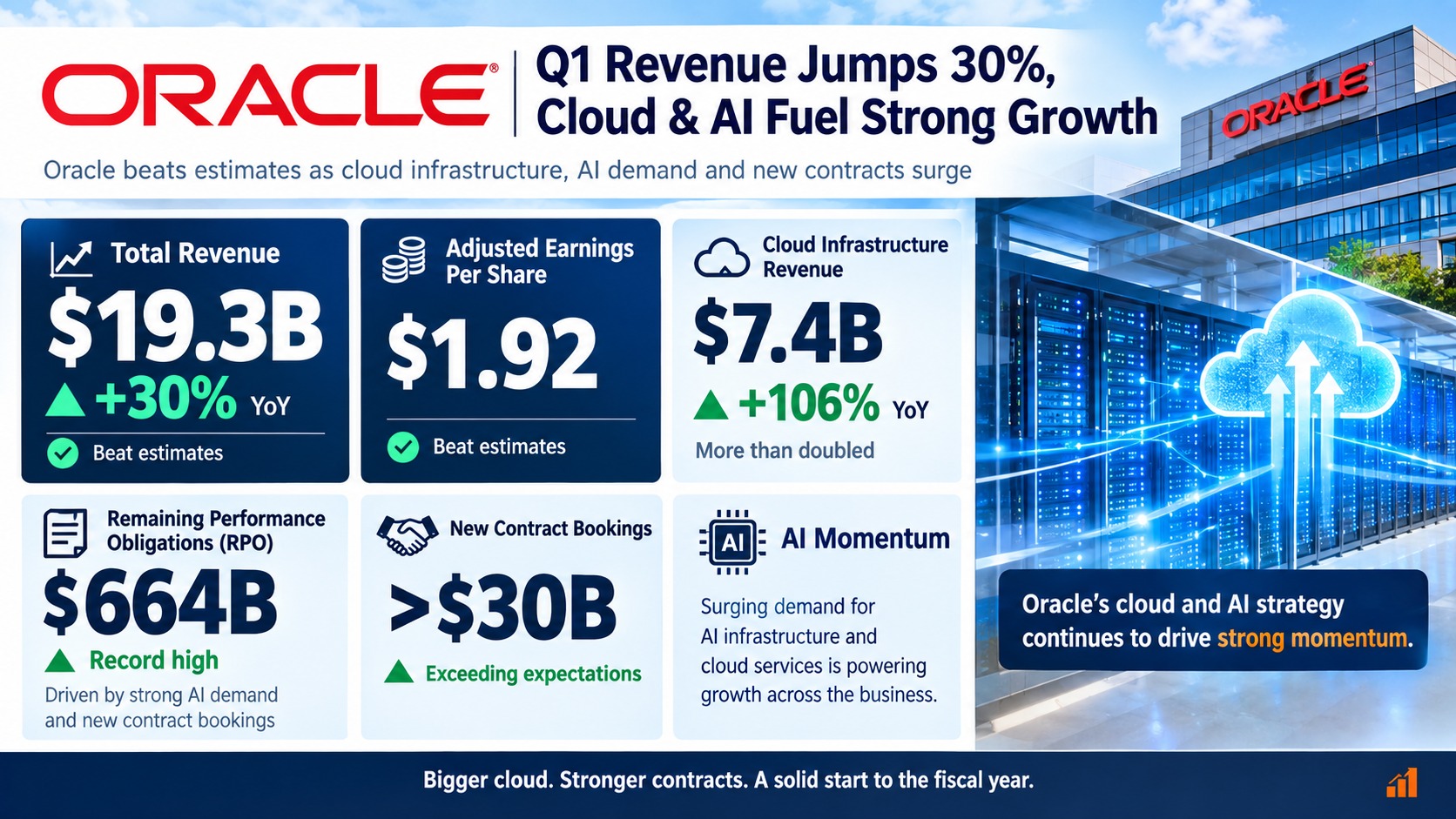
Oracle posted fiscal first-quarter results that topped Wall Street expectations, with total revenue climbing 30% to a record $19.3 billion and adjusted earnings per share reaching $1.92. Cloud infrastructure revenue surged 121% to $7.4 billion, while overall cloud revenue rose 62% to $11.6 billion, underscoring the company’s accelerating shift toward high-growth infrastructure services.
Remaining performance obligations hit $664 billion, an increase of $209 billion from a year earlier, after the company booked more than $30 billion in additional AI cloud contracts during the quarter. Management highlighted the delivery of more than 300,000 GPUs to AI customers and the addition of 850 megawatts of data-center capacity, metrics that illustrated both the scale of demand and Oracle’s ability to expand supply.
Capital expenditures remained elevated at roughly $28.5 billion, though free-cash-flow burn came in lighter than feared at $5.4 billion after customer prepayments covered a substantial portion of spending. Oracle raised its fiscal 2027 adjusted earnings forecast slightly and guided for continued strong growth in the current quarter, providing investors with visibility into sustained momentum.
Shares jumped nearly 7% in premarket trading as investors interpreted the results as confirmation that heavy AI infrastructure investments are beginning to generate returns. The report provided a rare bright spot for technology names after a week of broad market pressure from rising yields and oil prices that had weighed on growth stocks across the board.
Analysts pointed to the surge in backlog and the disclosure of customer prepayments as evidence that demand continues to outstrip supply for AI training and inference capacity. Oracle’s ability to convert that demand into revenue growth while moderating cash burn relative to earlier expectations supported the positive reaction and helped differentiate the company from peers still grappling with heavier near-term investment cycles.
The results arrive as markets weigh the path of interest rates and the sustainability of AI-related capital spending across the technology sector. Oracle’s quarter demonstrated both the scale of ongoing investment required and the revenue acceleration that can accompany successful capacity expansion, offering a template that other cloud providers will be measured against in coming reporting seasons.
Beyond the headline numbers, the composition of growth remains important. Infrastructure revenue now forms a much larger share of the overall business, reducing reliance on traditional software licensing that has been in structural decline as customers migrate to cloud models. This mix shift improves long-term margin potential even as near-term capital intensity remains high.
Investors will continue to monitor free-cash-flow trends and the pace of backlog conversion in subsequent quarters. For the moment, the combination of record revenue, explosive infrastructure growth, and a substantial order book has reinforced confidence that Oracle is successfully positioning itself as a key beneficiary of the multi-year AI infrastructure buildout.
The premarket rally also reflected broader relief that at least one major technology name delivered clean results and forward guidance that exceeded expectations, providing a potential catalyst for selective buying in the AI and cloud complex even as macro uncertainty persists.