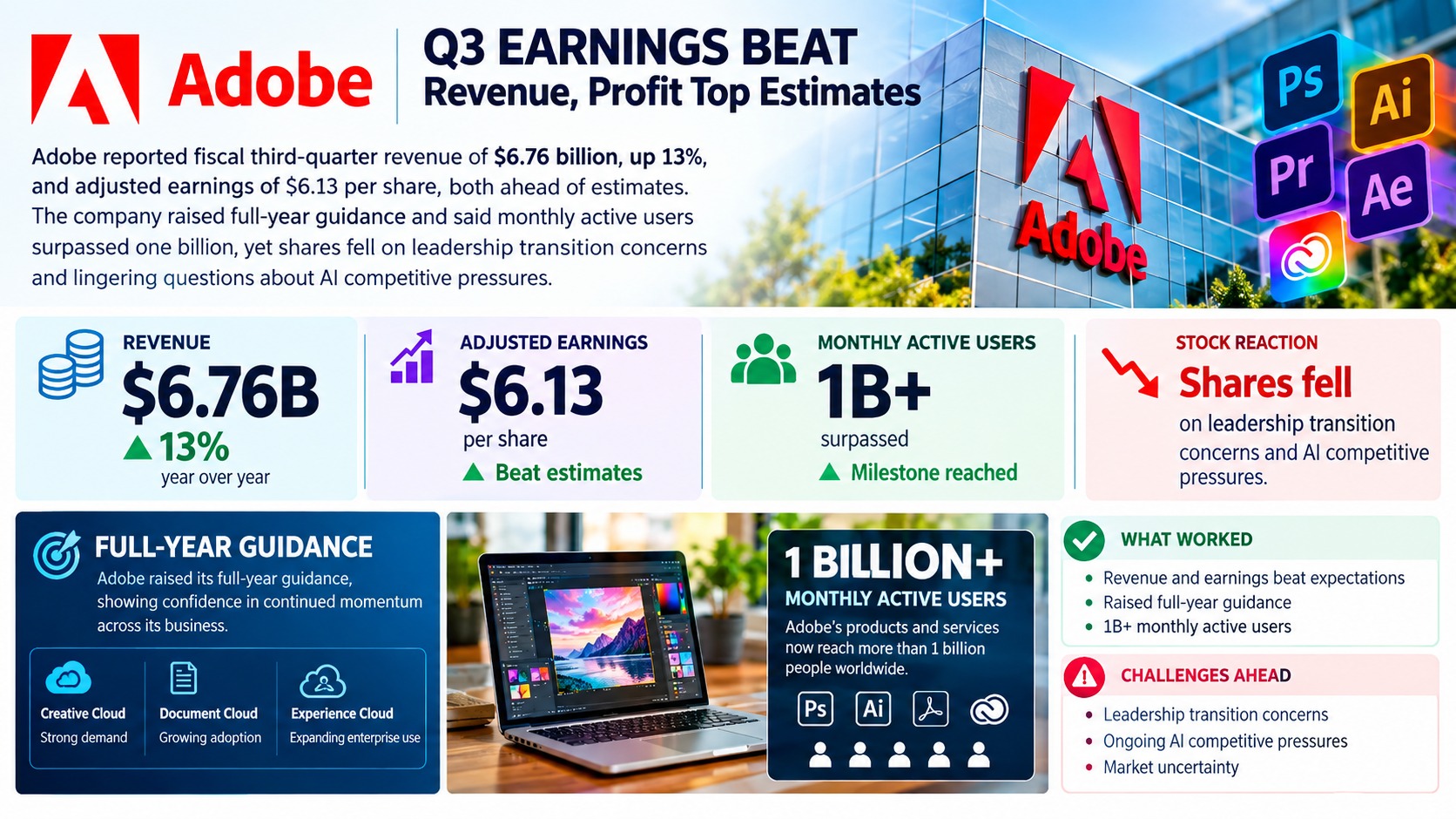
Adobe delivered record fiscal third-quarter revenue of $6.76 billion, a 13% increase year-over-year, and adjusted earnings of $6.13 per share. Both figures exceeded analyst expectations. Subscription revenue formed the bulk of the top line, while annualized recurring revenue reached $27.5 billion, underscoring the resilience of the company’s recurring-revenue model.
The company also announced that monthly active users across its creativity and productivity platforms had surpassed one billion. AI-first ARR grew more than 150% year-over-year, highlighting early traction in generative tools. Management raised full-year revenue and adjusted EPS guidance and provided fourth-quarter targets above consensus, signaling confidence in the near-term outlook.
Despite the beat-and-raise, Adobe shares declined in after-hours and premarket trading. Investors focused on the upcoming CEO transition scheduled for December and ongoing questions about competitive pressure from generative AI tools. The stock has already underperformed broader technology indexes this year, reflecting those overhangs.
Operating cash flow hit a quarterly record of $2.52 billion. Remaining performance obligations stood at $22.16 billion. The results showed continued growth in both professional creative tools and consumer freemium offerings, yet the market reaction underscored sensitivity to leadership change and AI disruption narratives that have weighed on the multiple.
Adobe’s quarter illustrated the dual reality facing established software platforms: solid financial execution and user-scale milestones coexist with valuation pressure driven by longer-term competitive and succession uncertainties. Traders appeared to prioritize those overhangs over the near-term numbers, resulting in a negative share-price response even as the fundamentals improved.
The reaction stands in contrast to the stronger response received by certain infrastructure peers reporting the same day, highlighting differentiated investor treatment of application software versus cloud infrastructure exposure in the current environment. While infrastructure names benefit from clear capacity-driven demand, application platforms face more nuanced questions about pricing power and feature differentiation in an AI-native world.
Management has emphasized that AI capabilities are being integrated across the product suite to expand addressable markets and deepen engagement. The one-billion-user milestone and rapid AI ARR growth provide early evidence that those efforts are gaining traction. Nevertheless, the market continues to debate whether the pace of innovation is sufficient to offset competitive threats and justify current valuations.
Looking ahead, investors will focus on the smoothness of the leadership transition, the trajectory of AI monetization, and any signs of share shifts within the creative software category. For the moment, the combination of a clean beat, raised guidance, and record user metrics was insufficient to overcome the prevailing caution surrounding succession and competitive dynamics.
The episode serves as a reminder that in the current market regime, even strong operational results can be overshadowed by narrative concerns, particularly for companies undergoing executive change or operating in categories undergoing rapid technological disruption.