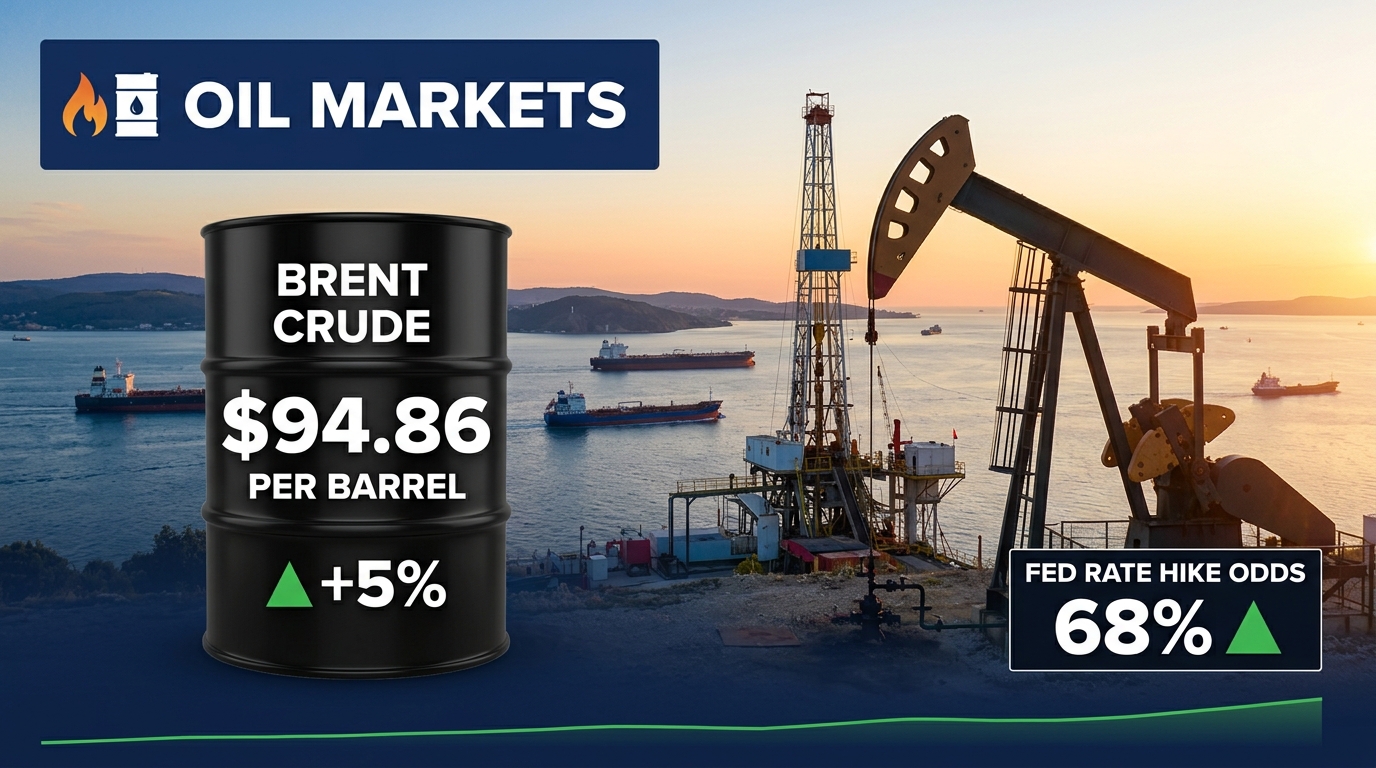
Crude oil prices remained near multi-month highs on Wednesday, with Brent crude trading at $94.86 a barrel, up modestly on the day but still reflecting a dramatic run-up over the past week as fighting between the United States and Iran intensified around the Strait of Hormuz, one of the world's most critical oil-shipping chokepoints. Brent has climbed more than 13% over the past month and is up more than 40% compared with a year ago, according to trading-data compiled by market trackers.
The latest leg higher followed U.S. military strikes on Iranian targets after two oil tankers were attacked while transiting the Strait, which normally carries roughly 20% of global oil shipments. U.S. officials have said the strait remains passable, with millions of barrels still moving through it daily, but the renewed exchange of fire has been enough to keep a substantial geopolitical risk premium embedded in crude prices, reversing an earlier retreat back toward pre-conflict levels.
The knock-on effects have rippled well beyond energy markets. The 10-year Treasury yield has climbed to roughly 4.79%, its highest intraday level since January 2025, while the 30-year yield has pushed toward 5.3%, levels not seen in decades. Rising yields reflect growing investor concern that an energy-driven inflation shock could force the Federal Reserve's hand even as broader economic data, including Wednesday's soft ADP jobs report, points to a cooling labor market. The bond sell-off has not been confined to the United States either — Japan's 10-year government bond yield touched 3% for the first time since 1996, while yields across the United Kingdom and the eurozone have also moved broadly higher.
Perhaps the most consequential market reaction has been in interest-rate expectations. Fed funds futures now imply roughly a 68% probability that the central bank raises rates at its September meeting, according to the CME FedWatch tool, up sharply from around 35% just two weeks earlier and a stark reversal from the rate-cut expectations that had dominated market pricing for much of the year. The shift follows increasingly hawkish public remarks from Fed leadership warning that recent inflation readings, while improved from earlier in the year, do not yet show underlying price pressures moving convincingly back toward the central bank's 2% target.
For equity markets, the combination has created a genuinely difficult environment to navigate. Energy and defensive sectors have found some support from higher oil prices, while technology-heavy indexes have shown more sensitivity to the prospect of higher borrowing costs, given the sector's reliance on future earnings growth that becomes less attractive to discount at higher interest rates. The Nasdaq Composite and small-cap Russell 2000 have both lagged the broader market in recent sessions, a pattern consistent with a rates-driven rotation away from higher-duration, growth-oriented assets.
Analysts caution that the path from here depends heavily on how the Iran conflict evolves over the coming days. A durable de-escalation could see oil prices retreat quickly, easing pressure on both inflation expectations and Fed policy calculations. But continued disruption to shipping through the Strait of Hormuz, or any signs of broader regional escalation, could push crude prices meaningfully higher still, adding fuel to an already uncomfortable inflation narrative heading into the Fed's September policy meeting.