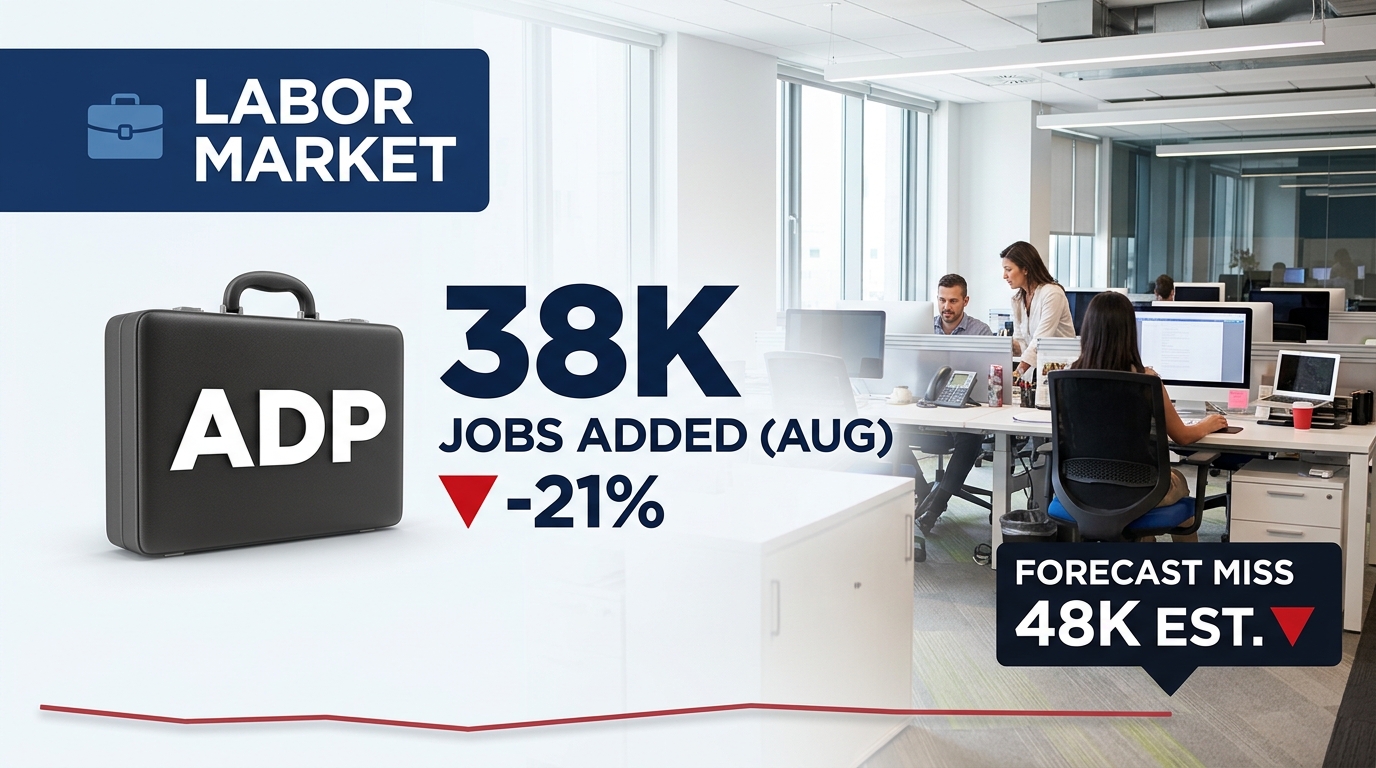
Private-sector hiring in the United States slowed sharply in August, with employers adding just 38,000 jobs, according to the ADP National Employment Report released Wednesday morning. The figure came in well below the roughly 48,000 jobs economists had forecast and marked a step down from July's upwardly revised gain of 46,000, making it the slowest month of private job creation since January.
The report, produced by ADP Research in collaboration with the Stanford Digital Economy Lab, showed a clear divide between goods-producing and service-providing industries. Goods-producing sectors lost a combined 10,000 jobs, with manufacturing alone shedding 17,000 positions and natural resources and mining down 5,000, only partially offset by a 12,000 gain in construction. Service-providing industries added 48,000 jobs overall, led by 45,000 in education and health services and 16,000 in leisure and hospitality, while professional and business services actually cut 16,000 positions during the month.
ADP's chief economist noted that pay trends are becoming an increasingly important signal in a hiring environment she described as choppy, pointing to demographic shifts, persistent inflation and the growing influence of AI adoption on where and how companies are hiring. Wage data released alongside the jobs figures showed median base pay up 3.2% year-over-year for all workers, with gross pay, which includes bonuses and other compensation, up 4.7%. Job-changers continued to command a meaningful premium over job-stayers, with base pay for switchers rising 4.7% compared with 3.0% for those who stayed in their roles.
The timing of the miss matters considerably. It arrives just two days ahead of Friday's more comprehensive nonfarm payrolls report from the Bureau of Labor Statistics, which markets treat as the more authoritative — if less timely — read on the labor market. ADP's report has historically been an imperfect predictor of the BLS figure, but a soft print still tends to color expectations heading into the more closely watched release, particularly with the labor market already showing signs of gradual cooling through the summer months.
What makes Wednesday's data especially tricky for investors to interpret is the broader macro backdrop it lands against. In a typical cycle, a weaker-than-expected jobs report would raise hopes that the Federal Reserve might ease off its rate-hike stance. But this cycle is unusual: fed funds futures were already pricing in a rising probability of a September rate increase, driven not by labor market strength but by a resurgence in inflation risk tied to a sharp run-up in oil prices amid the escalating conflict between the United States and Iran. That combination — a cooling labor market alongside energy-driven inflation pressure — is the kind of mix that raises the specter of stagflation-style conditions, complicating the Fed's calculus ahead of its September meeting.
Markets showed a muted initial reaction to the data, with major indexes little changed in the immediate aftermath, as investors appeared to be waiting for Friday's nonfarm payrolls figure and the ISM services data due later this week before drawing firmer conclusions about the trajectory of both the labor market and Fed policy.