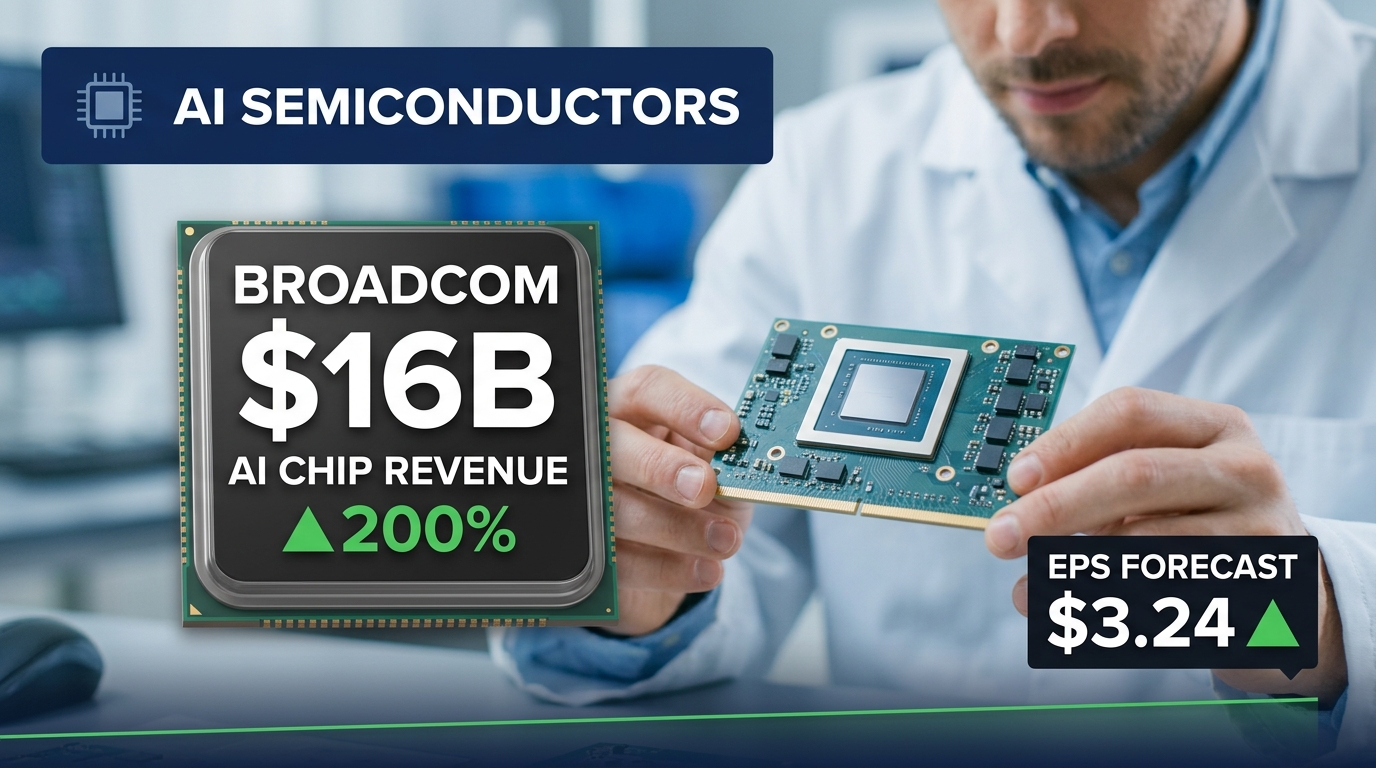
Broadcom is scheduled to report fiscal third-quarter 2026 results after Wednesday's closing bell, and the numbers Wall Street is bracing for are extraordinary even by AI-boom standards. Consensus estimates call for total revenue of roughly $29.4 billion, an 84% increase from the $15.95 billion the chipmaker posted in the same period last year, alongside non-GAAP earnings per share near $3.24, nearly double the $1.69 reported a year ago.
The figure investors will scrutinize most closely is AI semiconductor revenue, which management guided in its prior report to grow more than 200% year-over-year to approximately $16 billion for the quarter. That target isn't really upside at this point — analysts increasingly view it as a floor management has already committed to publicly, with the real debate centered on how much further the company can accelerate into its fiscal fourth quarter and beyond.
Broadcom's AI story differs meaningfully from peers like Nvidia. Rather than selling standardized GPUs into a broad market, the company designs custom AI accelerators tailored to individual hyperscale customers, a roster that reportedly includes Alphabet's Google, which relies on Broadcom for its custom TPU chips, along with other major cloud and AI labs. Networking products, which connect thousands of chips together inside AI data centers, made up roughly 40% of AI semiconductor revenue last quarter, underscoring that Broadcom's growth story extends well beyond accelerator silicon alone.
The setup into this report carries an unusual amount of tension. When Broadcom last reported in June, the company beat both revenue and profit estimates, yet shares still tumbled 12.6% in a single session because management declined to raise its longstanding fiscal 2027 AI semiconductor revenue target of 'in excess of $100 billion,' disappointing investors who had been pricing in an upward revision. Shares have since recovered much of that lost ground, rallying meaningfully over the past month as broader AI infrastructure sentiment improved.
Morgan Stanley, which maintains an Overweight rating on the stock, has framed the key risk heading into Wednesday's print as one of expectations rather than fundamentals. The firm's own model calls for roughly $120 billion in fiscal 2027 AI revenue, while some investors have reportedly set an informal bar closer to $150 billion — a gap that could determine whether even a strong beat is enough to move the stock higher. Attention will also fall on October-quarter guidance, where Morgan Stanley projects revenue near $34.8 billion and AI revenue climbing sequentially to roughly $21.2 billion.
Beyond the headline AI figures, semiconductor revenue overall is projected near $20.5 billion for the quarter, up 124% year-over-year, while infrastructure software revenue tied to the company's VMware business is expected around $8.9 billion, up 31%. Non-GAAP operating margin guidance sits near 67%, though the increasing mix of lower-margin custom silicon for hyperscaler clients could pressure that figure structurally over time even as absolute profits keep climbing.
With Dell's blowout AI server results from Tuesday night still reverberating through markets, Broadcom's report gives investors a second, and arguably more direct, read on the health of AI infrastructure capital spending — this time from the chip design side of the supply chain rather than the server assembly side.