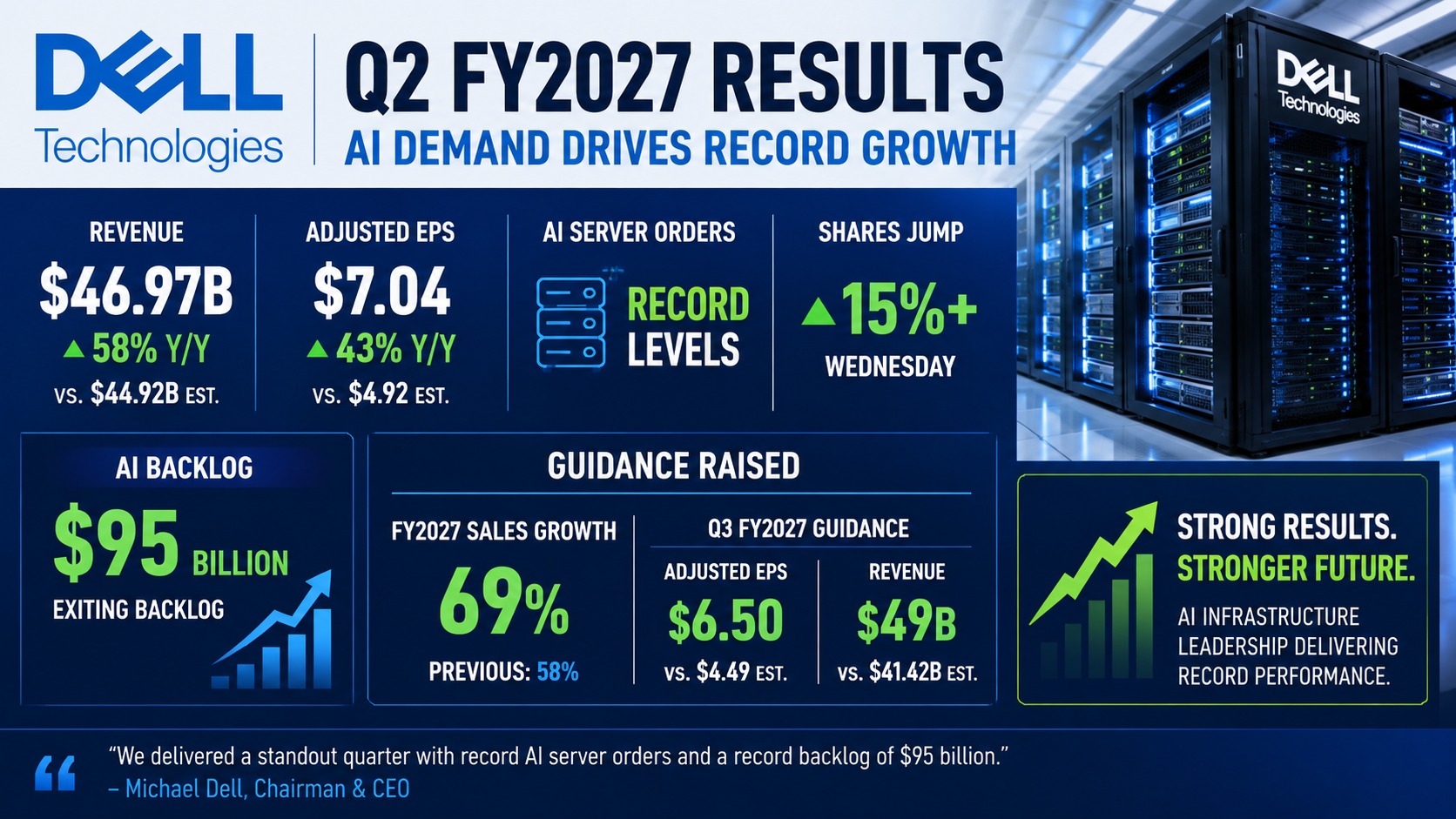
Dell Technologies delivered one of the most consequential earnings reports of the AI infrastructure boom on Tuesday evening, posting fiscal second-quarter 2027 revenue of $47 billion, up 58% from a year earlier and well above the $44.5 billion Wall Street had modeled. Adjusted diluted earnings per share came in at $7.04, more than triple the year-ago figure and far ahead of the $4.92 consensus estimate, marking one of the widest earnings beats the company has delivered in recent memory.
The results landed against an unusually tense backdrop. Dell shares had slid nearly 6% in the session leading into the report as investors, wary after a 266% year-to-date rally, worried that even a strong quarter might not clear the bar the market had set. Options traders had priced in an implied post-earnings swing of more than 11% in either direction. Instead, the numbers proved decisive: shares climbed roughly 7% in extended trading as the scale of the beat became clear.
The centerpiece of the quarter was Dell's Infrastructure Solutions Group, where AI server momentum accelerated sharply. The company booked a record $60.9 billion in AI-related orders during the quarter and recognized $16.4 billion in AI server revenue, both records. Perhaps most striking was the backlog figure: Dell closed the period with $95 billion in AI server orders still to be fulfilled, an eightfold increase from the prior year, giving investors a multi-quarter runway of visibility into future revenue that few hardware companies can match.
Executives framed the quarter as evidence that enterprise and hyperscaler demand for AI-optimized servers remains far from saturated, even as questions persist across the sector about how quickly capital expenditure on data-center buildouts can continue to climb. Dell's role supplying the physical infrastructure — servers packed with GPUs, high-speed networking and storage — has turned a company once defined by PCs into one of the more direct beneficiaries of the AI capital cycle, alongside peers such as Super Micro and Hewlett Packard Enterprise.
Margins remain a point investors will continue to watch closely. AI server hardware tends to carry thinner gross margins than Dell's traditional enterprise and PC businesses, meaning the mix shift toward AI infrastructure has pressured overall profitability even as absolute profit dollars grow. Component costs, particularly for high-bandwidth memory and advanced networking silicon, remain a swing factor management flagged as worth monitoring heading into the back half of the fiscal year.
Guidance for the fiscal third quarter will likely dominate analyst commentary in the sessions ahead, with Wall Street focused on whether Dell's Infrastructure Solutions Group can clear the operating income bar management has previously signaled. With the stock still up sharply for the year even before Tuesday's after-hours pop, the durability of the AI order backlog — and whether supply constraints in memory and networking components could slow the pace of backlog conversion into recognized revenue — will shape how the rally evolves from here.
The report arrives at a moment when broader markets are digesting a mix of cross-currents: a softer-than-expected August ADP jobs report, surging oil prices tied to the escalating conflict between the United States and Iran, and rising odds of a Federal Reserve rate hike later this month. Against that macro backdrop, Dell's results offer one of the clearest signals yet that corporate AI infrastructure spending is continuing largely undeterred by broader economic uncertainty.