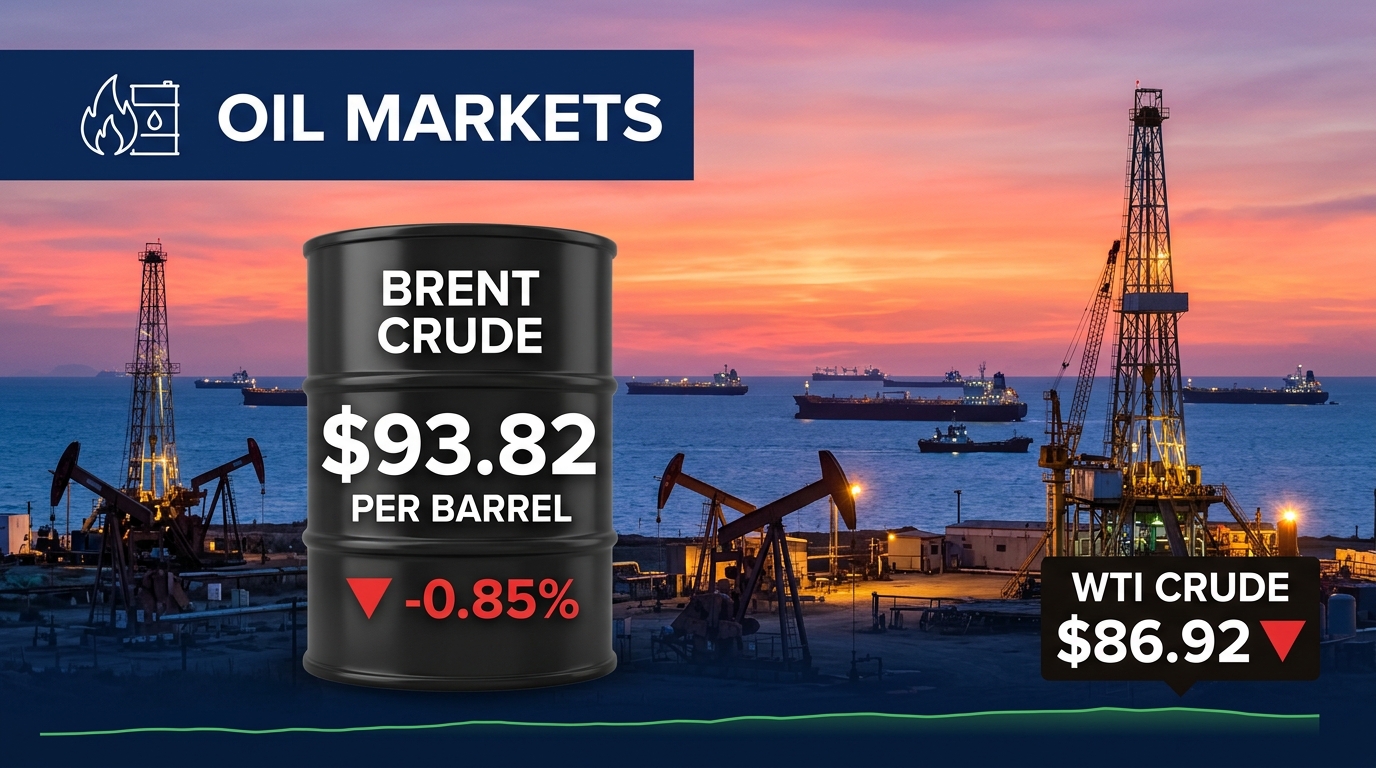
Oil prices fell for a fourth straight session on Thursday as traders bet that the losses Republicans suffered in this week's midterm elections would reduce the risk of further escalation in the US-Israeli war on Iran. According to Reuters, Brent futures slipped 80 cents, or 0.85%, to $93.82 a barrel by 0426 GMT, while US West Texas Intermediate crude fell $1.20, or 1.36%, to $86.92. Both benchmarks had tumbled by more than 8% in the previous session to settle at their lowest levels since August 31.
The repricing is largely political. Two sources close to Gulf government circles told Reuters that a weakened President Trump, now facing a Democratic Congress able to constrain his military options, has a greater incentive to seek a deal, and that a full-scale assault on Iran now looks less likely. Optimism grew overnight after Vice President JD Vance wrote on X that the war was the reason Republicans lost the midterms, a message investors read as a push toward a settlement.
The stakes for markets are large. The US and Israel attacked Iran in late February, and the Strait of Hormuz has been largely closed to traffic ever since, according to the Associated Press, driving sharp increases in oil and gas prices worldwide. A resolution could restore Middle East energy flows that have been disrupted by the conflict, although analysts caution that the path forward remains uncertain and that a single headline could reverse the move.
Cheaper crude also helped other markets. Yahoo Finance reported that Treasury yields fell alongside oil, with the 10-year yield near 4.89%, and that the VIX volatility gauge dropped close to 20% on Wednesday to around 17. Lower energy costs ease the inflation pressure that has forced central banks to act. The Bank of England, for example, raised its main rate to 4% today to counter a fuel-driven inflation shock, and softer oil would reduce the odds of similar tightening elsewhere.
Energy producers sit on the other side of the trade. ConocoPhillips is scheduled to release third-quarter results before the market opens, with a conference call at noon Eastern, and EOG Resources also reports today. In its second-quarter report, ConocoPhillips said higher commodity prices lifted adjusted earnings to $3.24 a share from $1.42 a year earlier, even as production was held back by the conflict's impact on Qatar. A sustained drop in crude would test how much of that price tailwind remains in forward guidance.
Beneficiaries of lower fuel prices typically include airlines, transport operators and consumer-facing businesses that have absorbed higher input costs this year, while upstream oil and gas producers and oilfield service providers are the most exposed. Gold was trading around $4,140 an ounce and bitcoin near $80,000 in early trading, according to Yahoo Finance, reflecting a broader bid for risk assets as political uncertainty cleared.
For traders, the key question is durability. Oil has fallen sharply in a short period, and positioning is likely to remain headline-driven until there is concrete evidence of diplomacy. Friday's US employment report adds another catalyst for rates and the dollar, which also influence crude. Until the Iran war has a clear path to resolution, energy stocks may remain volatile, while the benefit to the broader market from lower oil depends on whether the decline holds.