AI infrastructure stocks extended their post-election slide into Thursday as investors weighed what a Democratic Congress and newly elected Democratic governors could mean for the data center buildout that has powered much of this year's equity rally. Nasdaq-100 futures were down about 0.6% in early trading even as Dow futures pointed higher, a split that captured the market's rotation away from AI beneficiaries and toward sectors seen as winners from the change of power in Washington.
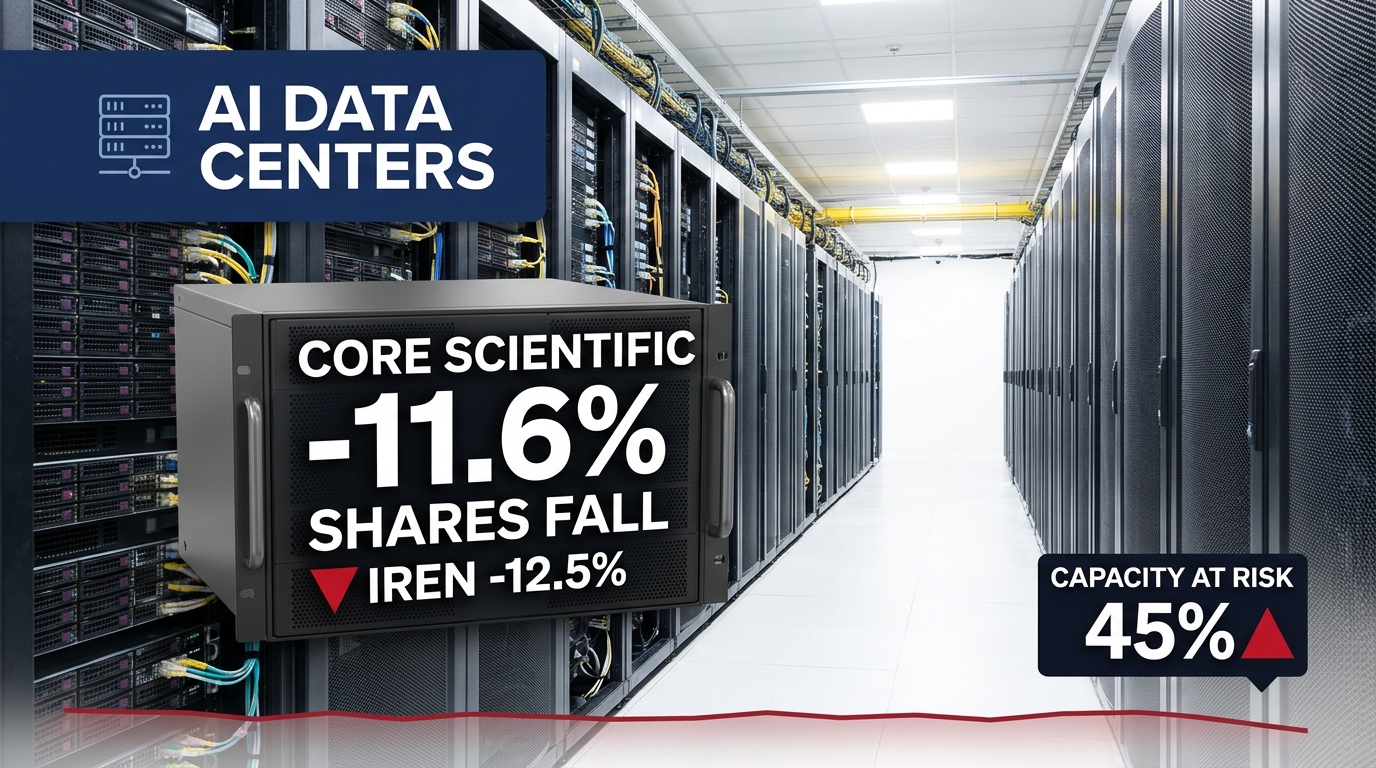
According to Reuters, Core Scientific fell 11.6% and Iren tumbled 12.5% on Wednesday as the scale of the Democratic sweep became clear, while Applied Digital, Hut 8, Cipher Digital and power producers including GE Vernova, Constellation Energy and Vistra also slumped. Charles Schwab's market commentary noted that CoreWeave was down 6.6% and Oracle 4% in early Wednesday trading, and that the PHLX Semiconductor Index had lost 12% over three sessions even though the S&P 500 sat only about 3% below its high.
The trigger was political. Democrats who campaigned in part on a moratorium on data center development won governor's races in Texas and Georgia, two states the party had not held in decades. Gina Hinojosa ousted Greg Abbott in Texas, which GLJ Research estimates will host roughly a quarter of the US data center capacity due online by 2030. In Georgia, Keisha Lance Bottoms won in a state where CBRE says Atlanta is the busiest data center construction market in the country. Morgan Stanley analysts also flagged delay risk in Ohio after Amy Acton's victory, including a 10-gigawatt project involving Nvidia.
Brokerages offered a range of scenarios. Goldman Sachs said Democratic wins at the state and local level would likely cause temporary halts affecting about 45% of planned US data center capacity expansion, but it expects the disruption to be short-lived. HSBC analysts described a milder path in which regulators tighten oversight without imposing broad moratoriums, or in which projects simply migrate to other states. Amundi's Aidan Yao argued the results looked more like a referendum on artificial intelligence than on President Trump, and warned that curbs on the AI theme would cloud the outlook for US growth, inflation and monetary policy.
Strategists were split on how far the selloff can run. Benzinga reported that Dan Ives warned chip stocks are not done falling and could drop another 12%, while Tom Lee called the AI selloff an overreaction and predicted a 20% tech rally. Reuters noted that some analysts view the Nasdaq's roughly 8% drawdown over the past month as a buying opportunity, arguing that slower US construction does not necessarily signal weaker demand for computing power.
The timing adds another test for AI sentiment. Anthropic is preparing to begin formally marketing its IPO shares to prospective investors next week, and an amended filing showed its third-quarter revenue rose 47% from the prior quarter to $16.96 billion even as growth slowed and the net loss narrowed.
Macro conditions are mixed. Oil prices and Treasury yields fell overnight, with the 10-year yield near 4.89%, and the VIX was around 17 after dropping nearly 20% on Wednesday. Investors also face Friday's employment report, which could shift expectations for rates and for the capital-intensive companies building data centers.
For traders, the setup favors selectivity over broad conviction. Smaller AI infrastructure operators posted the sharpest declines, while the largest cloud and software names fell less. Key variables to watch include whether state legislatures move from campaign rhetoric to actual moratorium bills, whether utilities and developers revise interconnection timelines, and whether Thursday's weakness in Nasdaq futures holds into the cash open. Any clarity on federal AI policy from a Democratic Congress, which takes control early next year, could either calm or amplify the repricing.