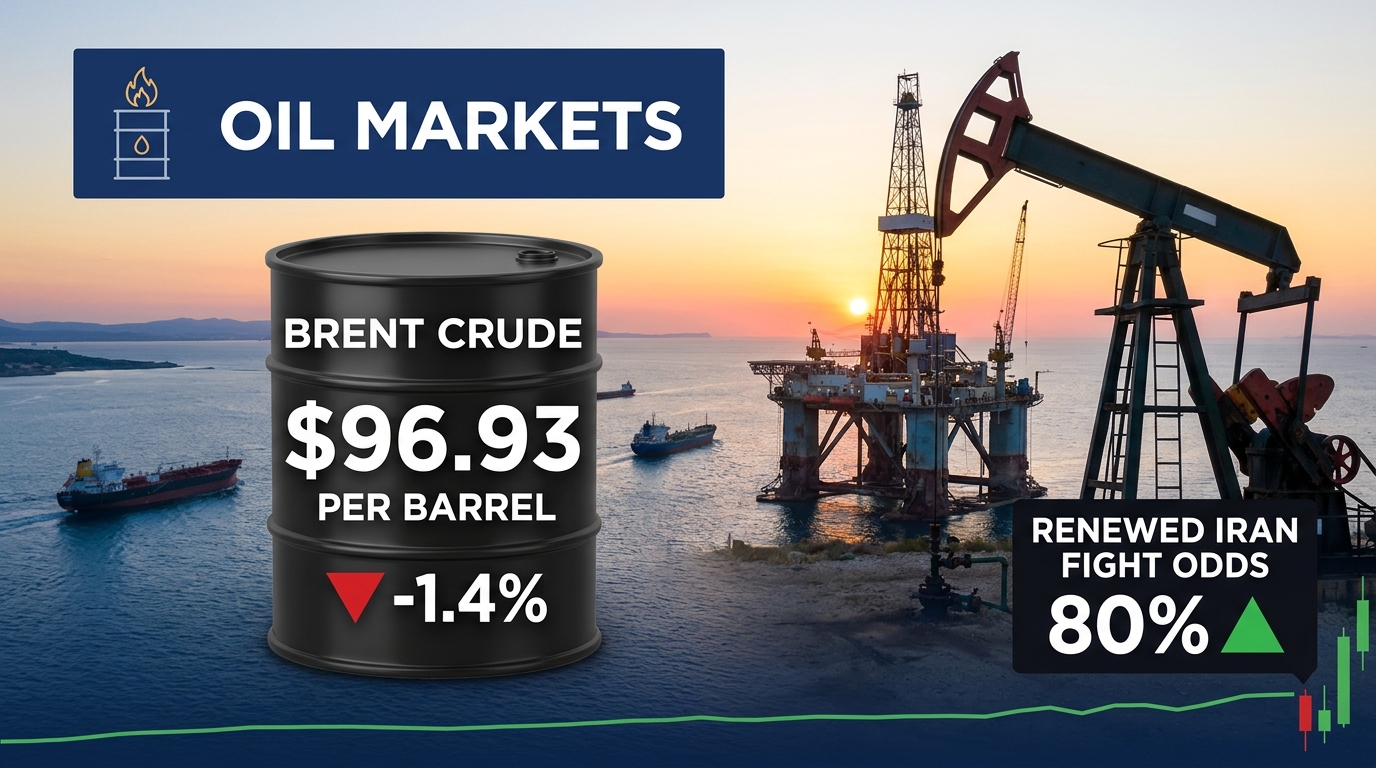
Brent crude futures fell about 1.4% to $96.93 a barrel in early Friday trading, reversing earlier gains, as investors weighed the risk of renewed U.S.-Iran military escalation against signs of a possible diplomatic opening. Oil is on course for a sharp weekly decline after Brent traded as high as $118 a barrel the previous Friday, but prices remain roughly 60% above where they started 2026.
The swings have been violent. Brent and U.S. West Texas Intermediate each tumbled more than 8% on Wednesday to their lowest settlements since August 31, as the midterm election results fed hopes for an end to the war. On Thursday, new attacks on tankers pushed Brent up $3.67, or 3.88%, to settle at $98.29, while WTI closed at $90.52, up 2.72%.
Forecasts diverge sharply. An energy-advisory founder said he sees an 80% probability that military fighting resumes, which could lift both benchmarks above $100 a barrel. A political-risk consultancy cut its estimate of renewed U.S. strikes to 60% from 65% but also lowered the chance of a deal to 10% from 20%, and said escalation could send Brent into a $110 to $125 range. Reports that Iran sent a nuclear proposal to Washington through Qatar offer a counterweight, and the president said earlier this week he has no immediate plans to strike Iran.
The war, launched in February by the United States and Israel, has disrupted shipping through the Strait of Hormuz and lifted fuel costs for consumers. The average U.S. gasoline price was about $4.12 a gallon on Wednesday, roughly 39% higher than before the conflict began on February 28, and voters cited prices as a major grievance in this week's midterm results.
For equities, oil is a swing factor for inflation and interest rates. Futures markets assign roughly 65% to 70% odds of a Federal Reserve rate hike on December 9, and October CPI is due Tuesday. A renewed spike toward $110 would raise inflation expectations and could strengthen the case for tightening, while a diplomatic breakthrough would ease pressure on consumers, airlines and rate-sensitive sectors. Veterans Day closes the bond market on Wednesday while shares trade, which could concentrate rate-sensitive moves in Tuesday's CPI reaction.
Supply fundamentals add another layer. Some analysts see a near-term surplus building, and early Friday headlines pointed to fresh signs of a glut as high prices curb demand. But low commercial inventories and thin strategic reserves leave little buffer if Hormuz disruptions delay cargoes, which means bad headlines can move prices faster than good news.
Trading implications are two-sided. Energy producers and tanker-exposed names tend to benefit from escalation, while airlines, transport and consumer discretionary stocks benefit from de-escalation. With Brent near $97, the risk premium is still elevated, and position sizing should reflect that headline risk can reverse intraday moves in either direction. Watch tanker incident reports, diplomatic statements and the 8:30 a.m. ET payrolls release.