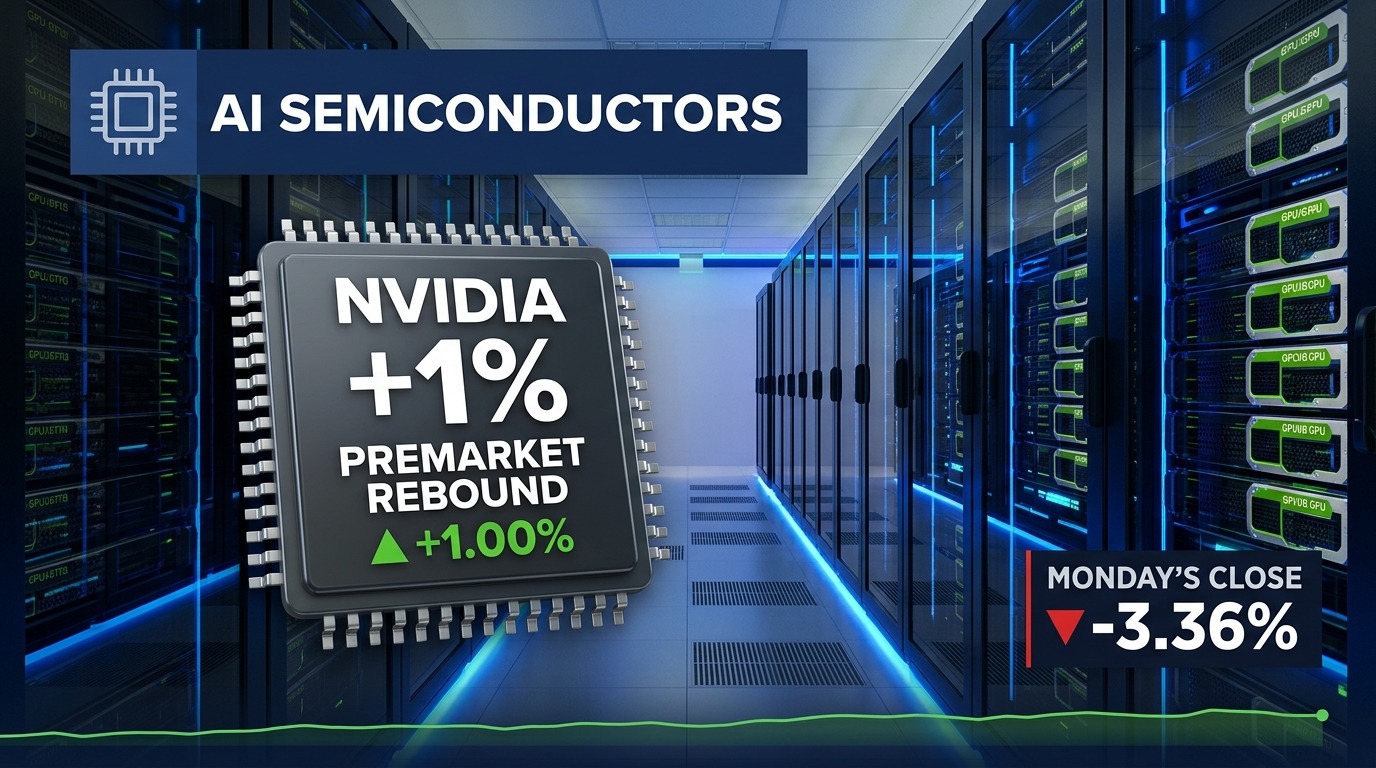
Nvidia shares advanced roughly 1% in premarket trading Tuesday, attempting to stabilize after a 3.36% decline on Monday that left the stock closing at $210.96. The prior session’s drop was driven by renewed investor caution following essays and comments from Anthropic CEO Dario Amodei and OpenAI leadership urging a more measured approach to frontier AI model capabilities due to safety and misuse risks. The comments raised questions about the pace of capital expenditure among major technology firms that have been the primary drivers of Nvidia’s explosive growth.
Chipmakers more broadly came under pressure Monday as the PHLX Semiconductor Index suffered one of its sharpest one-day declines in recent months. Memory and related names such as Micron and SanDisk also sold off on the same AI slowdown narrative. Nvidia’s market capitalization remains above $5 trillion, leaving the stock highly sensitive to shifts in sentiment around data-center spending and generative AI adoption. Even modest changes in expectations for hyperscaler budgets can produce outsized moves in the shares.
While some recovery is visible in early trading, the broader backdrop of elevated Treasury yields near 5% and a near-certain Federal Reserve rate hike continues to weigh on high-valuation growth stocks. Investors will watch for any further commentary from major AI labs and for signs that capital expenditure plans among cloud providers and technology giants remain intact. The simultaneous pressure from rising borrowing costs and energy-driven inflation creates a challenging environment for multiples that have expanded sharply on AI optimism.
Nvidia remains the single largest influence on the Nasdaq and semiconductor sector performance, making its intraday price action a key barometer for risk appetite in technology. On Monday the broader market was already soft, with the S&P 500 and Nasdaq both finishing lower. The AI safety discussion added a sector-specific catalyst that amplified the move lower in chip stocks. Some software and cybersecurity names actually benefited from a rotation out of pure AI infrastructure plays, highlighting the nuanced nature of the selling.
Analysts note that the fundamental demand for Nvidia’s data-center products has remained robust in recent quarters, supported by ongoing deployments of advanced GPU clusters. However, valuation remains elevated relative to historical norms, leaving limited margin for error if growth expectations are revised lower. Guidance updates and commentary from major customers in the coming weeks will be scrutinized for any signs of caution.
The premarket rebound, while modest, suggests that some buyers view Monday’s decline as an overreaction. Still, the combination of macroeconomic headwinds and the new safety narrative means volatility is likely to persist. Options markets continue to price elevated near-term uncertainty around the name. Portfolio managers who have concentrated exposure to Nvidia and related AI beneficiaries are reassessing position sizes ahead of the Fed decision and potential further commentary from industry leaders.
Broader technology sentiment will also be influenced by any developments on the regulatory front and by the trajectory of energy prices, which affect the cost of operating large-scale data centers. Higher electricity and cooling expenses could eventually pressure margins even if unit demand remains strong. For now, the focus remains on whether the safety discussion represents a temporary sentiment hit or the beginning of a more sustained reassessment of AI investment timelines.
Nvidia’s ability to deliver continued strong results and forward guidance will ultimately determine whether the stock can resume its upward trajectory. In the near term, price action is likely to remain tightly linked to both company-specific news flow and the evolving macroeconomic picture. Traders are watching the $210 level closely as a potential near-term support zone after Monday’s close.