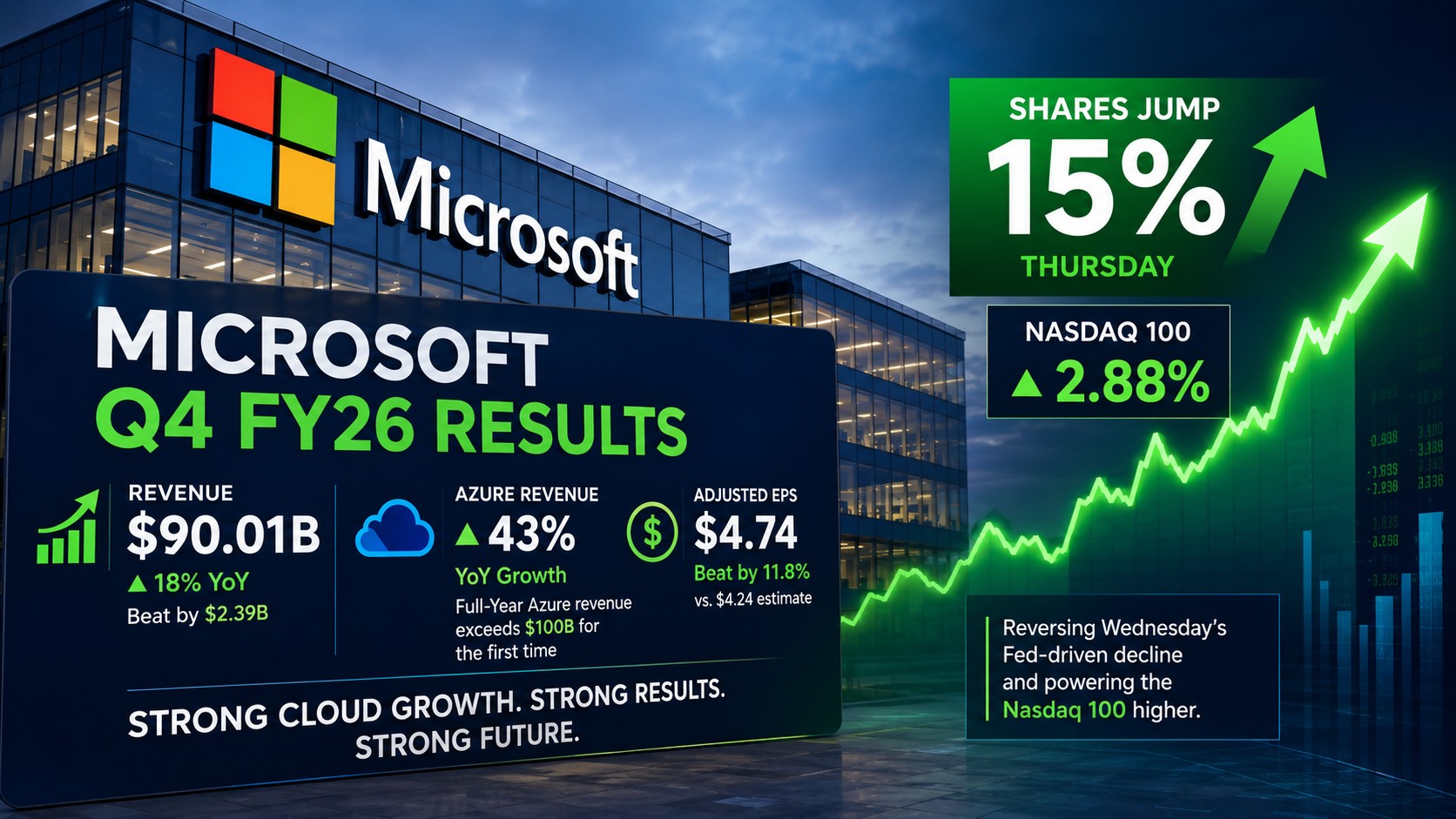
Microsoft closed its fiscal year 2026 with a fourth quarter that topped Wall Street expectations across every headline metric, reporting revenue of $90.01 billion — 18% above the same period a year earlier and $2.39 billion ahead of the $87.62 billion analyst consensus compiled by LSEG. Adjusted diluted earnings per share of $4.74 beat the $4.24 estimate by 11.8%, while GAAP net income of $35.77 billion, or $4.81 per share, rose 31% and 32% respectively from the prior year.
The defining milestone of the quarter was Azure. The cloud platform grew 43% in the fiscal fourth quarter — the fastest growth rate in four years — pushing full-year Azure revenue past $100 billion for the first time in the company's history. Microsoft's Intelligent Cloud segment, which houses Azure, produced $39.3 billion in quarterly revenue, up 32% year-over-year. CEO Satya Nadella declared on the earnings call: "We are only at the beginning phases of AI diffusion, and already Microsoft has built an AI business that is larger than some of our biggest franchises." For fiscal year 2027's first quarter, management guided Azure growth to approximately 45% in constant currency — an acceleration from the 43% Q4 print that further raised the bar for expectations.
Total Microsoft Cloud revenue reached $59.3 billion in the quarter, up 27%, with commercial remaining performance obligations expanding 84% to $678 billion — a figure that provides extraordinary multi-year revenue visibility. Approximately 45% of that RPO is tied to OpenAI commitments, embedding the company's AI partnership directly into its contractual backlog. Copilot paid seats surpassed 30 million by the end of the quarter, up from 20 million reported in April, and the Productivity and Business Processes segment — which includes Microsoft 365 and LinkedIn — generated $37.85 billion in revenue, up 14.3%.
The quarter included $3.2 billion in gains from Microsoft's stake in Anthropic and lower-than-expected costs from its voluntary retirement program, which together added $0.27 to diluted EPS. Those tailwinds were partially offset by Xbox impairment charges and severance expenses. Capital expenditures for the quarter reached $41 billion, up 69% year-over-year, though CFO Amy Hood revised Microsoft's full-calendar-year 2026 capex forecast down to approximately $175 billion from $190 billion by extending the assumed useful life of office and data center properties from 15 to 25 years — a change that also shifts new data center leases from finance to operating treatment starting in fiscal 2027.
Hood guided total revenue for fiscal first-quarter 2027 at $89.85 billion to $90.95 billion, implying 16% to 17% growth, and confirmed Microsoft will remain free cash flow positive in fiscal 2027 despite capital expenditures set to exceed $50 billion per quarter. The guidance was read as confirmation that Azure's monetization engine is operating efficiently enough to absorb the infrastructure buildout without compressing cash generation — a critical point of differentiation from Meta, which reported a 91% collapse in free cash flow the same evening.
Microsoft shares surged approximately 15% on Thursday, recovering not only Wednesday's Fed-induced decline but adding substantially to year-to-date gains. The iShares Semiconductor ETF (SOXX) jumped more than 7% in sympathy, as Azure's acceleration was read as validation that AI infrastructure spending is converting to enterprise revenue at scale — the central question hanging over the entire technology sector heading into earnings season.