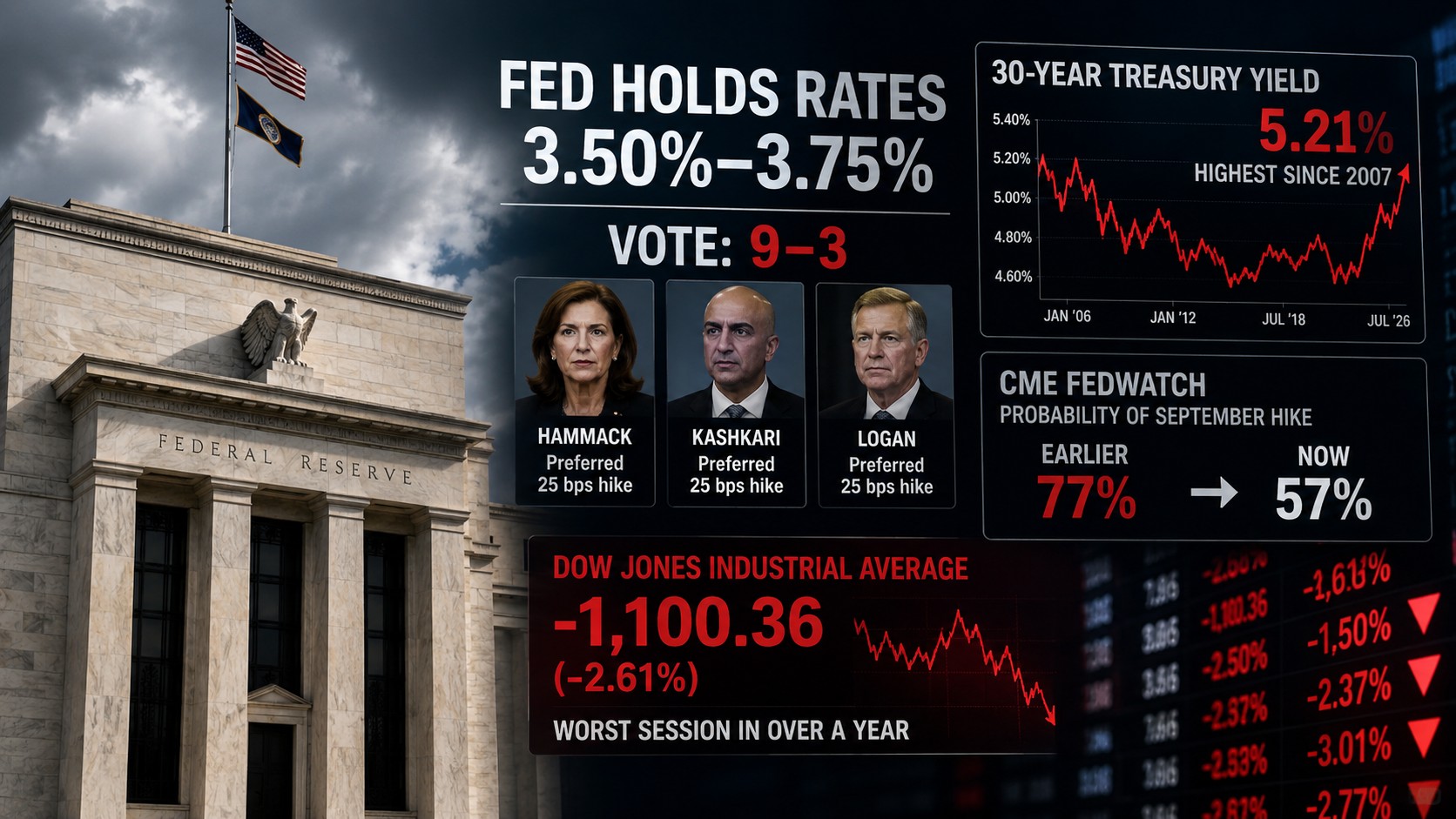
The Federal Open Market Committee delivered its most divided policy outcome in nearly a decade on Wednesday, voting 9–3 to maintain the federal funds rate target at 3.50%–3.75% — but the three dissenters who formally preferred an immediate 25 basis-point increase sent Treasury yields surging and drove the Dow Jones Industrial Average down more than 1,100 points, its worst single-day decline in over a year.
Cleveland Fed President Beth Hammack, Minneapolis Fed President Neel Kashkari, and Dallas Fed President Lorie Logan each voted for a rate hike — the first time three policymakers have dissented toward tightening in a unified direction since September 2016. The post-meeting statement noted the three dissenters "preferred to raise the target range for the federal funds rate by ¼ percentage point at this meeting." The S&P 500 finished the day down 1.52%, the Nasdaq Composite fell 1.74%, and the Dow closed at –2.19%.
The long end of the Treasury curve bore the brunt of the reaction. The 30-year yield rose more than nine basis points to 5.193%, touching its highest level since 2007, as investors recalibrated their assumption that rates would remain stable into year-end. The 10-year yield rose five basis points to 4.657%. The 2-year yield, which is more sensitive to near-term policy expectations, actually declined four basis points to 4.236% — a pattern consistent with markets repricing not a single imminent hike but a sustained elevated rate environment rather than a tightening cycle.
Fed Chair Kevin Warsh, presiding over only his second FOMC meeting since replacing Jerome Powell, reinforced that the committee is in a phase of what he called "watchful waiting" — but refused to offer the forward guidance markets have grown accustomed to under previous chairs. Warsh said there is "no soft inflation target" and committed to press conferences at every remaining 2026 meeting, a signal that each gathering carries live optionality. The CME FedWatch tool briefly showed a 77% probability of a September rate hike immediately after the decision before settling near 57% by Wednesday's close, with approximately 35 basis points of additional tightening priced by year-end.
Goldman Sachs Asset Management's Kay Haigh framed the dissent in the context of the Middle East: "The committee's growing hawkish sentiment, shown by the three dissents against today's hold, has also likely been exacerbated by the recent flare-up in hostilities in the Middle East." She added that a September hike is "finely balanced" and will depend on a combination of Middle East developments and the next two CPI prints. The dual overhang of Iran-driven energy inflation and tariff-driven goods prices has left the FOMC unable to cut while growth data softens — a classic stagflationary bind.
J.P. Morgan's Tactical Positioning Monitor, however, flagged conditions as "oversold enough to warrant a tactical buying opportunity" Wednesday evening, citing five short-term tailwinds: falling bond yields on a relative basis, a weakening dollar, strong corporate earnings, easing Middle East tensions on the margin, and the mechanical tendency for equities to recover after oversold Fed-reaction selloffs. That tactical framing proved correct into Thursday's open, where Microsoft's blowout results and a semiconductor rebound drove the Nasdaq 100 up 2.88%, the S&P 500 up 1.18%, and the Dow up 0.61% — a sharp reversal that underscores the tension between the hawkish macro backdrop and AI-driven earnings momentum.
For portfolio positioning, the July FOMC outcome narrows the probability distribution for the remainder of 2026. A September hike — the base case for the three dissenters — would push the fed funds rate to 3.75%–4.00%, a level that would materially reprice rate-sensitive sectors including real estate, utilities, and high-duration tech. Any investor holding long-duration bonds or high-multiple growth stocks into August CPI should plan for binary risk around that data release.