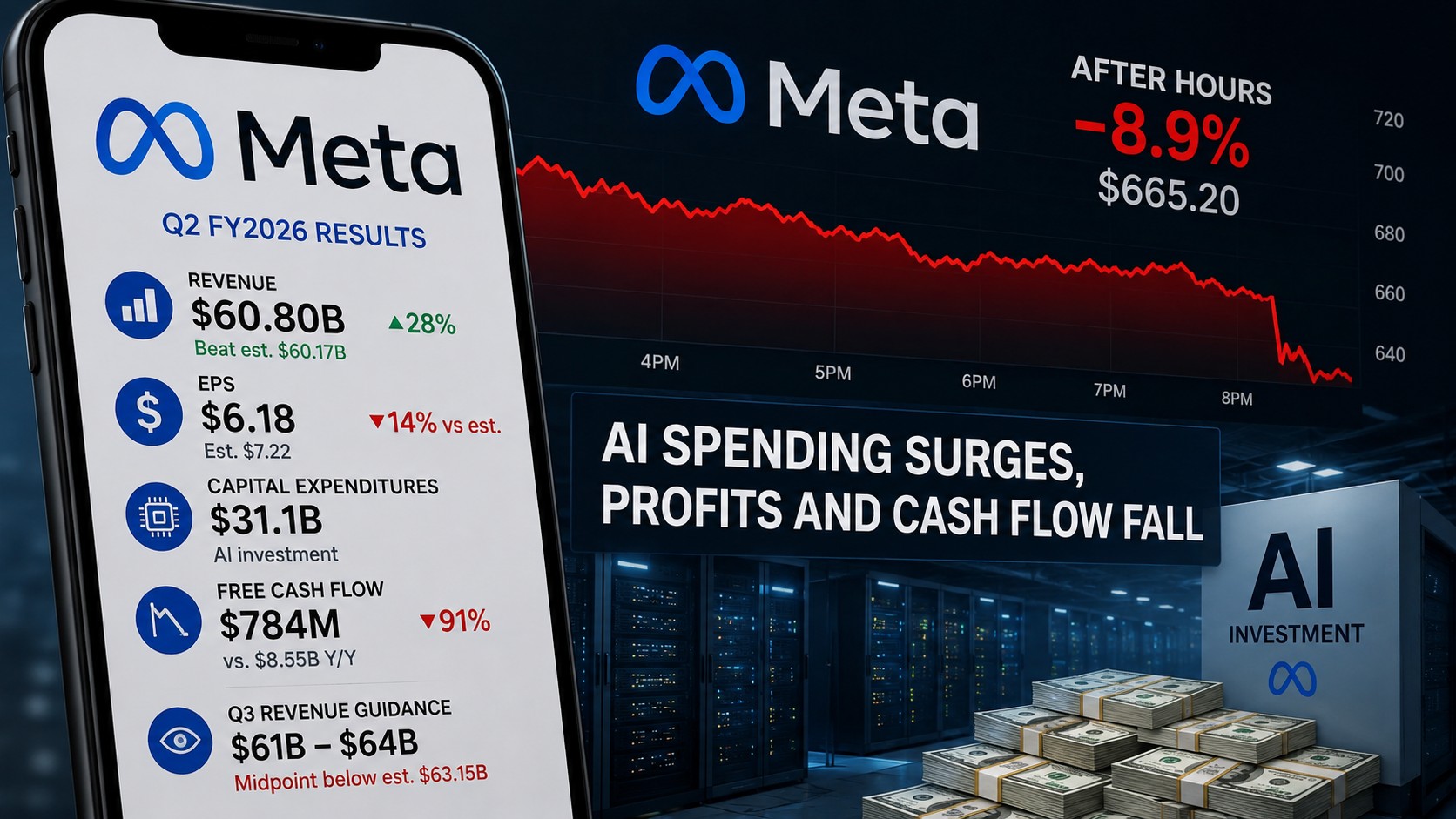
Meta Platforms delivered its highest-revenue quarter in company history on Wednesday evening — and the stock fell approximately 9% in after-hours trading. The tension between those two facts has a specific dollar amount: $784 million, the free cash flow Meta generated in the three months ended June 30, 2026, after spending $31.1 billion on AI data centers, chips, and infrastructure. In the same quarter one year earlier, free cash flow was $8.55 billion — a 91% collapse.
Revenue of $60.80 billion grew 28% year-over-year and came in approximately $630 million above the $60.17 billion consensus compiled by LSEG, continuing a streak of top-line beats driven by advertising strength across Instagram, Facebook, and WhatsApp. However, GAAP earnings per share of $6.18 missed the $7.22 analyst estimate by nearly 14%, as total costs and expenses reached $42.03 billion — a 55% year-over-year increase — that included $2.40 billion in legal charges tied to youth social media litigation and $1.18 billion in severance expenses from a round of layoffs initiated in May. Net income fell 14% to $15.85 billion from $18.34 billion in the year-ago period.
Capital expenditures of $31.1 billion represented 97.5% of the company's $31.9 billion in operating cash flow — a ratio that, if sustained, leaves almost no residual free cash flow for buybacks, dividends, or balance sheet flexibility. CEO Mark Zuckerberg raised full-year capital expenditure guidance for the second time in 2026, narrowing the range from $125–$145 billion to $130–$145 billion. Last year, Meta spent approximately $72 billion in capex across the full year; the new midpoint of $137.5 billion implies spending will nearly double in 2026. Zuckerberg told analysts: "We expect that a significant portion of our compute is going to go towards training our models, growing our core business, and delivering personal agents and new products."
Q3 revenue guidance was set at $61 billion to $64 billion, implying roughly 25% growth at the $62.5 billion midpoint — above the $60.17 billion prior-year comparable but landing below the $63.15 billion analyst consensus. The combination of EPS miss and light Q3 guidance midpoint gave investors two negative data points simultaneously, driving the after-hours decline from Wednesday's close of $585.61 to approximately $529–$542, depending on the source.
The structural issue Meta faces is one shared across hyperscalers but uniquely acute here: unlike Microsoft, Amazon, and Alphabet, Meta does not operate a cloud-computing business that generates incremental external revenue from AI infrastructure investments. Every dollar Meta spends on AI data centers serves its own advertising and AI product goals rather than generating direct infrastructure-as-a-service revenue from third parties. Until Meta can demonstrate that agentic AI features and personal AI agents translate into measurable advertising price increases or new revenue streams, the market will penalize the capex trajectory.
Analyst Stephen Evans of Pave Finance summarized the market's view concisely: "This is ultimately a tale of two AI investment strategies. One company is increasing profits while spending heavily, while the other is allowing those costs to eat into its bottom line" — a direct contrast drawn against Microsoft's simultaneous 15% stock gain on Azure's 43% growth. Reality Labs, Meta's VR and augmented reality division, lost $4.65 billion in Q2 alone, an additional drag on earnings that underscores the breadth of Meta's concurrent infrastructure commitments.