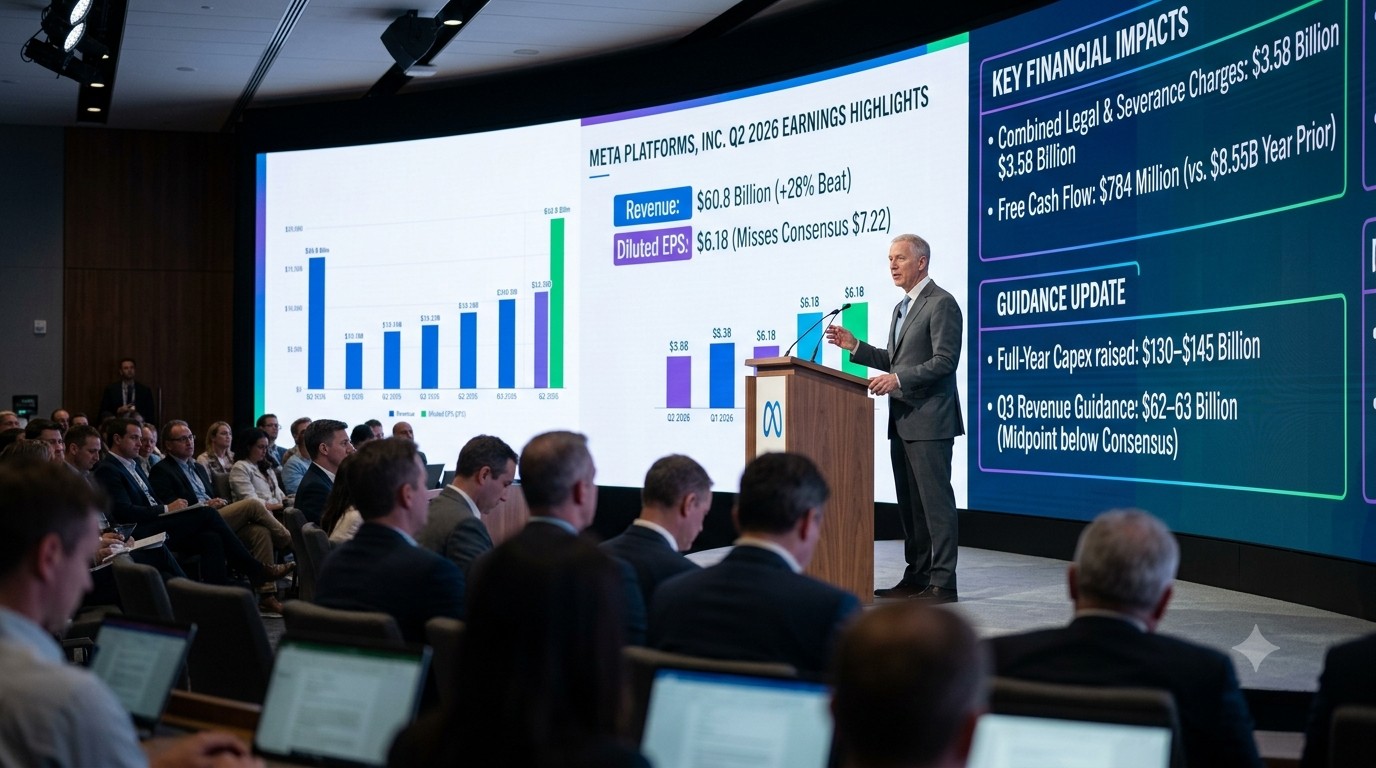
Meta Platforms reported second-quarter 2026 results Wednesday that delivered a 28% revenue beat on the top line but a significant miss at the earnings level, sending shares down approximately 8.4% in premarket trading Thursday as investors focused on the deterioration in profitability metrics rather than the headline sales growth.
Revenue of $60.80 billion grew 28% year-over-year and beat the $60.19 billion LSEG consensus, powered by 14% growth in advertising impressions and a 12% rise in average price per ad. Daily active people across Meta's family of apps grew 3% to 3.60 billion — a healthy engagement number that confirms the core advertising business remains structurally sound. The problem resided entirely in costs. Total costs and expenses surged 55% year-over-year to $42.03 billion — nearly twice the revenue growth rate — driven by $2.40 billion in legal contingency charges, $1.18 billion in severance costs related to the 8,000-person headcount reduction announced in May, and continued acceleration in AI infrastructure depreciation and third-party cloud spending.
Diluted EPS of $6.18 missed the $7.22 consensus by approximately 14%, representing Meta's steepest earnings miss in years and snapping a multi-quarter streak of EPS beats. GAAP net income of $15.85 billion declined year-over-year from $18.34 billion in Q2 2025 despite the 28% revenue increase — an inversion that illustrates how dramatically the cost structure has expanded relative to revenue. Free cash flow collapsed from $8.55 billion in Q2 2025 to $784 million in Q2 2026, as $31.1 billion in capital expenditures consumed nearly all of the $31.9 billion in operating cash flow generated during the quarter. The magnitude of the free cash flow deterioration — a decline of approximately $7.8 billion year-over-year — was the single most alarming metric in the report for cash-flow-focused institutional investors.
Capital expenditure guidance for the full year 2026 was raised to $130–$145 billion from the prior range of $125–$145 billion, marking the second upward revision of the year. Full-year expense guidance was also raised at the lower end. Q3 revenue guidance of $61–$64 billion implies a midpoint of $62.5 billion against the $63.15 billion consensus — a miss on the forward outlook that compounded the EPS shortfall in the after-hours reaction. The effective tax rate for remaining 2026 quarters was raised from 13%–16% to 15%–17%, adding a further headwind to forward EPS estimates.
Meta also announced a separate, constructive capital-structure development during the week: a $14 billion, 1-gigawatt data center in Texas co-developed with BlackRock, with BlackRock holding an 80% stake and Meta retaining 20%. The arrangement mirrors structures being explored by SpaceX and others to off-balance-sheet infrastructure while retaining compute access — a model that could partially address the FCF pressure if expanded. CEO Mark Zuckerberg separately indicated Meta is evaluating leasing out data center capacity to third-party customers, a potential future revenue stream.
The divergence between Meta's outcome and Microsoft's on the same earnings night illustrates the central variable defining AI-era investment returns: whether infrastructure spending is anchored to concrete contracted revenue — as Microsoft's $678 billion RPO demonstrates — or is being deployed ahead of demand with less visible near-term monetization. Meta's 28% revenue growth confirms the advertising engine is healthy; the question for the next four quarters is whether capex can slow without sacrificing the AI product roadmap that management argues is the foundation of its competitive position.