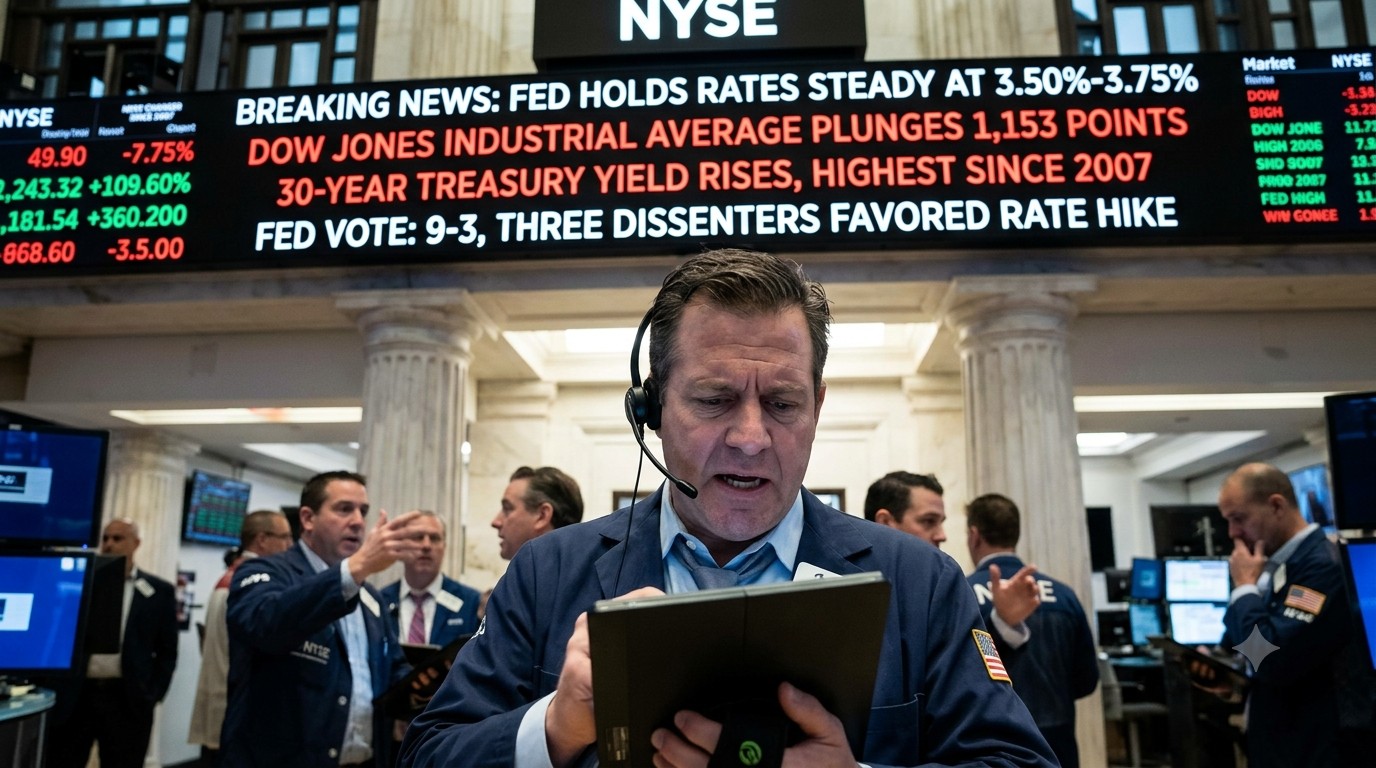
The Federal Open Market Committee voted 9-3 to leave the federal funds target rate unchanged at 3.50%–3.75% at its July 29 meeting — the second policy decision under Chair Kevin Warsh — but the three-member dissent in favor of an immediate quarter-point rate hike sent bond yields surging and stocks tumbling in the hours following the 2:00 p.m. ET announcement, with the Dow Jones Industrial Average declining 1,153 points in its worst single session in more than a year.
The dissenters — Cleveland Fed President Beth Hammack, Minneapolis Fed President Neel Kashkari, and Dallas Fed President Lorie Logan — each voted for a 25-basis-point increase, the largest coordinated dissent in the FOMC in recent memory. Their collective view reflects the position articulated by Kashkari in recent weeks: that inflation risks have risen since the June meeting and that the committee risks falling behind the curve if it waits for more data before tightening. Governor Christopher Waller, previously a consistent dove who had been among the first to call for easing in 2025, voted with the majority for a hold — a positioning signal that he remains just barely on the hold side of a knife-edge internal debate.
Chair Warsh, in his second post-meeting press conference, maintained his governing philosophy of minimal forward guidance. The post-meeting statement was described by analysts as nearly identical to the June statement, providing neither rate trajectory signals nor the kind of conditional language markets typically use to pre-price future moves. Warsh told reporters that tightening in financial conditions was doing some of the Fed's work for it — a reference to the ongoing rise in long-dated Treasury yields — and committed to holding press conferences for the remainder of 2026. National Economic Council Director Kevin Hassett expressed full confidence in Warsh, telling CNBC his stewardship is "already a home run."
Bond markets delivered an unambiguous verdict on the credibility gap. The 30-year Treasury yield advanced more than 9 basis points to 5.193%, its highest level since 2007, while the 10-year yield rose 5 basis points to 4.657%. The 2-year yield, which tracks near-term rate expectations most directly, fell 4 basis points to 4.236% — a flattening of the curve that reflects markets simultaneously pricing higher long-run inflation risk and near-term policy uncertainty. Equity markets took the combined pressure of the hawkish dissent, the yield spike, and Warsh's refusal to guide hard: the S&P 500 closed 0.6% lower, the Nasdaq fell 0.5%, and the Dow fell 840 points before extending losses to close down 1,153 — its worst day in over a year.
The session's decline proved to be a one-day correction. Thursday's session saw a dramatic reversal driven by Microsoft and Amazon's blockbuster earnings reports, with the S&P 500 surging 1.7% and the Dow gaining 613 points. The CME FedWatch tool now shows a 41.9% probability that rates remain unchanged in September — up sharply from 24% a day before the meeting — suggesting that while the market has absorbed the hawkish dissent, it still assigns a meaningful probability to a September hike ahead of Warsh's keynote at Jackson Hole on August 27–29.
The Jackson Hole speech will be the most closely watched Fed communication of the summer. Warsh's arguments about restoring the Fed's institutional credibility, his disdain for forward guidance as practiced by his predecessors, and his stated priority of reaching 2% inflation leave all options — hold, hike, or eventually cut — formally on the table through year-end, maintaining the maximum-uncertainty policy backdrop that has defined markets since he took office.