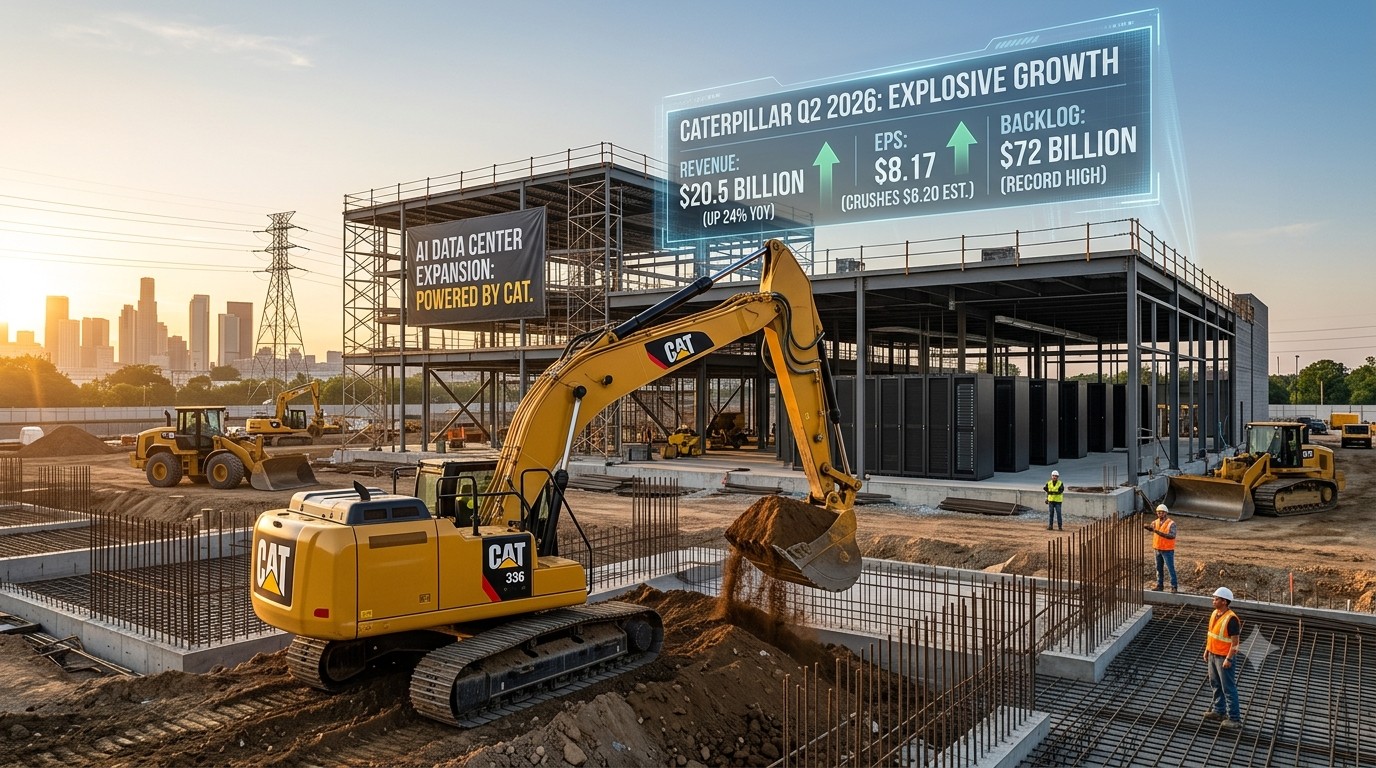
Caterpillar Inc. delivered its strongest quarterly earnings beat in recent memory on Tuesday, reporting second-quarter 2026 revenue of $20.54 billion — a 24% year-over-year increase and an 8.4% beat versus the $18.95 billion Wall Street consensus. Adjusted earnings per share of $8.17 obliterated the $6.20 estimate by 31.8%, and the company's operating margin expanded 360 basis points year-on-year to 20.9%, reflecting the powerful combination of volume leverage and disciplined cost management. Shares jumped more than 10% in premarket trading, adding approximately $38 billion in market capitalization and immediately lifting Dow Jones futures by 0.6%.
The single most strategically important figure in the report was not the earnings beat but the order backlog, which climbed to an all-time record of $72 billion. The backlog figure is a forward-looking indicator of demand visibility, and its record level directly addresses the question that has weighed on industrial and power-equipment stocks for weeks: whether the AI data center capital expenditure wave that has powered equipment demand through 2025 and the first half of 2026 is decelerating. Caterpillar's numbers answer that question with clarity — construction equipment and power-generation products tied to hyperscaler data center projects are being ordered faster than they can be delivered.
The results land in the context of a broader investor debate that had sent power-equipment-adjacent stocks meaningfully lower through July. Prominent short seller Michael Burry had raised public concerns about AI infrastructure spending sustainability, and a cluster of analyst downgrades had pressured peers including Vertiv Holdings, Eaton, and Emerson Electric. Caterpillar's $72 billion backlog and Q2 revenue beat represent the most concrete empirical rebuttal to the deceleration thesis that the market has seen, and are expected to trigger significant estimate revisions upward across the industrial and power equipment sector.
Enterprise operating cash flow for the quarter was $4.4 billion, and Caterpillar ended the period with $6.7 billion of enterprise cash. The company deployed $1.5 billion on share repurchases and $0.7 billion on dividends during the quarter, demonstrating robust capital return even as it services its record backlog. Full-year tariff cost exposure was trimmed to approximately $2.2 billion from prior guidance of $2.2 billion to $2.6 billion — a modest but symbolically important improvement that suggests supply chain adaptation is progressing ahead of plan.
Management raised its full-year 2026 sales growth target following the quarter, without providing a specific revised number, citing the record backlog and continued strong order rates. CEO Jim Umpleby described demand across construction, mining, oil and gas, and data center-related power applications as "broad-based and durable," a characterization that contrasts sharply with the inventory destocking concerns that have clouded industrial sector sentiment since spring.
The Caterpillar result carries significant read-through implications for the broader market. The AI data center capital expenditure cycle — which flows from hyperscaler spending plans through to chip demand, power infrastructure, and ultimately construction and heavy equipment — remains intact and, by the evidence of this backlog, is accelerating into the second half of 2026. For investors who have been questioning whether to maintain overweight positions in AI infrastructure beneficiaries, Caterpillar's numbers provide a powerful fundamental anchor.