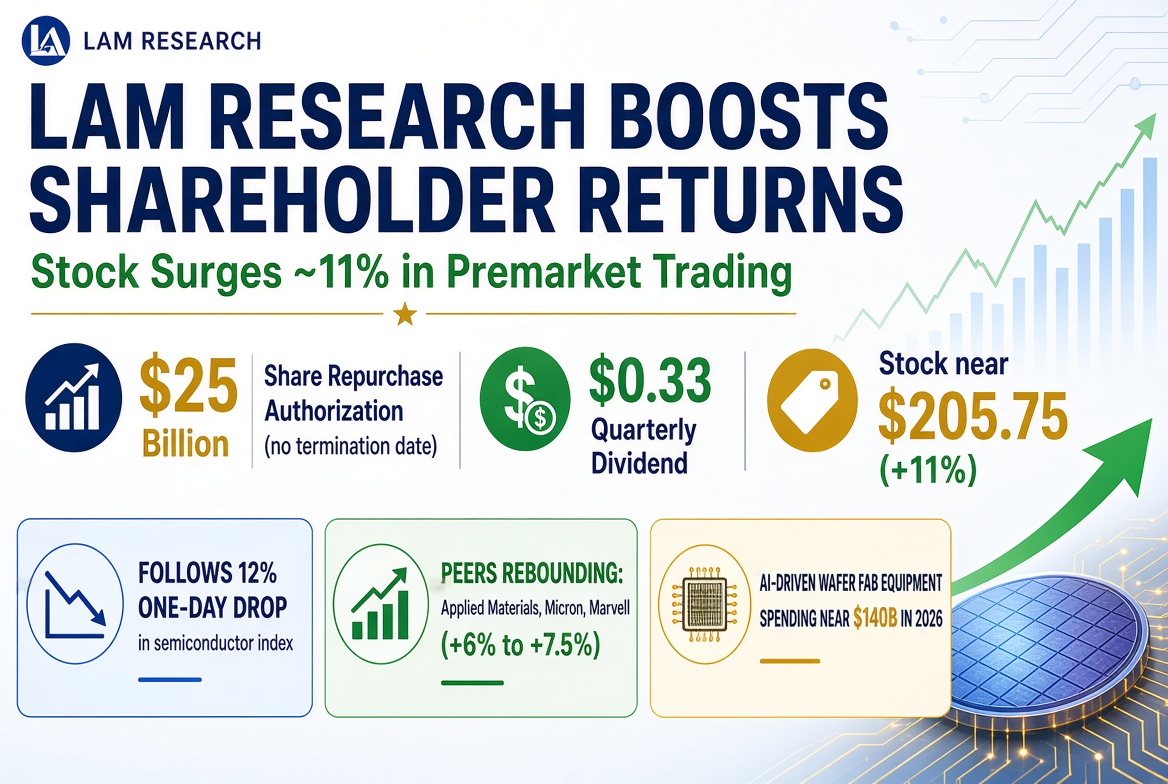
Lam Research said its board approved a new $25 billion share repurchase authorization and a quarterly dividend of $0.33 per share, and the stock rose about 10% to 11% in premarket trading on Friday to near $205.75. The announcement, made on November 5, came as chip stocks were reeling from the sharpest technology selloff in more than a year.
The new authorization supplements the remaining balance of the prior program, has no termination date and may be executed through open-market or private transactions, including structured repurchase agreements. The dividend is payable on January 6, 2027 to shareholders of record on December 2, 2026. Chief Financial Officer Doug Bettinger said the plan reinforces the company's commitment to returning significant value to stockholders.
The buyback is large relative to recent activity. In the fiscal third quarter of 2026, Lam generated about $810 million of free cash flow and returned roughly $1.16 billion through repurchases and $326 million in dividends. Management has said it intends to return at least 85% of free cash flow over time, and the new authorization gives it room to accelerate purchases while shares trade below recent highs.
Operationally, the company has been a beneficiary of AI-driven chip investment. Fiscal third-quarter revenue reached a record $5.84 billion, up 24% year over year, with non-GAAP earnings of $1.47 per share, and management expects wafer fabrication equipment spending of about $140 billion in calendar 2026, with possible upside. The shares had roughly doubled year to date before this week's selloff.
Thursday's rout hit equipment makers hard. The semiconductor index fell about 12% as investors worried that Democratic gains in the midterm elections could slow U.S. data center construction, a key source of demand for advanced chips. Applied Materials rose more than 6% in Friday premarket trading, Micron gained about 7.5% and Marvell Technology about 7%, indicating that dip buyers are returning across the semiconductor supply chain.
The buyback also signals management's view that the selloff is overdone. A company repurchasing stock into weakness reduces its share count and supports earnings per share, but it does not by itself change the demand outlook. Investors still need clarity on how local opposition, financing costs and political oversight will affect customers' capital spending plans, which determine equipment orders in 2027.
Technically, one ranking service rates the stock's short-, medium- and long-term price trends as negative despite a strong quality score, a reminder that a single-session pop does not repair damage done over several days. Traders may use the gap as an opportunity or wait for confirmation after payrolls and Tuesday's October CPI report before adding exposure.
Peers matter for context. Equipment suppliers such as Applied Materials derive revenue from the same foundry and memory capital spending cycle, so any shift in Lam's tone about order visibility tends to ripple across the group. The company's next earnings report will be the first full test of whether demand held through the political and market turbulence.