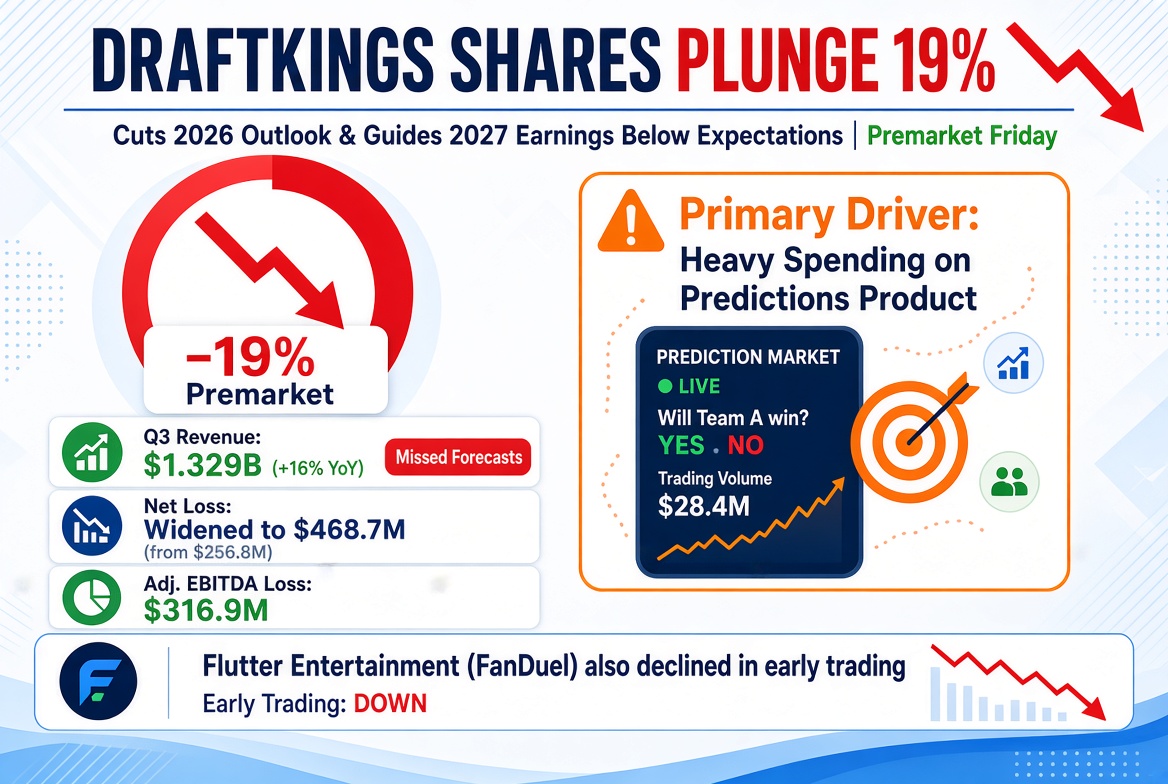
DraftKings shares fell about 19% in premarket trading on Friday after the sportsbook operator cut its 2026 outlook and issued 2027 earnings guidance below Wall Street expectations. Third-quarter revenue was $1.329 billion, up 16% from $1.144 billion a year earlier but short of analyst forecasts, as spending on the new DraftKings Predictions product weighed on profitability.
The quarterly loss widened sharply. Net loss attributable to common stockholders was $468.7 million, compared with a loss of $256.8 million in the third quarter of 2025, and adjusted EBITDA was a loss of $316.9 million versus a loss of $126.5 million a year ago. The results were released after Thursday's close, adding pressure in a market already under heavy selling.
The market reaction was driven less by the quarter than by the outlook. DraftKings lowered its 2026 guidance, attributing the cut to the money it is putting into Predictions, and introduced 2027 targets that investors viewed as light. The product places the company in the fast-growing event-contract category, where rivals are also investing aggressively to win customers.
Flutter Entertainment, owner of FanDuel and the largest U.S. competitor, fell alongside DraftKings in premarket trading, highlighting sector-wide sensitivity to the cost of prediction-market competition. Both companies have spent heavily to acquire customers for event-contract products, and investors are weighing whether that spending will pay off or erode margins in the core sportsbook and online casino businesses.
Context matters for positioning. The broader market fell sharply on Thursday, with the Nasdaq Composite down 5.52% and the S&P 500 down 4.36%, so a stock-specific drop of this size on a guidance reset suggests investors are rewarding clarity on profitability and penalizing open-ended investment. Weakness in gaming contrasts with strength in earnings-beat names such as Airbnb and Cloudflare.
Investors will also parse the call for details on customer acquisition costs, promotional intensity, hold rates and state-by-state launches, all of which have driven earnings volatility. With the NFL season in full swing and the holiday period ahead, the fourth quarter is typically among the most important stretches for handle, making guidance credibility especially important.
Risks and catalysts remain two-sided. Regulatory developments on prediction markets and state-level gaming taxes are central to the thesis, while customer-friendly sports outcomes can swing quarterly revenue. Analysts are likely to cut estimates and price targets today, and the stock may remain volatile as traders assess whether the 2027 guide marks a trough or the beginning of a longer investment cycle.
For portfolio managers, the setup is binary: a durable Predictions payoff could expand the addressable market, but another year of widening losses would challenge the premium that sportsbook equities have carried. Investors unwilling to take that risk may prefer to wait for stabilization after the first full trading session.