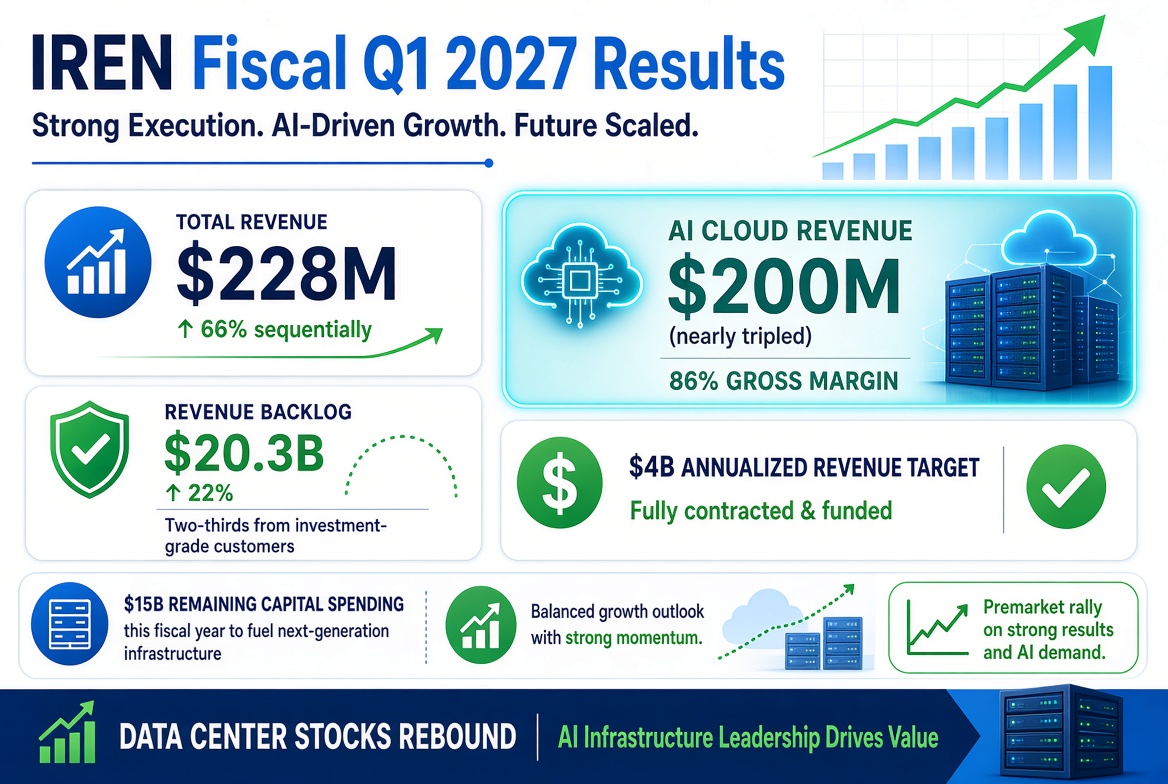
IREN reported fiscal first-quarter 2027 revenue of $228 million, up 66% sequentially and above the roughly $221 million consensus, as its AI Cloud segment nearly tripled to $200 million. Shares rallied in premarket trading on Friday, helping lead a rebound in data center and neocloud names after Thursday's technology selloff. The quarter ended September 30, and the results were released after the close on November 5.
AI Cloud revenue rose 182% sequentially at an 86% segment gross margin, in line with the prior quarter. Total revenue was $137 million in the June quarter, when legacy bitcoin mining still made up a larger share. Revenue backlog increased 22% sequentially to $20.3 billion, with about two-thirds tied to investment-grade counterparties and Microsoft representing the largest piece at roughly $9.6 billion.
Management said Horizon 1 went into service for Microsoft with NVIDIA Exemplar Cloud status for GB300 NVL72 systems, and operating annualized recurring revenue doubled to $1 billion. IREN also said its target of more than $4 billion in annualized recurring revenue is fully contracted and fully funded, and that it expanded a contract with a leading frontier AI lab after the quarter ended.
Not all details were positive. One analysis of the release noted that the $4 billion run-rate target slipped into 2027 and that IREN gave no new delivery date for certain Microsoft buildings in Texas. IREN also expects $15 billion of remaining capital spending this fiscal year, of which about $9 billion is covered by cash, committed GPU financing and customer prepayments, leaving roughly $6 billion to line up.
The financing question is central to this week's debate. Co-chief executive Dan Roberts said capital markets have become more selective about data center deals in recent weeks, and credit-default swap prices on some AI builders' debt have risen. That helps explain why investors punished neocloud and data center stocks on Thursday and why proof of contracted revenue is being rewarded today. Peers such as CoreWeave rose about 6% in premarket trading.
Net loss narrowed in the quarter, according to the results summary, and the company said it owns the land, the power and the data centers underlying its operations, which gives it more ways to fund growth and set its pace. That ownership model is intended to reduce dependence on third-party colocation capacity at a time when power and permitting are becoming the scarcest inputs in the AI buildout.
The setup also matters for the broader market. With the Nasdaq Composite in correction after falling 5.52% on Thursday, the first earnings reports from data center operators are being read as evidence about whether the AI buildout is slowing or simply being repriced. IREN's backlog and margins support the view that contracted demand remains intact, even as financing costs and political scrutiny rise.
For investors, the takeaway is that contracted AI revenue with investment-grade counterparties looks sturdier than headline AI sentiment. The risk is execution: delays in construction, power delivery or GPU installation can push revenue recognition out, and capital intensity remains high. Traders should expect outsized swings in IREN as macro headlines, payrolls and political developments on data center permitting hit the tape.