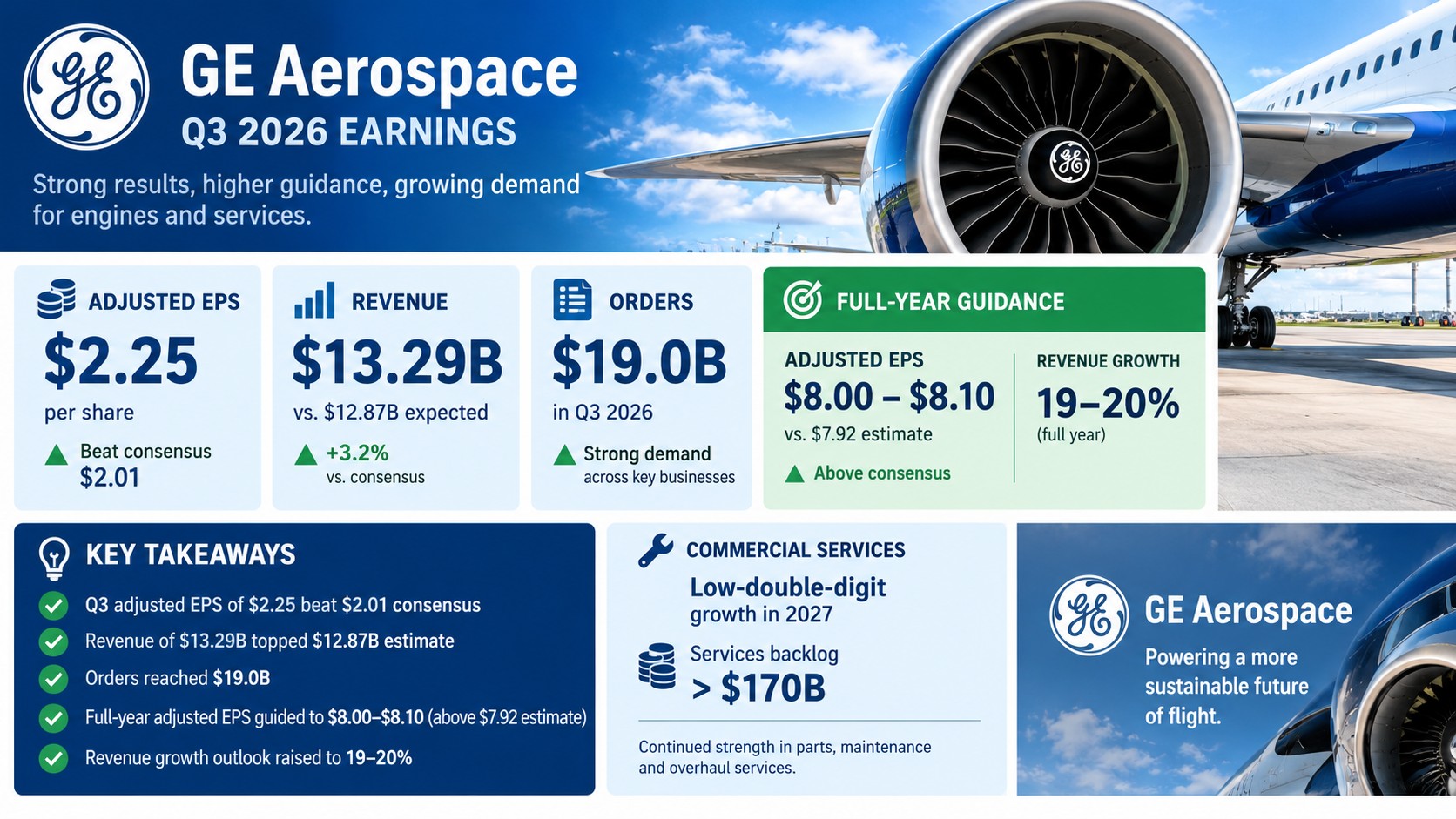
GE Aerospace delivered a third-quarter 2026 report that beat Wall Street on every headline line item and pointed to a stronger year than analysts had modeled. Adjusted earnings came in at $2.25 per share, ahead of the $2.01 consensus, while revenue of $13.29 billion topped the $12.87 billion estimate. Orders for the quarter totaled $19.0 billion, a figure that underscores how much demand continues to build behind the jet-engine maker's deliveries and services business.
Guidance carried the same message. GE Aerospace now expects full-year 2026 adjusted EPS of $8.00 to $8.10, compared with a consensus estimate of $7.92, and revenue growth of roughly 19% to 20%. Looking further out, the company said it expects commercial services revenue to grow at a low-double-digit rate in 2027, supported by a commercial services backlog of more than $170 billion. That backlog, tied to long-term maintenance and spare-parts needs of installed engines, is the earnings stream that investors prize most in the aerospace supply chain.
Orders are the line to watch. At $19.0 billion for the quarter, they exceed the quarterly revenue of $13.29 billion, implying the backlog continues to grow faster than the company can convert it into sales. For a business whose engines then generate years of aftermarket revenue, that gap is a leading indicator of future services income, and it helps explain why management felt confident enough to discuss 2027 growth in specific terms.
The results arrive after a second quarter in which operating profit rose 18% to $2.75 billion but the margin slipped 130 basis points to 21.7%, a decline attributed to growth investments and cost inflation, according to a Zacks analysis. Investors will want to see whether margins stabilized as production increased, particularly because the shares have traded at a premium multiple, about 41 times forward earnings in that analysis, compared with an industry average near 32 times.
Aerospace and defense peers also reported on Tuesday. Northrop Grumman posted third-quarter sales of $11.1 billion, a touch below the $11.13 billion estimate, but lifted its full-year adjusted EPS outlook to a range of $29.35 to $29.75 from $28.60 to $29.10 and raised its segment operating income view to between $4.94 billion and $5.04 billion. Its backlog increased to $110 billion. The pattern across the group is steady raises supported by strong order books.
The macro backdrop is more complicated for commercial aerospace. Brent crude near $110 and tanker attacks around the Strait of Hormuz raise fuel costs for airlines, which are among the largest customers for engines and services, and a 10-year Treasury yield near 5.12% pressures high-multiple industrials. Strong orders and a deep services backlog provide a cushion, but they do not remove sensitivity to airline profitability if fuel prices stay elevated for an extended period.
For a paper portfolio, the setup favors holding quality compounding exposure on weakness rather than chasing strength, with a close eye on oil-driven moves in airline stocks and on whether broader selling in technology drags down richly valued industrials. Execution on production ramps and margins will determine whether the premium valuation can be sustained into 2027, and the next signal will come from how the shares trade relative to the market after today's report.