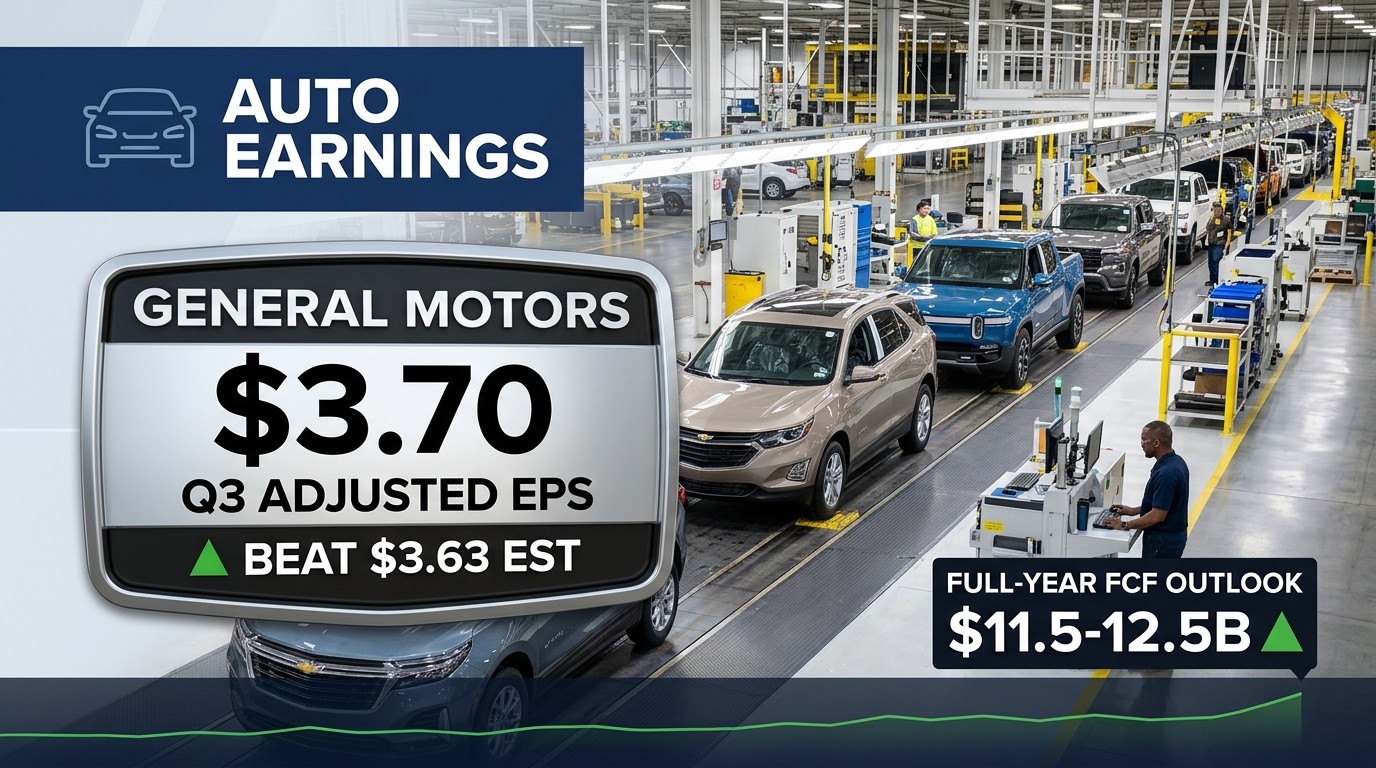
General Motors posted third-quarter 2026 results that beat expectations on both profit and sales and came with a sharper full-year cash flow forecast. Adjusted earnings were $3.70 per share against a consensus of $3.63, and revenue reached $50 billion versus the $48.76 billion analysts expected. Q3 EBIT rose 22% from a year earlier to $4.1 billion, a rate of improvement that stands out in an industry where input costs and consumer affordability remain persistent pressures.
The size of the beat is worth putting in context. The earnings surprise was about 2%, while the revenue upside of roughly $1.2 billion was closer to 2.5%. That combination suggests the quarter was driven more by volume and pricing than by one-time accounting items, although the company's own detail on mix, incentives and warranty costs will matter for judging how repeatable the performance is heading into the fourth quarter.
Management narrowed its 2026 adjusted EBIT guidance to a range of $14.5 billion to $15.5 billion, tightening the previous $14 billion to $16 billion band. Full-year EPS is guided to $12.75 to $13.75, compared with a consensus estimate of $13.41, which sits in the upper half of that range. Narrowing a range after three quarters typically signals greater visibility, though the unchanged $15 billion midpoint for EBIT means the quarterly beat did not translate into a higher profit target.
The cash flow upgrade was the clearer positive. GM raised its 2026 adjusted automotive free cash flow guidance to $11.5 billion to $12.5 billion from a prior $9.5 billion to $11.5 billion, lifting the midpoint by $1.5 billion to $12 billion. Free cash flow is the metric that funds capital spending, shareholder returns and balance sheet strength in a capital-intensive business, although how the company will deploy the extra cash was not part of the headline figures reported on Tuesday.
The report lands in a challenging macro tape. Brent crude near $110 per barrel raises gasoline prices, which can shift consumer demand away from the large trucks and sport utility vehicles that anchor Detroit profitability, while a 10-year Treasury yield near 5.12% keeps auto loan rates high. That GM still delivered a 22% EBIT increase and raised its cash flow outlook suggests pricing and cost discipline are holding, a point that will be tested if fuel prices remain elevated into the holiday selling season.
What to watch next: investors will focus on how management characterizes pricing, incentives and inventory in the fourth quarter, how fuel costs affect product mix, and whether the narrowed EBIT range leaves room for upside. The Federal Reserve is expected to hold rates on October 27 to 28, but a December hike is heavily priced in, which would weigh on auto financing affordability if borrowing costs rise further.
For portfolio positioning, GM pairs improving cash generation with a business that is highly sensitive to consumer sentiment and interest rates. Investors who already own the stock may prefer to hold through the oil volatility, while new buyers could wait for a pullback tied to broader market weakness rather than chasing an earnings gap. The shares are likely to trade on the cash flow upgrade and on any commentary about demand resilience as fuel costs climb.