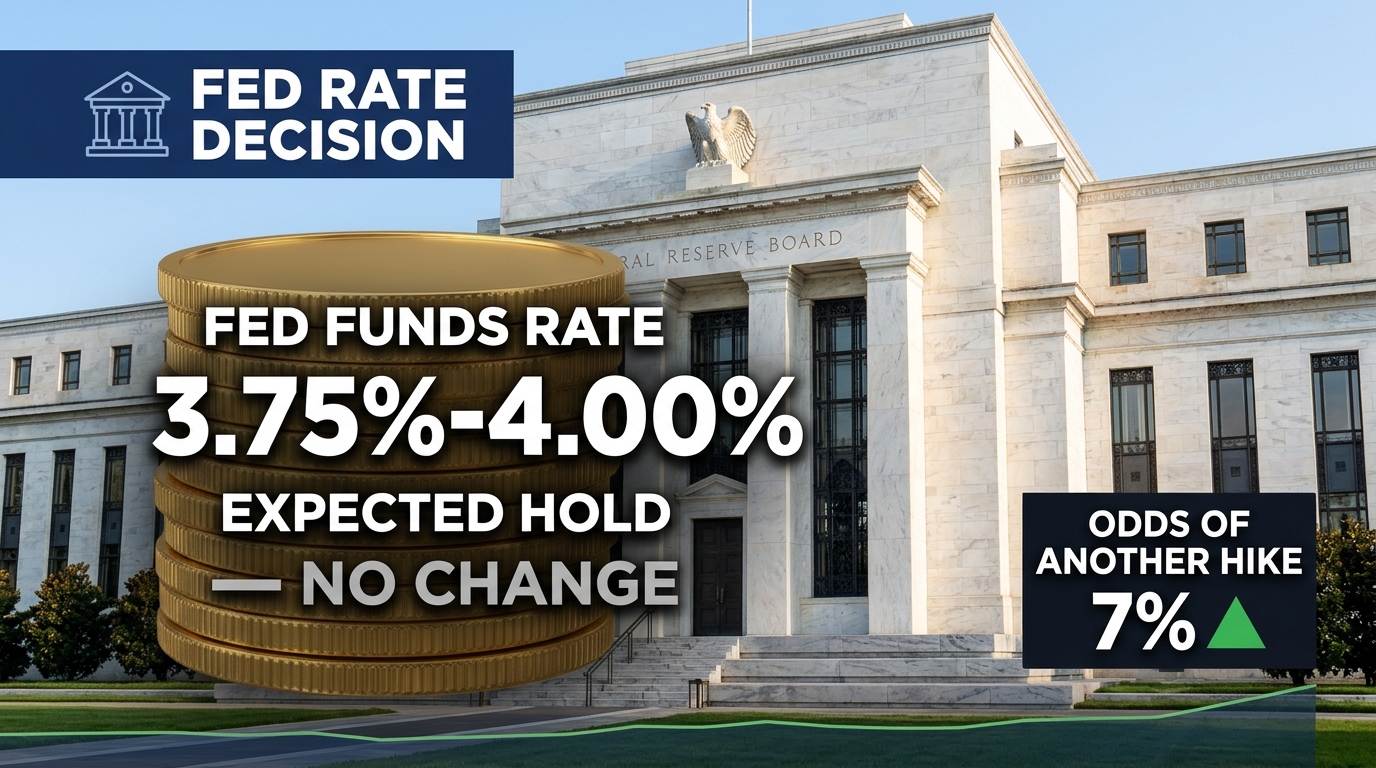
The Federal Reserve concludes its two-day policy meeting on Wednesday with a rate decision due at 2:00 p.m. ET, and investors broadly expect the central bank to leave its benchmark rate in a range of 3.75% to 4.00%. A hold would follow the 25-basis-point increase delivered on Sept. 16, the Fed's first hike since July 2023, and would shift the debate to how many more increases policymakers believe are needed to return inflation to 2%.
Market pricing reflects that consensus. Traders assign only about 7% odds to another hike this week, and wire-service previews describe a committee in wait-and-see mode, trying to judge whether inflation moderates or remains strong enough to warrant additional tightening. Hotter-than-expected inflation readings in recent weeks, however, have kept the meeting in play, according to strategists quoted in market coverage.
The tone of the statement and Chair Kevin Warsh's press conference, scheduled for 2:30 p.m. ET, may matter more than the decision itself. After September's move, Warsh said inflation had been running too high for too long and that the Fed needed to remove some accommodation. Sixteen of the 18 other officials projected at least one additional hike this year. The policy statement has also grown noticeably shorter since Warsh took over in late May, which places extra weight on his spoken remarks as a source of forward guidance.
The backdrop is delicate for equities. The S&P 500 closed Tuesday at 7,722.60 after back-to-back gains led by technology, the Nasdaq Composite rose 1.18%, and the VIX settled at 17.52. The 10-year Treasury yield is hovering just under 5%, while Brent crude has climbed above $115 a barrel after a reported missile strike on a Saudi Arabian refinery. Higher energy prices add a supply-driven inflation risk that could complicate any message of patience.
Wednesday's calendar is unusually crowded for rate-sensitive growth stocks. A power-equipment maker reported strong results before the open, and two of the largest technology companies in the world report after the close, with investors focused on artificial intelligence spending plans. That sequence means a policy signal at 2:00 p.m. will be immediately tested by earnings that bear directly on the valuation of long-duration assets.
The scenarios are straightforward. A hold with a hawkish bias, including language that keeps further hikes on the table, would likely keep yields near 5%, support the dollar and pressure high-multiple technology shares. A surprise hike, which futures treat as a low-probability event, would force a sharper repricing across equities and credit. A hold paired with data-dependent, patient language would reinforce the risk-on tone that returned this week and could extend the dip-buying that has lifted semiconductor and software names.
Politics adds another layer. The meeting comes less than a week before the midterm elections, which are focused heavily on the cost of living, so every phrase Warsh uses about inflation is likely to draw scrutiny. For traders, the 2:00 p.m. headline is the starting gun rather than the verdict: statement wording, any dissents in favor of a hike and the answers at 2:30 p.m. will set the tone for the next meeting and for positioning into next week's data.