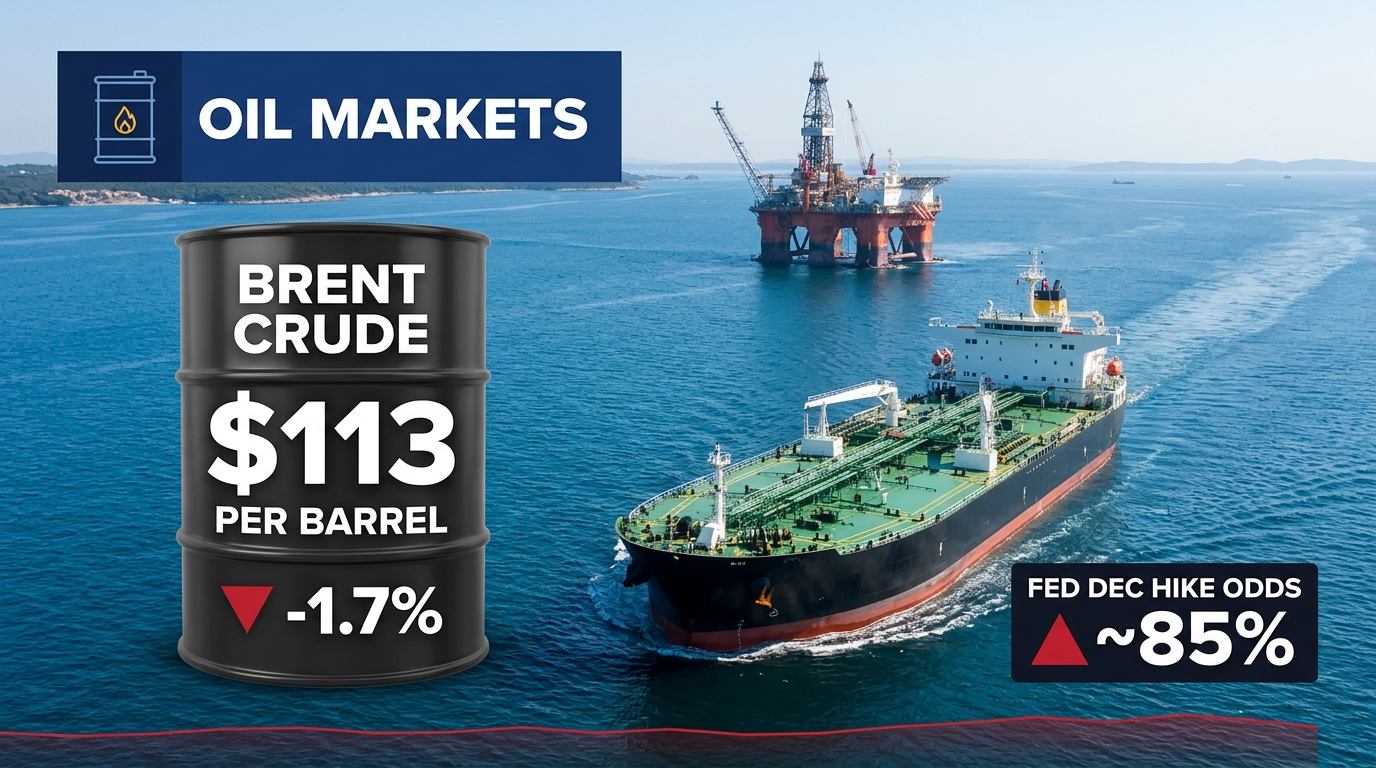
Brent crude futures slipped about 1.7% to roughly $113 per barrel on Thursday and U.S. West Texas Intermediate fell about 2.1% to around $101, as reports of renewed U.S. outreach to Tehran took some war-risk premium out of the market. The pullback is modest against the backdrop: Brent has gained more than 16% in October and sits only about $3 below the six-month high of $117.18 set on October 23.
The diplomatic signals are mixed. A U.S. media report said Vice President JD Vance contacted Mohsen Rezaei, the head of Iran's Security Council, in an effort to restart peace negotiations, but President Donald Trump has denied that talks are under way. Iran has dismissed a Qatari peace draft as unacceptable and is pressing its own seven-day plan to reopen the Strait of Hormuz, while Houthi missiles continued to strike Saudi targets. Reports that Trump is weighing a short, intense military campaign after next week's midterm elections have kept a floor under prices, although no decision has been announced.
Physical flows remain constrained. The Strait of Hormuz is effectively closed to normal commercial traffic, with the IMF's PortWatch recording just two transits on October 25 against a pre-crisis baseline of about 85 per day. Bypass routes are absorbing some of the shortfall, with Gulf crude flows reaching 11.7 million barrels per day in October versus 9.75 million in September, according to tanker-tracking data cited by analysts. U.S. commercial crude inventories fell by 1.9 million barrels in the latest weekly data, and stocks at the Cushing, Oklahoma hub declined by 624,000 barrels, both supportive for prices.
The energy shock is feeding directly into inflation and rate expectations. September consumer prices rose 3.7% from a year earlier, with gasoline up 9.1% on the month, and the September PCE inflation report due at 8:30 a.m. ET Thursday is expected to show headline inflation of about 3.6% and core inflation of 3.1%. The Federal Reserve held rates at 3.75% to 4% on Wednesday in a 10-2 vote, with two policymakers dissenting in favor of a hike, and futures pricing put the odds of a December increase near 85%. The 10-year Treasury yield is hovering around 5%, a level last seen consistently in 2007.
For equities, the oil move cuts in several directions. Energy producers and oilfield-services names benefit from prices above $100, while airlines, chemicals and consumer-discretionary companies face higher fuel and input costs. Higher oil also reinforces the bond market's inflation concerns, which pressure long-duration growth valuations at a moment when Alphabet-style earnings disappointments are already testing technology multiples. One analyst noted that a decline in WTI toward $70 per barrel would materially strengthen the case for eventual rate cuts, but WTI is currently roughly $30 above that level.
Traders may watch several markers today: whether Brent can hold below its October 23 peak, any confirmation of direct U.S.-Iran talks, shipping transit counts through Hormuz, and the 8:30 a.m. ET data on U.S. growth and inflation. Positioning around the November 3 midterm elections adds event risk, and the reported possibility of renewed military action afterward means volatility could persist well beyond this session. A broad energy exchange-traded fund offers one way to express a view on crude without single-company risk.
This article is for informational purposes only and is not investment advice.