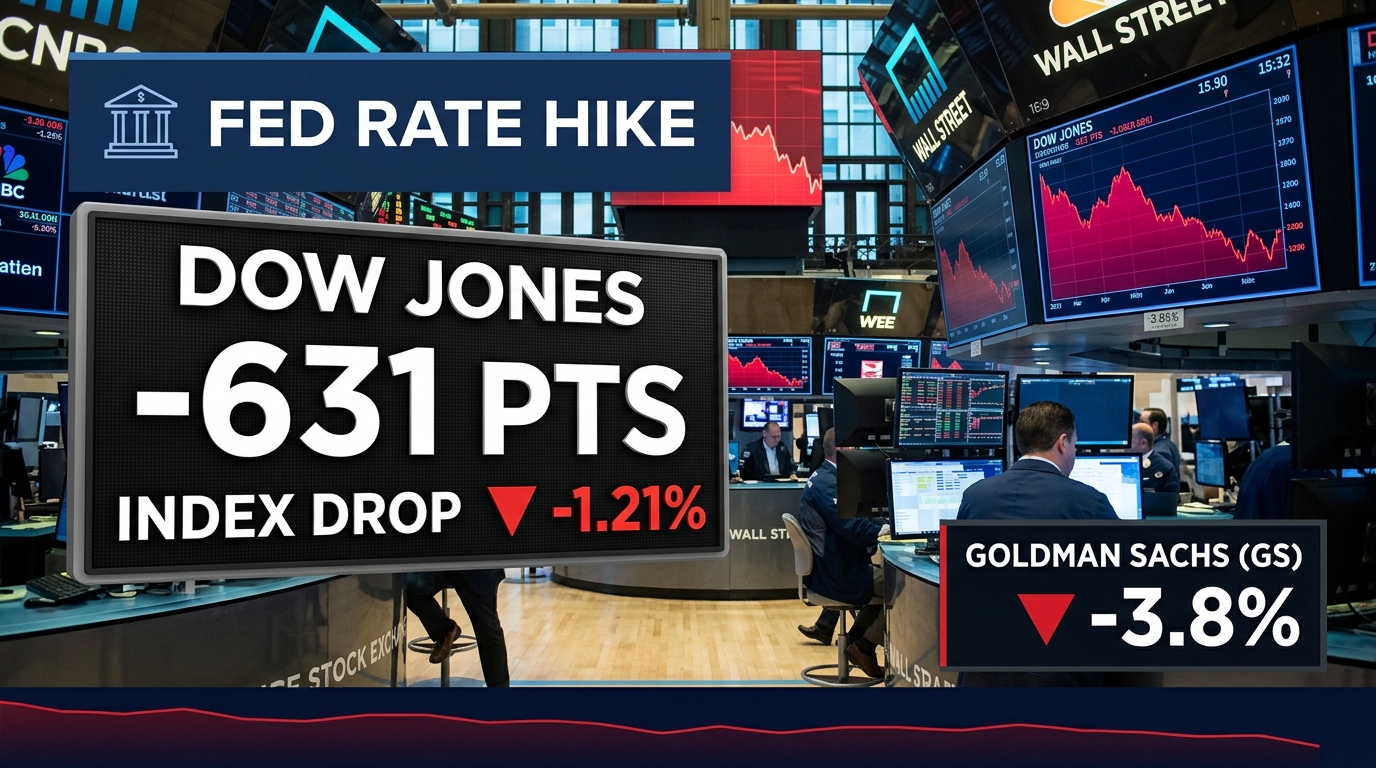
The Federal Reserve raised its benchmark federal funds rate by 25 basis points to a target range of 3.75% to 4% on Wednesday, marking the central bank's first interest rate increase in three years and confirming months of market speculation that followed Chair Kevin Warsh's hawkish remarks at the Jackson Hole symposium in late August. The decision was unanimous among voting committee members.
Equity markets initially took the widely telegraphed hike in stride, with all three major indexes trading higher heading into the 2 p.m. announcement. The selling began in earnest once Warsh took the podium for his press conference. Rather than framing the increase as a one-time adjustment, Warsh described current policy as insufficiently tight. "I would be hard pressed to describe broad financial conditions as restrictive," he told reporters, adding that the committee had simply "removed a dose of accommodation." Pressed directly on whether policy is now restrictive, he declined to answer, and he distanced himself from the Fed's own Summary of Economic Projections, which shows officials expect one additional hike this year followed by a pause through 2027. "Those aren't my forecasts," Warsh said. "Those are the forecasts of my 18 colleagues."
The market reaction was swift. The Dow Jones Industrial Average tumbled 631.21 points, or 1.21%, to close at 51,461.90, with financial shares leading the decline. Goldman Sachs fell nearly 4%, while IBM and Boeing each dropped more than 3.5% as investors repriced the odds of sustained higher borrowing costs. The S&P 500 slid 0.45% to 7,551.81 and the Nasdaq Composite finished essentially flat at 25,978.42, cushioned by resilient mega-cap technology names. The dollar index jumped 0.6% to its strongest level since late July, and the 10-year Treasury yield held near 5%, a level not touched since 2007.
Strategists were split on what comes next. "The history is clear that once the Fed begins raising rates, they do it multiple times," said Chris Zaccarelli, chief investment officer at Northlight Asset Management. Jeffrey Roach, chief economist at LPL Financial, warned in a client note that "if the economy keeps up like it has, the Fed is telling us that we may not see a cut until 2028." Not everyone agreed with the more hawkish read. Michael Pearce, chief U.S. economist at Oxford Economics, said he expects just one more increase before the Fed pauses. "We don't think this is the beginning of another major tightening cycle," he wrote, arguing markets have priced in too much additional tightening over the coming year.
By Thursday morning, sentiment had partially stabilized. U.S. equity-index futures climbed and Treasuries pared some of Wednesday's losses as Warsh's demonstrated resolve on inflation was reinterpreted by some investors as a credibility-restoring move rather than a fresh shock. The two-year Treasury yield, which is especially sensitive to near-term Fed policy, eased one basis point to 4.72% after touching its highest level since 2024 in the prior session. Fed funds futures now show traders roughly split on whether the next hike arrives as soon as the October meeting.
For portfolio positioning, the episode underscores a market still adjusting to a genuine change in the Fed's reaction function under new leadership. Rate-sensitive sectors — regional banks, homebuilders, and high-multiple growth names — remain the most exposed to further hawkish surprises, while energy and value-oriented financials with strong net interest margins may see relative support if yields stay elevated. With the Fed's dot plot still pointing to at least one more hike in 2026, investors should expect continued two-way volatility around every subsequent data print and Fed commentary through year-end.