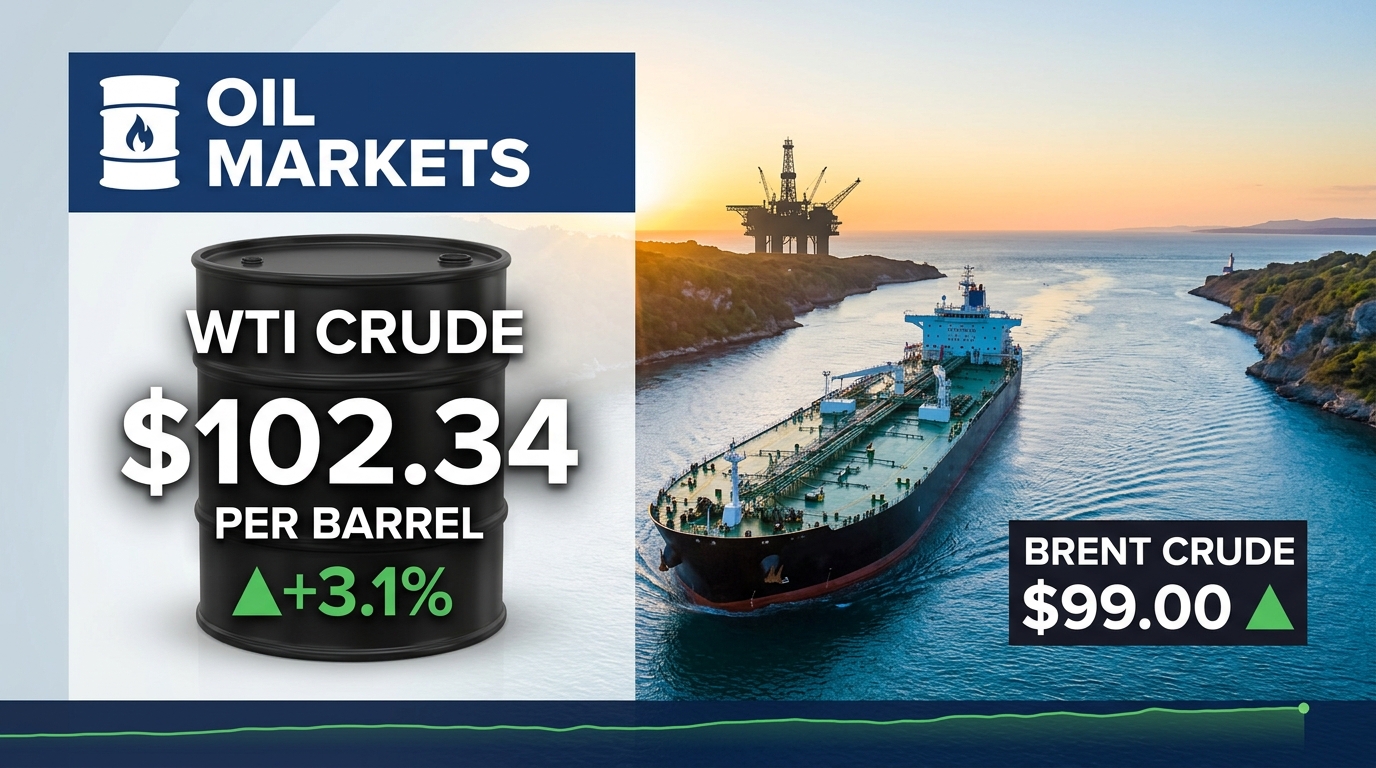
Crude oil extended its rally into Thursday, with West Texas Intermediate trading around $102.34 a barrel and Brent crude near $99, as fresh military strikes across the Middle East deepened concerns about the durability of global energy supply. The moves cap a volatile month in which WTI has swung between roughly $90 and $104 a barrel, its widest range since the early days of the conflict.
The latest leg higher traces back to an escalation between U.S. and Iranian forces, with American strikes targeting Iranian oil tankers after attacks on U.S. warships, followed by Iranian strikes near the Strait of Hormuz. Houthi forces have separately attacked Saudi energy facilities and moved to control shipping choke points near the Bab el-Mandeb Strait on Yemen's Red Sea coast, effectively threatening a second major transit route for Gulf crude. Analysts estimate Middle East shut-in production has reached roughly 6.7 million barrels per day, a level that would have seemed extreme just months ago.
"WTI did not break $100 because every Middle East barrel disappeared," one energy desk noted this week. "It broke $100 because the number of barrels that cannot reach the market keeps growing while the routes available to move the remaining supply are getting more dangerous." OPEC has compounded the uncertainty by trimming its 2026 global oil demand growth forecast for a fifth consecutive month, a signal that higher prices and slower economic activity are beginning to weigh on consumption even as supply risk dominates headlines.
For equity investors, the setup is a familiar one: higher crude prices are a tailwind for major integrated producers with exposure to both upstream production and refining margins. Exxon Mobil and Chevron, the two largest U.S.-listed oil majors, are best positioned to capture the widening war premium through higher realized prices on their production base, even as they face some offsetting pressure from higher input costs in refining and petrochemicals. Both companies have spent recent quarters emphasizing capital discipline and shareholder returns, a strategy that becomes more lucrative on a per-barrel basis as benchmark prices climb.
The knock-on effects extend well beyond the energy sector. Sustained triple-digit crude adds a fresh layer of inflation risk just as the Federal Reserve has signaled it is not done raising interest rates, complicating the central bank's path and adding to the case that borrowing costs could stay elevated well into 2027. Airlines, trucking and logistics companies, and other fuel-intensive industries face margin pressure, while consumer discretionary spending could soften if pump prices climb further heading into the fourth quarter.
Traders are watching two things closely: whether shipping through the Strait of Hormuz and the Bab el-Mandeb Strait can be sustained via escorted convoys and alternate routing, and whether diplomatic efforts can de-escalate the broader conflict before winter demand adds further strain to global balances. Until then, portfolio managers with energy exposure are likely to stay overweight the integrated majors and oilfield services names, while remaining alert to the possibility that a ceasefire or diplomatic breakthrough could unwind much of the current war premium quickly.