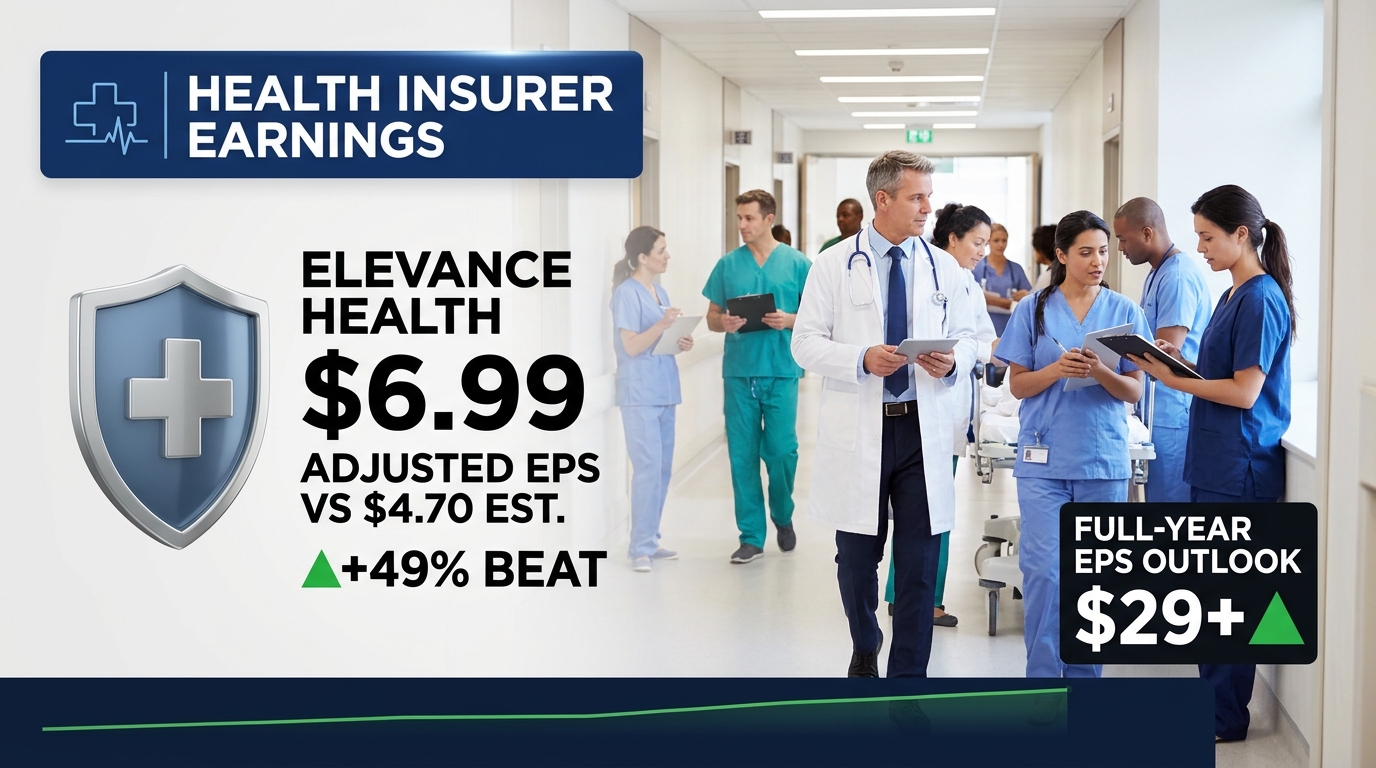
Elevance Health (ELV) reported third-quarter 2026 results that comfortably beat expectations and raised its full-year earnings floor, lifting the shares roughly 2% in premarket trading. Adjusted diluted earnings per share reached $6.99 versus a consensus estimate of $4.70, according to Investing.com.
Revenue rose 0.7% year over year to $50.4 billion. Management raised its full-year adjusted EPS outlook to at least $29.00 and lifted its operating cash flow outlook to at least $6.5 billion.
The size of the earnings beat, roughly 49% above consensus, is notable in the managed-care industry, where investors have monitored medical cost trends closely. Because revenue growth was modest, the upside versus estimates appears to have come from profitability rather than top-line expansion. Details such as the medical loss ratio, membership trends by business segment and the composition of any one-time items will determine how repeatable the quarter is. Investors should also check whether the quarter benefited from favorable prior-period reserve development.
A raised guidance floor matters as much as the quarter itself. By committing to at least $29.00 in adjusted EPS for the year, management signals confidence in the remaining months, although the phrase at least leaves room for upside and also suggests the company is keeping a measured stance. The higher cash flow outlook points to improved earnings quality, since cash generation can diverge from reported profit when accounting items shift.
Health insurers are generally less exposed to oil prices than cyclical sectors, which gives them a defensive profile when energy and interest-rate volatility dominate headlines. On Tuesday, eight of the 11 S&P 500 sectors finished lower even as the Dow Jones Industrial Average rose 1%, and Brent crude remains near $110. In that environment, a large earnings surprise from a company with predictable demand can attract rotation from investors seeking stability.
Higher interest rates add a second-order effect. Insurers hold large fixed-income portfolios, so a 10-year Treasury yield near 5.1% can influence investment income, although the impact varies by company and by portfolio duration. Rate moves also shape sentiment toward the group when investors reassess discount rates for long-dated earnings.
Analysts will focus on several items in the coming sessions: whether management explains the gap between consensus and actual results, how the guidance floor compares with the Street’s full-year estimate, and what the company says about utilization in its government and commercial business lines. Price targets may move higher, but a stock that gaps up on a large beat can also retrace if broader markets weaken.
For traders, the risk is a crowded reaction in an otherwise calm tape: the VIX closed Tuesday at 17.31, and heavy after-the-close earnings from large technology companies could redirect flows later today. Position sizing and stop discipline are advisable around any gap.
This article is for informational purposes only and does not constitute investment advice.