Capital One Financial (COF) reported third-quarter 2026 results that topped Wall Street expectations, sending the shares up roughly 3% to 4% in after-hours and premarket trading. According to CNBC, net income reached $3.5 billion, or $5.61 per share, compared with $3.2 billion, or $4.83 per share, in the same quarter a year earlier.
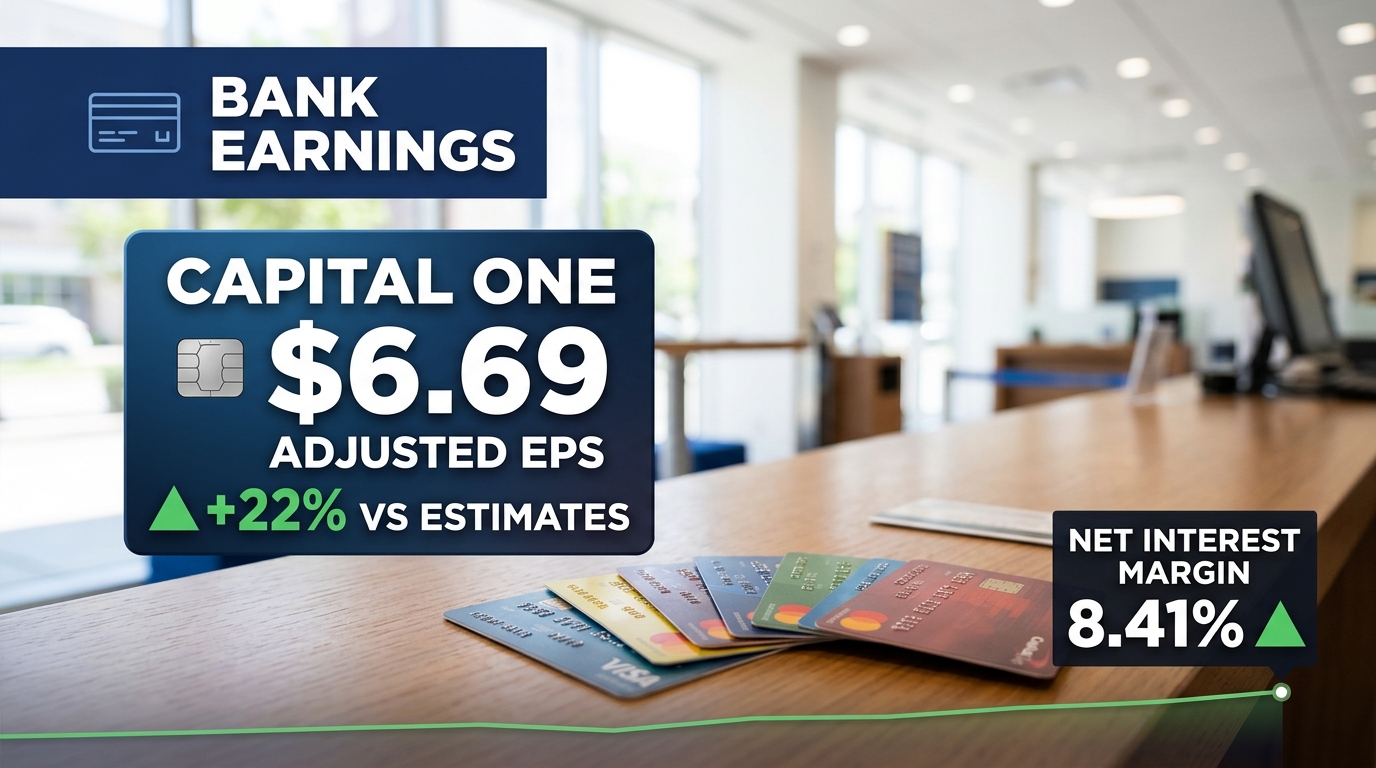
Investing.com reported adjusted earnings per share of $6.69, about 22% above analyst estimates. Net interest margin expanded 40 basis points from the prior quarter to 8.41% on higher card loan yields, while lower provisions and a $225 million loan reserve release further supported profitability.
The margin figure is the center of the story. Net interest margin measures the spread a lender earns between what it charges on loans and what it pays for funding, and for a card-focused lender such as Capital One it is driven largely by yields on revolving balances. A reading of 8.41% indicates that pricing on card loans is running well ahead of funding costs, even with the 10-year Treasury yield near 5.1%. The reserve release suggests management sees credit performance as manageable, although reserve releases can flatter earnings and are not a recurring source of income.
The report arrives during a mixed week for rate-sensitive and consumer-linked businesses. Housing starts fell 5.2% month over month, Brent crude is trading near $110 a barrel and traders are weighing the possibility of further Federal Reserve tightening. Higher-for-longer interest rates generally help lenders with high-yield loan books, but they can also strain borrowers and raise delinquency risk, which is why provisions and reserve levels draw close scrutiny from analysts.
Energy costs are another variable. Elevated fuel prices can squeeze household budgets, particularly for lower-income consumers who make up a meaningful share of card borrowers across the industry. Investors will look to management commentary on delinquency trends, charge-off rates and loan growth to judge whether the improvement in credit metrics can persist if oil stays elevated and inflation remains sticky.
Several questions will frame the stock’s reaction at the open. Analysts are likely to ask whether the 8.41% margin is sustainable or reflects temporary factors, how much of the earnings beat came from the reserve release rather than core operations, and how the company’s capital return plans fit with a volatile rate environment. A strong open followed by a fade would suggest expectations were already elevated going into the print.
For paper-trading portfolios, the setup offers exposure to a clear earnings-revision catalyst in financials, but valuation, credit-cycle sensitivity and interest-rate risk argue for careful position sizing. Traders may prefer to wait for the first hour of trading to see whether buyers defend the gap, while longer-term investors may focus on the durability of card yields and credit quality over the next several quarters.
This article is for informational purposes only and does not constitute investment advice.