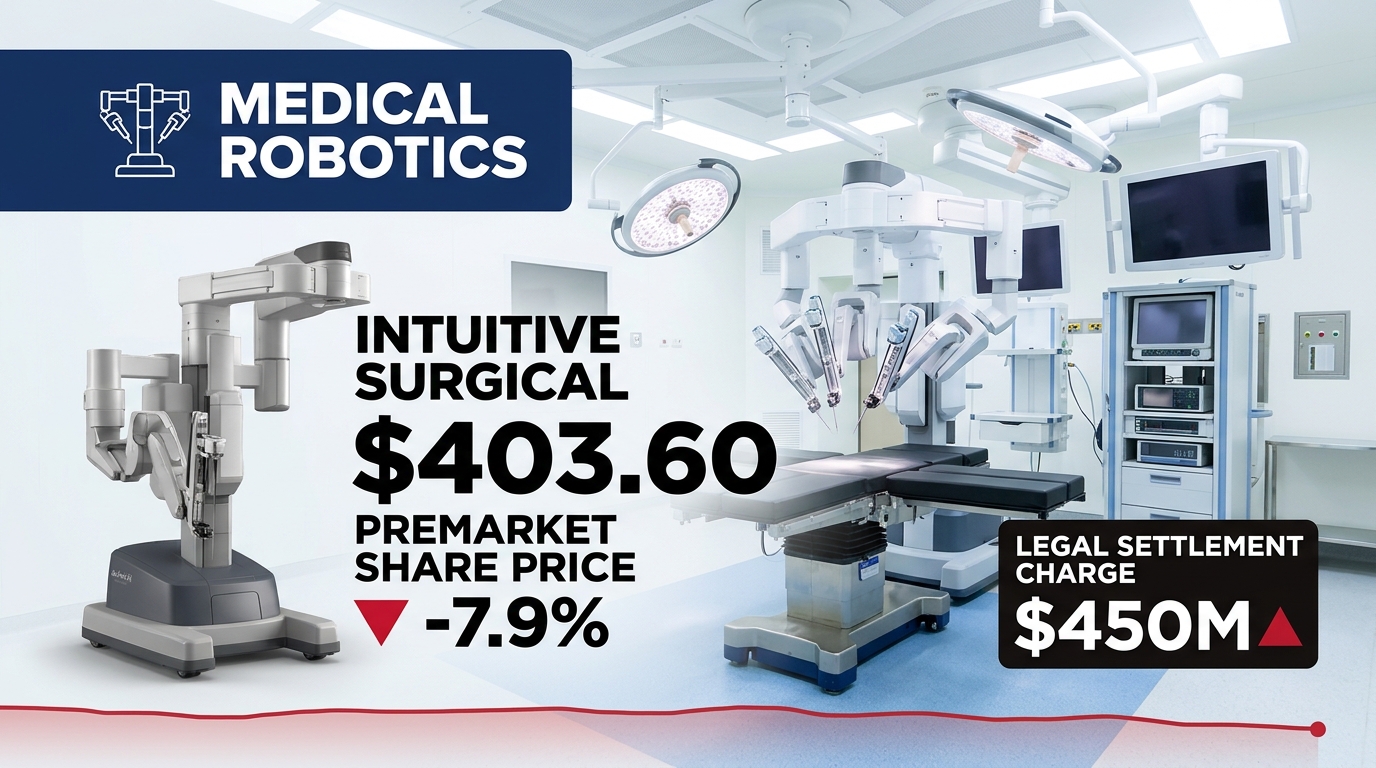
Intuitive Surgical (ISRG) reported third-quarter 2026 results that topped headline estimates, but the shares fell about 7.9% to $403.60 in premarket trading after the company disclosed a $450 million pre-tax charge tied to a legal settlement involving its da Vinci systems.
According to CNBC, adjusted earnings were $3 per share on revenue of $3.05 billion. Investing.com reported that revenue rose 22% from a year earlier. Once the charge was included, GAAP net income fell to $523 million, a gap that explains why a quarter that beat on adjusted figures still disappointed investors.
Intuitive Surgical makes the da Vinci robotic surgery platform and generates revenue from system sales, leasing, instruments and services. Growth of 22% points to continued procedure demand, but the market response shows how sensitive the stock is to anything that clouds the earnings picture. Coverage from CoinCentral described the charge as an antitrust matter.
The gap between adjusted and reported results is worth understanding. Adjusted earnings exclude items management considers unusual, such as the $450 million legal charge, while GAAP net income of $523 million reflects every cost incurred in the period. Investors often accept the adjusted view when a charge is clearly one-time, but they become skeptical when similar charges recur or when the underlying legal dispute remains unresolved.
One-time legal costs are typically excluded from adjusted earnings, which is why the non-GAAP figures looked strong. The question for investors is whether the settlement resolves the issue or whether additional litigation exposure could follow. Management commentary on legal reserves, remaining claims and any related changes to business practices will be central to assessing the risk.
The decline also reflects valuation sensitivity. Premium-multiple growth stocks can react sharply to modest disappointments, particularly when the 10-year Treasury yield sits near 5.1% and raises the discount rate applied to future earnings.
Several factors will shape the next move. Traders will watch whether the stock stabilizes near $400, how analysts adjust price targets after the call, and whether procedure growth guidance changes. A sustained recovery would signal that investors view the charge as a one-time event, while continued selling would suggest concern about the durability of margins and legal costs.
For active traders, premarket gaps of nearly 8% in large-cap names often produce wide intraday ranges. Some wait for the first 30 to 60 minutes of trading to see whether the stock holds support near $400 before entering, while others fade sharp gaps if volume dries up. Longer-term investors may instead weigh whether the quarter’s 22% revenue growth justifies treating the decline as an opportunity, keeping in mind that legal outcomes can be hard to model.
In the broader market, the session is crowded with catalysts, including large technology and semiconductor earnings after the close and continued volatility in oil markets tied to the US-Iran conflict. Brent crude is near $110, and the Dow Jones Industrial Average closed Tuesday at 52,494.88. Healthcare technology names can be affected by rotation away from growth, so position sizing matters.
This article is for informational purposes only and does not constitute investment advice.