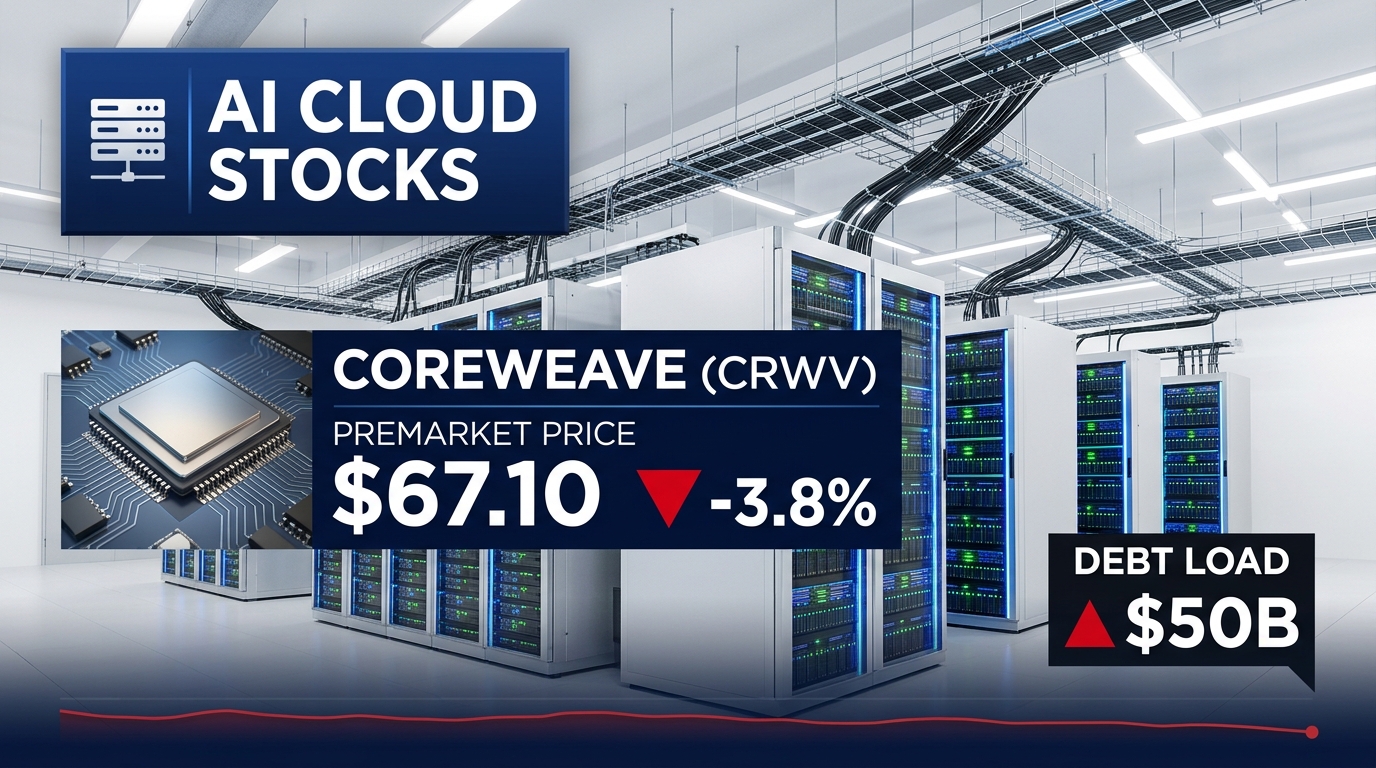
CoreWeave shares fell 3.8% to $67.10 in premarket trading on Friday as investors continued to scrutinize the AI cloud computing company's debt burden and the cost of expanding its infrastructure.
Concerns center on roughly $50 billion of debt and broader questions about whether future artificial intelligence revenue will justify the scale of current investment in data centers and computing capacity. The stock plunged more than 15% on Wednesday and swung sharply on Thursday, tumbling on fears over its debt pile before closing higher. Friday's decline came as AI-related stocks faced renewed pressure globally.
The weakness is part of a wider reassessment of AI spending. Earlier this week, South Korea's Kospi index fell 7.6% in a single overnight session as investors worried about funding for the AI build-out. In the United States, AI server makers sold off on Wednesday after a broker downgrade questioned how much of recent enterprise hardware strength reflects memory costs rather than AI demand. Global semiconductor stocks also fell on Thursday after hotter-than-expected U.S. inflation data raised concerns about the path of interest rates.
Rates are a central part of the story. The 10-year Treasury yield is near 5.09%, close to multi-year highs, and heavily indebted growth companies are particularly sensitive to higher borrowing costs. For a business financing rapid capacity expansion, higher yields increase the cost of capital and narrow the margin for error if customer demand or contract timing falls short.
Even so, the sell-off has not erased the longer-term narrative. Demand for AI computing remains a central theme across technology, and at least one Wall Street analyst has projected that infrastructure demand will outstrip supply for years. The debate is whether companies funding that build-out with leverage can sustain it if financing conditions tighten.
For traders, CoreWeave has become a high-volatility barometer for AI credit sentiment. Moves of more than 15% in a day and reversals within a single session argue for reduced position sizes and clearly defined risk. Investors should watch debt-related disclosures, any financing announcements and customer commitments, as well as Fed Chair Kevin Warsh's remarks later today, which could move yields and, in turn, high-beta technology shares.
The near-term setup is two-sided. A squeeze higher is possible given how quickly the stock reversed on Thursday, but renewed debt headlines can just as quickly erase gains. Those who are underweight the group may prefer to wait for evidence that selling pressure has exhausted, such as stable volume on down days and a pullback in yields, before adding exposure.
A stabilization in Treasury yields would help leveraged AI infrastructure names, while a further rise could prolong the pressure. With S&P 500 futures up about 0.2% but the Nasdaq Composite headed for a weekly loss of more than 2%, the market is still treating AI-linked balance sheets as the key risk to monitor.