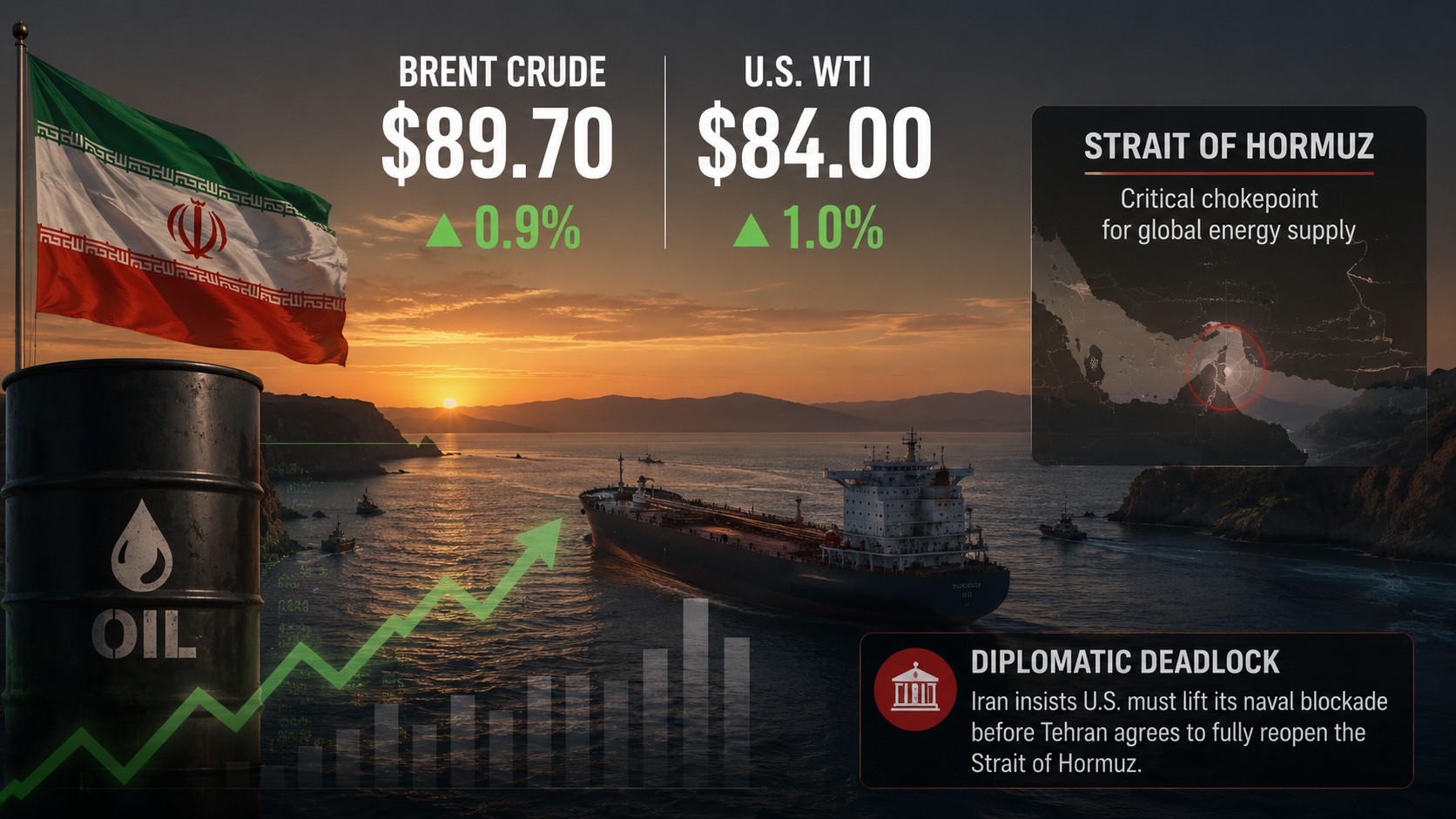
Crude oil prices extended their advance Wednesday, with Brent crude futures rising 0.9% to $89.70 a barrel and U.S. West Texas Intermediate gaining 1% to $84, as hopes faded for a near-term diplomatic breakthrough that would fully reopen the Strait of Hormuz to commercial shipping traffic. Both benchmarks had already settled more than $1 higher in Tuesday's session, marking their highest closing levels since July 31.
The persistent gains reflect deepening market anxiety over the strategic waterway, through which a significant share of the world's seaborne oil and petroleum products normally transits. Iran's Foreign Ministry has repeatedly insisted that Washington must lift its naval blockade before Tehran will agree to fully restore normal ship traffic, a precondition the United States has so far resisted. Ship transits through Hormuz have remained a fraction of pre-conflict levels, with U.S. Energy Secretary Chris Wright saying this week that oil exports through the strait have reached only a seven-day moving average of roughly 9 million barrels per day under U.S. military escort, well below historical norms.
The U.S. Energy Information Administration has projected that Middle East supply disruptions of around 600,000 barrels per day could persist through the end of 2027, a forecast that underscores how geopolitical risk premiums embedded in crude prices may prove more durable than markets initially expected when the conflict began. Some analysts at OilPrice.com have floated the possibility of Brent testing the $100 mark if Iranian loadings continue to approach zero and Tehran moves to halt Hormuz transits entirely.
Diplomatic signals have remained contradictory in recent days. Pakistan's Defense Minister suggested this week that the U.S. and Iran were 'close to some sort of arrangement,' and separate talks between Iran and Oman over restoring maritime traffic were described as being at an advanced stage by a Qatari Foreign Ministry spokesperson. Those comments briefly pulled prices off their highs earlier in the week, but renewed hardline rhetoric from both Washington and Tehran, including U.S. demands for Iranian reparations tied to regional conflicts, has since reasserted upward pressure on crude.
For equity investors, the sustained rise in energy prices carries implications well beyond the oil patch. Higher crude costs feed directly into transportation, shipping, and manufacturing input expenses, and could complicate the Federal Reserve's inflation outlook just as Wednesday's CPI report showed price pressures holding steady rather than continuing to cool. Energy-sector equities have outperformed the broader market in recent sessions as a result, while airlines and other fuel-sensitive industries have lagged.
Traders are likely to remain highly reactive to headlines out of the Gulf region in the sessions ahead, with any confirmed diplomatic breakthrough carrying the potential to unwind a meaningful share of the risk premium built into current prices, and any further military escalation carrying the opposite risk. For now, the market's baseline assumption appears to be that disruption, not resolution, is the more probable near-term outcome.