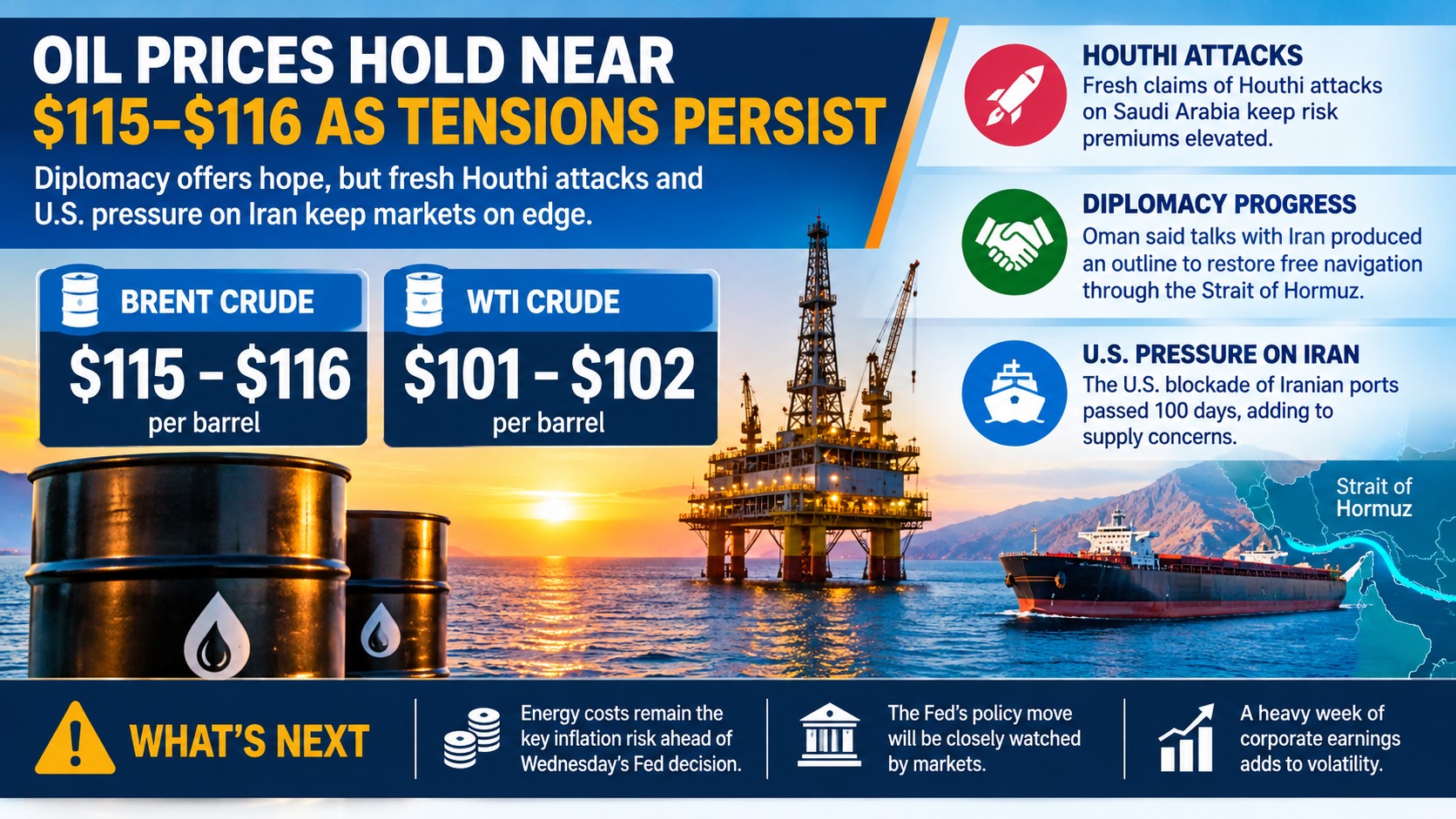
Oil prices swung in both directions on Tuesday as traders balanced a flurry of diplomacy in the Middle East against fresh attack claims on Saudi Arabia, leaving crude well above $100 a barrel. Benchmark Brent futures rose 0.5% to $116.38 in early trading, according to Investing.com, while West Texas Intermediate gained 0.6% to $102.35. Later reports showed December Brent down 0.8% at $114.93 and December WTI down 0.9% at $100.90, according to the Wall Street Journal. Last week Brent touched six-month highs on fears of attacks on energy sites and commercial shipping.
The swings reflect a market trying to price two opposing outcomes. On Monday, senior officials from Saudi Arabia, Turkey and Pakistan met Iranian leaders in Tehran, and a joint statement said the four countries agreed to continue talks on regional peace and security. Saudi Arabia’s Foreign Ministry said the visit aimed to reduce tensions and support mediation by Qatar and Pakistan. Oman separately said its discussions with Iran produced an outline for a temporary arrangement to restore free navigation through the Strait of Hormuz, though it would require compromises from both Washington and Tehran.
Against that, Houthi forces said on Monday they attacked pumping stations on Saudi Arabia’s East-West crude pipeline as well as Riyadh airport. Saudi authorities had not immediately confirmed those claims, though the Saudi-led coalition said it intercepted a ballistic missile launched toward Riyadh and destroyed four missile launchers and five storage tunnels in Yemen. The East-West pipeline matters because it lets Saudi Arabia export crude without relying on the Strait of Hormuz.
The U.S. position remains unresolved. President Donald Trump has left open the possibility of more military action against Iran, while Tehran has said talks with Washington would require an end to the U.S. blockade and the lifting of sanctions on Iranian oil exports. Analysts at Capital Economics said the blockade, now in place for more than 100 days, is hurting Iran’s economy, with the rial weaker and inflation close to 90% a year.
The longer-term message from the International Energy Agency was equally cautious. Executive Director Fatih Birol said on Monday that energy markets are unlikely to return to pre-war conditions in 2027, reinforcing the view that supply risk is not a short-lived phenomenon.
For U.S. markets, the transmission channels are straightforward. Elevated crude supports energy producers but raises costs for airlines, transportation and consumer-facing companies, and it feeds the inflation data the Federal Reserve is weighing this week. With the Fed deciding on Wednesday and futures pricing only about 10% odds of a rate hike, a sustained push higher in crude could change that conversation quickly.
Traders should expect headline-driven volatility rather than a clean trend. A confirmed Hormuz arrangement could pull prices down by several dollars in a single session, while a successful strike on Saudi export infrastructure could send them sharply higher. Position sizing and stop discipline matter more than conviction until a durable agreement emerges, and energy exposure is best treated as a hedge against geopolitical tail risk rather than a one-way bet.