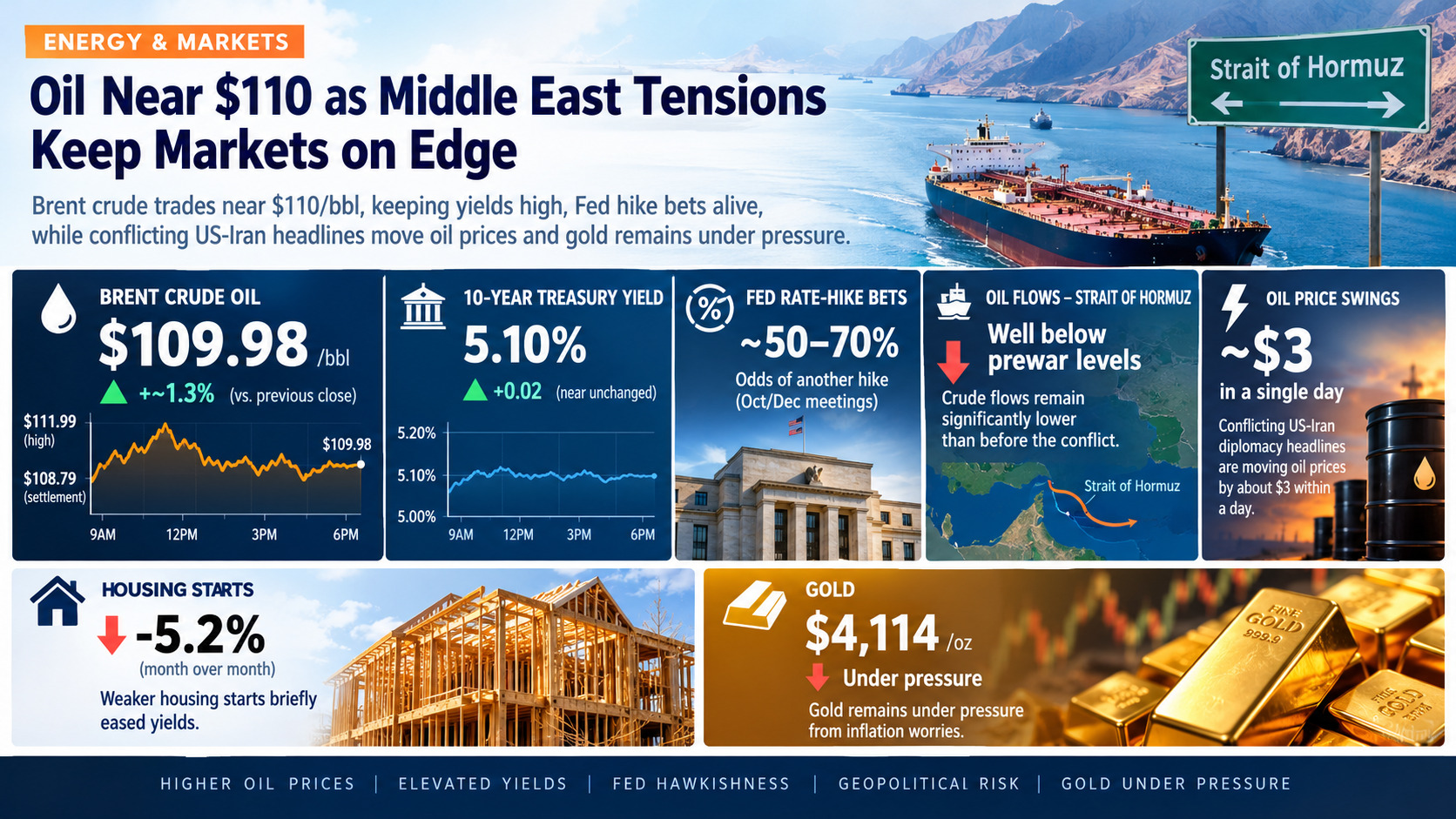
Oil prices are swinging on diplomatic headlines in the US-Iran conflict, with Brent crude trading near $110 a barrel early Wednesday after touching a five-month high of $111.99 on Tuesday and settling at $108.79. U.S. West Texas Intermediate was around $98.60 to $99.50. Tuesday’s reversal followed reports that Pakistan’s army chief met senior Iranian officials in Tehran to discuss mediation, but a diplomat involved dismissed suggestions that a deal was imminent.
Physical supply risks have not gone away. Crude shipments through the Strait of Hormuz remain substantially below prewar levels, according to Kitco’s market report, and Tuesday’s spike was driven by reports of tanker attacks, a mine strike near Hormuz and claims by Houthi forces against Saudi sites. Iran’s first vice president said Monday that the country has no choice but to assert control over Hormuz, according to state media cited by Bloomberg. The weekly U.S. petroleum inventory report arrives at 10:30 a.m. Eastern.
Higher energy prices feed straight into the rates debate. The 10-year Treasury yield slipped about 1.9 basis points to 5.116% on Tuesday as weak housing data and lower crude helped bonds, but it remains near the highest levels since 2007. Markets continue to weigh the possibility of additional Federal Reserve tightening, and U.S. housing starts showed a 5.2% monthly decline, according to NordFX. A 20-year Treasury auction is scheduled for 1 p.m. Eastern, a test of demand for long-dated debt.
Wall Street finished Tuesday mostly higher. The Dow Jones Industrial Average gained 1% to 52,494.88, the S&P 500 rose 0.3% to 7,712.57 and the Nasdaq Composite slipped 0.02% to 26,424.82, according to Zacks. Eight of the 11 S&P 500 sectors ended lower, and the VIX fell 6.1% to 17.31. S&P 500 futures were up about 0.1% early Wednesday.
Overseas markets were mixed. Japan’s Nikkei 225 rose about 1.15%, led by chip stocks, even as the country’s September trade deficit of 536.6 billion yen was far wider than the 181 billion yen expected. South Korea’s KOSPI rebounded 2.8%, Hong Kong’s Hang Seng slipped 0.4% and Australia’s ASX 200 gained 0.2% after a Reserve Bank of Australia official said the inflation outlook looks worse than forecast, putting a November hike in play. UK and Canadian inflation data are also due today.
Gold has fallen for a fourth straight session to about $4,114, roughly 26% below its January record, as higher yields and rate-hike expectations outweigh haven demand, according to Invezz and TradingKey. Analysts cited in those reports see $4,100 as key support. The dollar index is near 101.5, close to a three-week low.
For portfolio positioning, the oil-yield link is the key variable. Energy producers and refiners tend to benefit from sustained crude strength, while rate-sensitive groups such as homebuilders, small caps and long-duration growth stocks face pressure if the 10-year yield pushes higher. A diplomatic breakthrough would likely reverse that pattern quickly, which is why Tuesday’s intraday swing of roughly $3 matters. Traders should size positions for headline risk, particularly ahead of heavy after-the-close earnings from large technology and semiconductor companies.
This article is for informational purposes only and does not constitute investment advice.