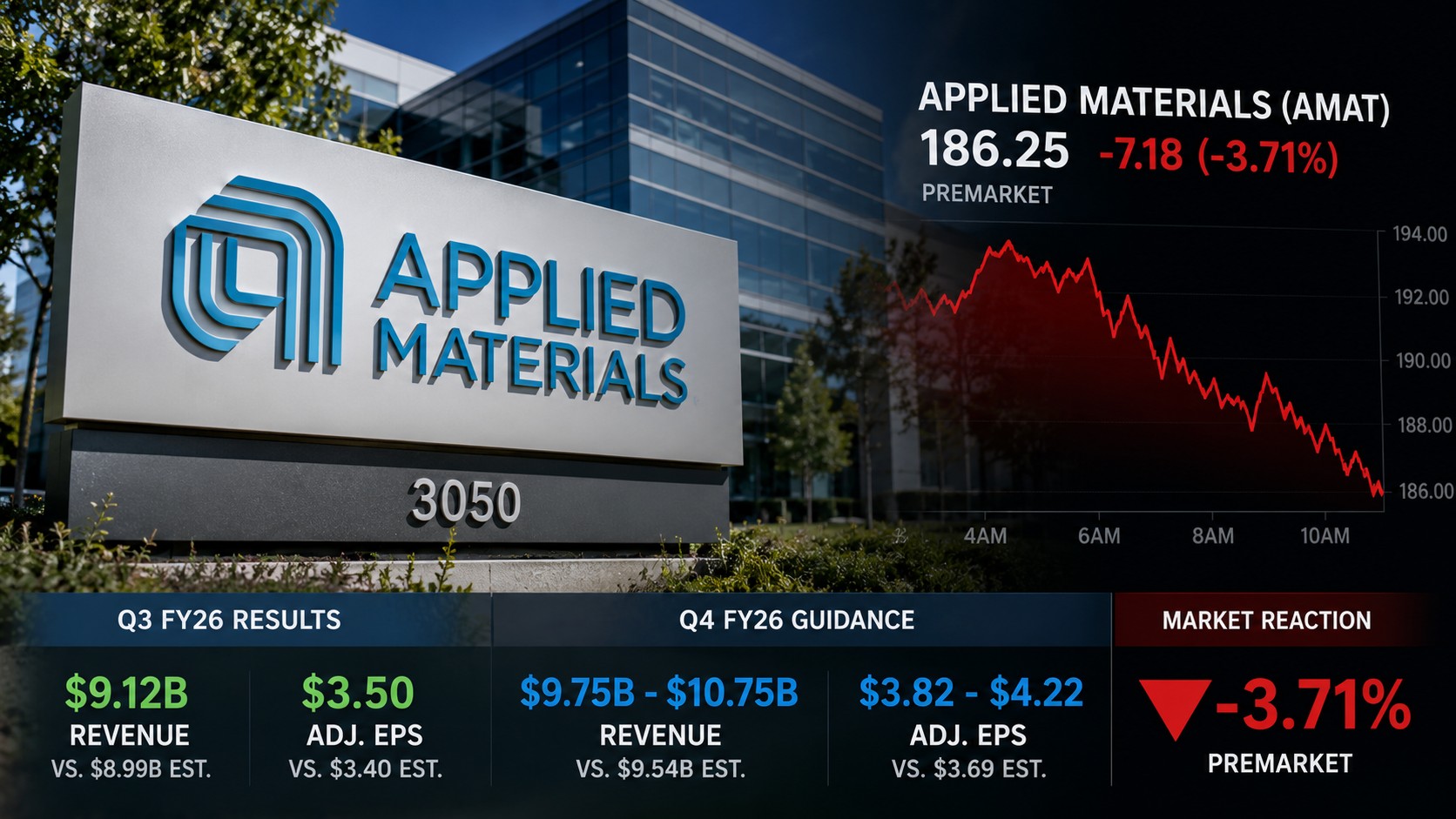
Applied Materials reported fiscal third-quarter revenue of $9.12 billion, ahead of the $8.99 billion Wall Street had expected, with adjusted earnings per share of $3.50 topping the $3.40 consensus estimate. The semiconductor equipment maker's adjusted gross margin came in at 50.4%, while adjusted operating income totaled $2.67 billion.
Despite the headline beat, adjusted operating income of $2.67 billion fell short of the $3.03 billion analysts had modeled, and adjusted operating margin of 34.0% pointed to some cost pressure even as revenue climbed. Adjusted free cash flow for the quarter came in at $2.33 billion.
Looking ahead, Applied Materials guided fourth-quarter revenue to a range of $9.75 billion to $10.75 billion, comfortably above the $9.542 billion Wall Street consensus. The company also projected adjusted earnings per share of $3.82 to $4.22 for the current quarter, topping the $3.69 analysts had penciled in.
Shares of the chip-equipment maker fell in premarket trading Friday even as the guidance topped expectations, a reaction traders attributed to the margin shortfall relative to estimates and lingering questions about the pace of capital spending among chipmaking customers. The stock's decline stood out against a broader semiconductor sector that has otherwise been a leading beneficiary of the artificial intelligence buildout this year.
Applied Materials is one of the largest suppliers of equipment used to manufacture semiconductors, selling tools used in deposition, etching and other steps of chip fabrication to customers including major foundries and memory makers. Its results are closely watched as a proxy for capital spending trends across the broader chip industry, since equipment orders often signal how aggressively manufacturers plan to expand production capacity in coming quarters.
The report comes during a busy week for chip-sector news. Peer equipment maker Lam Research separately said it intends to invest more than $3 billion over the next five years to expand its global research and development lab network, a move the company said would increase its experiment capacity by more than 50% as it seeks to keep pace with customer demand tied to advanced logic and memory chips.
Analysts have generally maintained a constructive stance on the semiconductor capital equipment sector this year, citing robust demand tied to artificial intelligence infrastructure buildouts at hyperscale cloud providers. Applied Materials' better-than-expected guidance suggests that demand trend remains intact even as the company navigates near-term margin pressure, though the market's initial reaction Friday suggests investors want more clarity on the drivers behind the operating income miss before fully re-rating the stock higher.
For investors, the divergence between Applied Materials' upbeat guidance and its initial stock decline underscores how selective the market has become this earnings season, rewarding not just top-line beats but consistent margin execution. With the stock giving back gains despite better-than-expected numbers, some analysts framed Friday's move as a buying opportunity for long-term investors betting that AI-related equipment demand continues to accelerate into 2027.