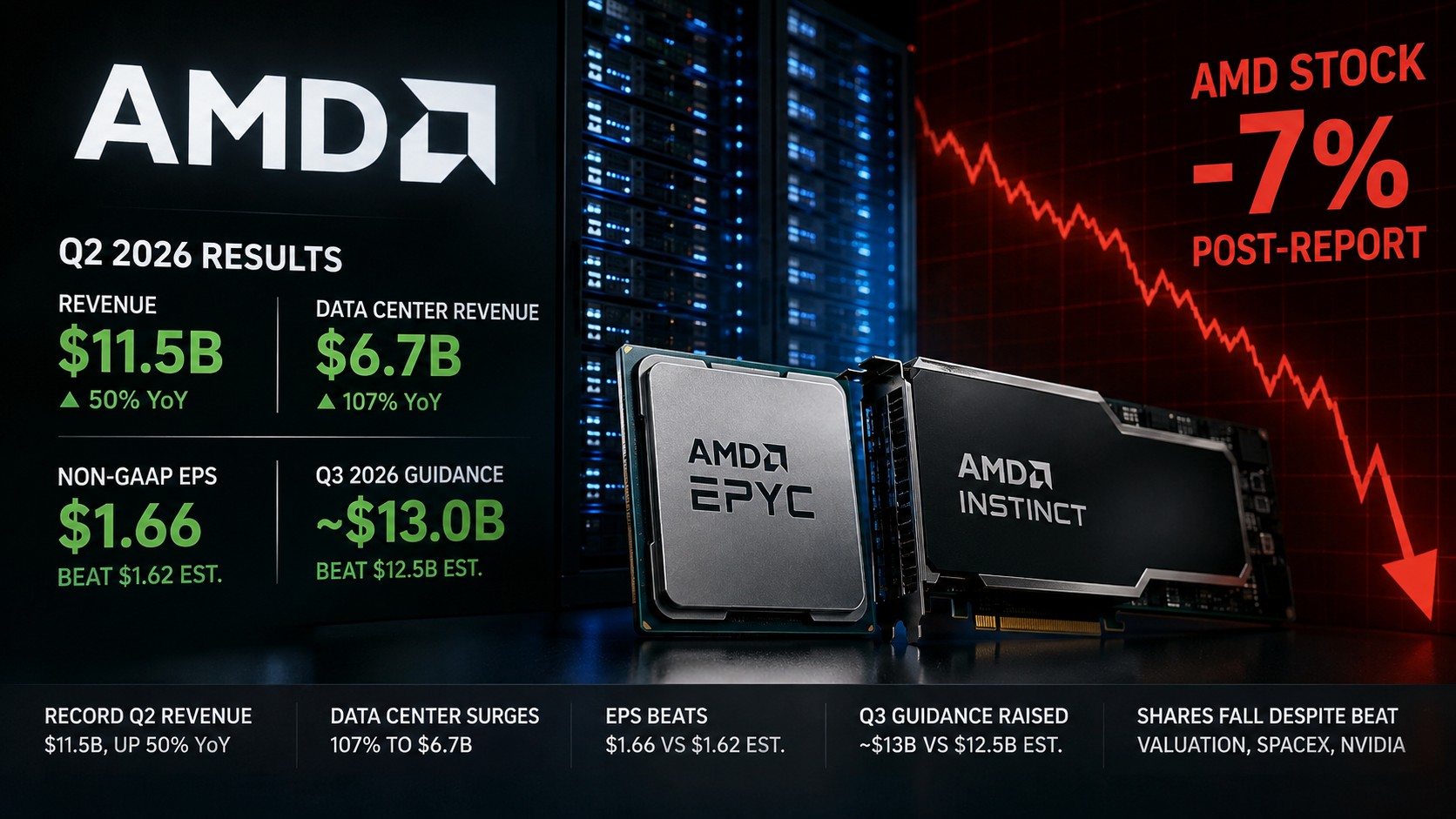
Advanced Micro Devices delivered the strongest quarter in its history last week, reporting second-quarter 2026 revenue of $11.536 billion — up 50% year-over-year and 13% sequentially — with data center revenue more than doubling to $6.718 billion, accounting for 58% of total company sales. CEO Lisa Su said AMD was entering the second half of 2026 with "strong momentum as EPYC demand accelerates, Instinct deployments scale and Helios begins to ramp." Non-GAAP earnings per share of $1.66 beat the $1.62 consensus, and non-GAAP gross margin expanded to 56%, up more than 200 basis points year-over-year.
The data center segment was the defining story of the quarter. EPYC server CPU adoption continued to take market share from Intel across major cloud deployments, while Instinct GPU shipments accelerated into AI training and inference workloads at hyperscalers and enterprise customers. Su also disclosed that AMD has expanded its technology footprint through the Mexico Export Technology program and announced a customer deployment ceiling for Anthropic, which uses Instinct GPUs as part of its model training infrastructure.
Third-quarter guidance was similarly constructive: AMD guided for revenue of approximately $13 billion, plus or minus $300 million, implying 41% year-over-year growth at the midpoint — a figure that surpassed the $12.5 billion analyst consensus and reinforced the view that the data center segment will continue accelerating in the second half. CFO Jean Hu said AMD expects data center sales growth to accelerate in H2 2026. Looking further out, AMD guided for data center revenue to more than double year-over-year in 2027, with server CPU revenue projected to grow over 70% and data center AI revenue to grow well over 100%.
Despite all of this, the stock's post-earnings reaction was negative. Shares surged approximately 7% on the initial print but fell back roughly 7% the following session, consolidating in the $480s to $490s as investors weighed several headwinds: elevated valuation multiples after a strong year-to-date run; a parallel news item that SpaceX selected Nvidia as its exclusive AI hardware supplier — a high-profile win for Nvidia that highlighted the ongoing competitive gap in the highest-margin segment of the AI accelerator market; and ongoing scrutiny of AMD's operating expenses, which have grown faster than revenue.
The gaming segment remained a clear weak point, declining 31% year-over-year to $779 million due to lower semi-custom demand at this stage of the console cycle. Embedded returned to growth at 19% year-over-year to $977 million. Inventory rose sequentially to approximately $8.5 billion, and cash and investments stood at $13.1 billion at quarter-end. Analysts at TradingKey note the stock is now forming a symmetrical triangle, with $470 representing support and $503 resistance — a technical setup that suggests a directional decision point is approaching.
For investors with a $100,000 portfolio deploying capital today, AMD represents a classic beat-and-raise at a pullback price. The $13 billion Q3 guide and the multiyear AI data center acceleration thesis are intact. The risk is that Nvidia's SpaceX win reinforces a market perception that AMD remains the structural second choice for the most demanding AI workloads — a perception that can cap the multiple even when the underlying business is compounding at 50% annually.