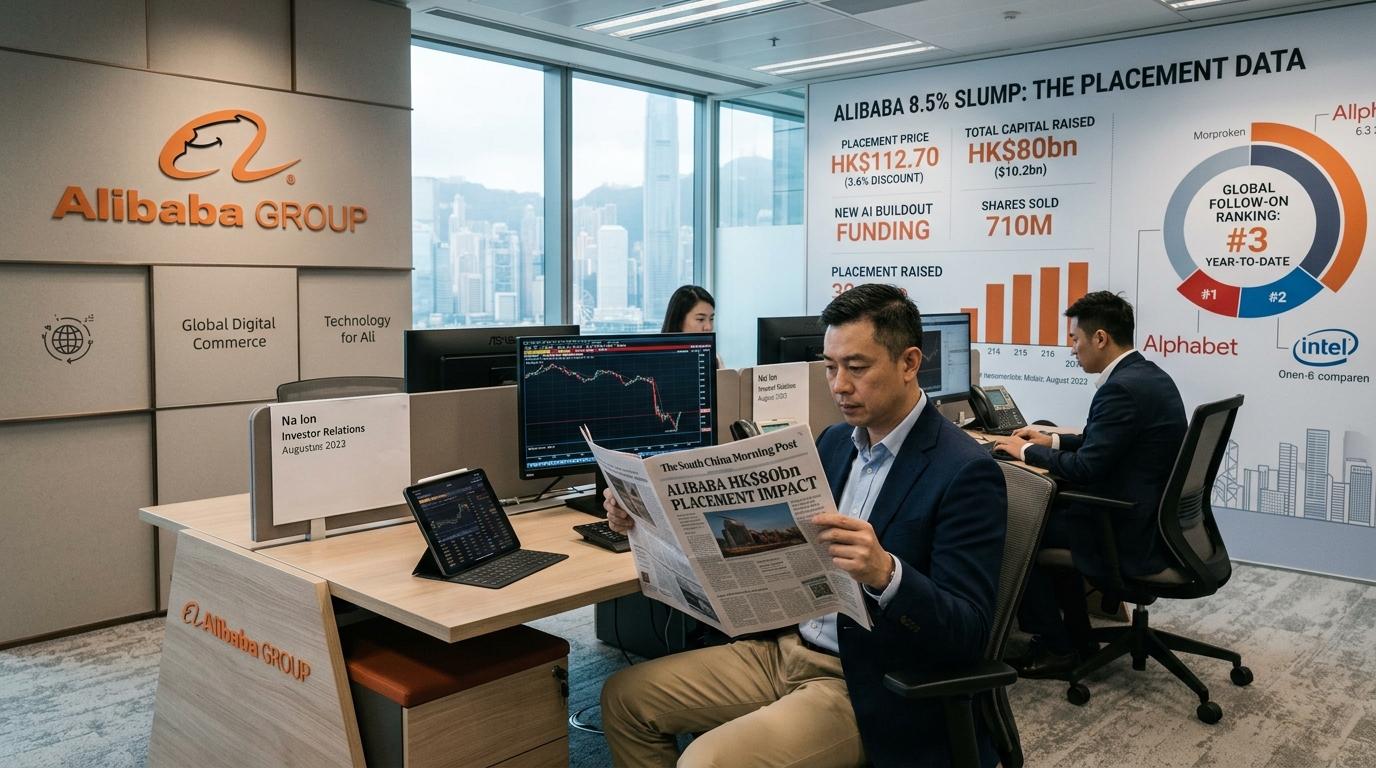
Shares of Alibaba fell 8.5% Monday, their steepest single-day decline since early 2025, after the Chinese e-commerce and cloud computing giant priced a HK$80 billion ($10.2 billion) share placement to fund its artificial intelligence expansion. The stock's U.S.-listed shares led losses across the broader Asian tech sector as investors weighed the dilutive impact of the fundraising.
Alibaba sold 710 million newly issued ordinary shares at HK$112.70 apiece, a 3.6% discount to the stock's Friday close, in what ranks as the largest-ever primary follow-on offering by a Hong Kong-listed company. The deal is expected to close on August 26, subject to customary closing conditions. Globally, it is the third-largest primary follow-on share sale of the year, trailing only offerings from Alphabet and Intel.
The company said it intends to use 100% of the net proceeds from the placement to invest in its "full stack" artificial intelligence capabilities, a category spanning chips, data-center infrastructure and the development and deployment of AI models. Alibaba has been racing to keep pace with domestic and international rivals in AI infrastructure spending, a category in which the four largest U.S. hyperscalers, Microsoft, Amazon, Alphabet and Meta Platforms, are together expected to spend roughly $725 billion in capital expenditures this year, according to industry estimates.
Despite the stock's sharp drop, bankers on the deal said institutional demand for the offering was strong, with orders reportedly totaling almost three times the shares on offer, even though the placement was priced at a discount to the prior close. The strong demand suggests investors remain willing to back Alibaba's AI ambitions even as the near-term dilution weighed on the share price.
Alibaba's fundraising lands amid a broader selloff in Asian technology and memory-chip shares Monday. South Korea's Kospi index, viewed as a bellwether for the AI trade, fell 1.4%, with Samsung Electronics sliding more than 5% after its own capital-return announcement disappointed investors. Shares of memory chipmakers, including SK Hynix and Micron, also traded lower in overnight trading as the sector digested a wave of capital-raising and capacity-expansion announcements.
The scale of Alibaba's raise underscores how aggressively Chinese technology companies are moving to compete in artificial intelligence infrastructure, even as they face financing constraints not shared by their better-capitalized U.S. counterparts. Alibaba has previously signaled ambitious AI infrastructure spending plans, and the new capital is expected to accelerate build-out of chips and data-center capacity central to its cloud computing and AI model businesses.
The deal also highlights Hong Kong's resurgence as a fundraising hub for Chinese technology companies, following a wave of large listings and follow-on offerings this year as firms look to tap public markets for capital to fund AI investment rather than relying solely on debt or private financing.
Investors will be watching how Alibaba deploys the new capital in the coming quarters, as well as whether the equity raise signals further fundraising activity across the sector as Chinese technology companies compete for AI leadership against deep-pocketed U.S. rivals with far greater access to capital markets.