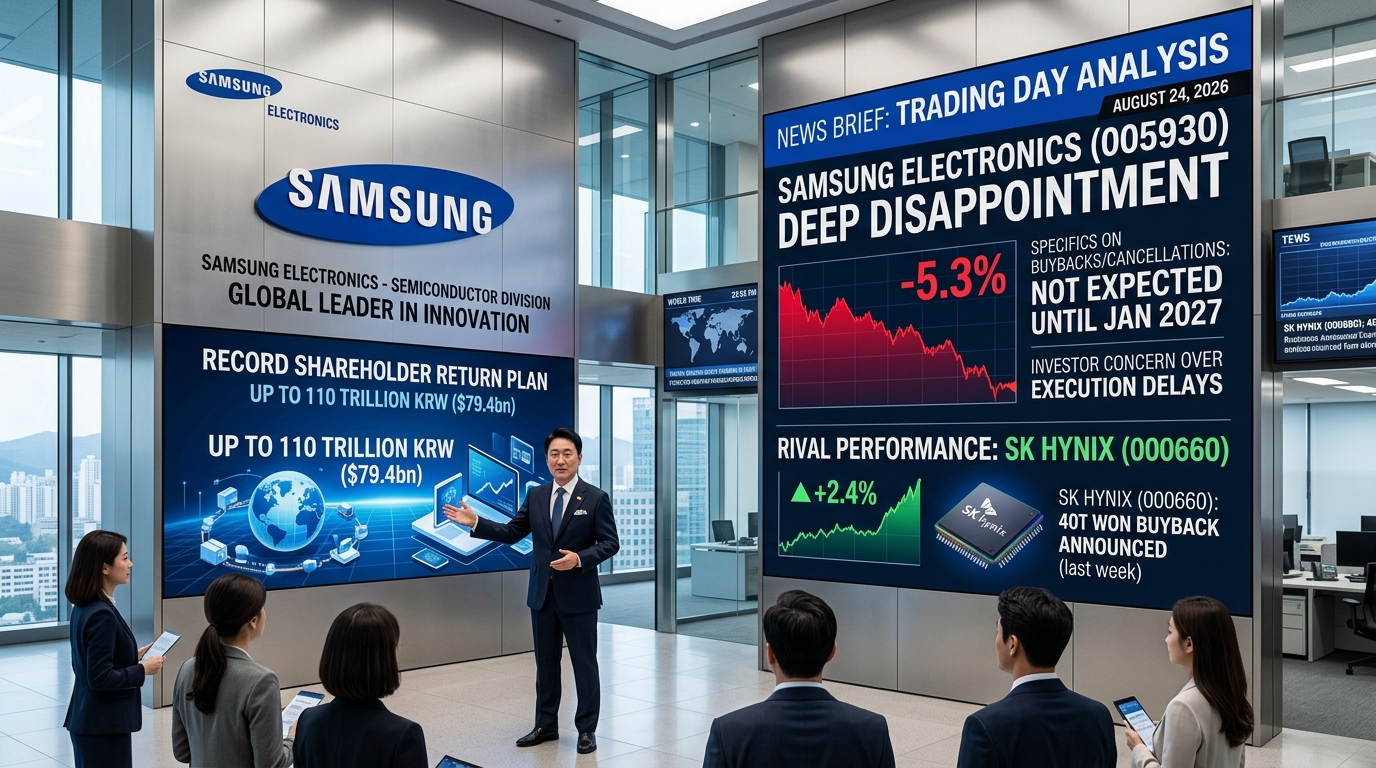
Shares of Samsung Electronics fell more than 5% in early trading Monday, even after the world's largest memory-chip maker unveiled the biggest shareholder return program in South Korean corporate history. The stock was down 5.2% by mid-morning in Seoul, while the benchmark Kospi index slipped 0.7%.
Samsung's board approved a plan late Friday to return between 90 trillion and 110 trillion won, or roughly $65 billion to $79.4 billion, to shareholders in 2026, more than five times its previous record of 20.3 trillion won set in 2020. The company said about 30 trillion won will go out as cash dividends in the third quarter, including its regular quarterly payout, equivalent to roughly 5,000 won per share, more than 13 times the second-quarter dividend of 374 won.
Samsung's board separately approved a share purchase of about 15 trillion won intended for employee compensation, with the company set to buy 53,285,968 common shares on the open market between August 24 and November 21. Crucially, those shares are earmarked for performance incentives rather than cancellation, meaning the purchase should not be read as a direct reduction in Samsung's outstanding share count.
The lack of a specific buyback-and-cancellation plan appears to be the primary source of investor disappointment. Samsung said the method and timing for returning the remainder of the targeted amount will be determined at a board meeting in January 2027, once full-year 2026 results are finalized. Some analysts, including those at KB Securities, had estimated Samsung's shareholder returns could reach as much as 200 trillion won, well above the announced range.
The muted reaction stood in sharp contrast to the market's response to SK Hynix's announcement the prior week. SK Hynix disclosed on August 19 a 40 trillion won, or roughly $28.6 billion, buyback-and-cancellation program, specifying it would repurchase about 24.07 million shares, or roughly 3.3% of shares outstanding, and cancel all of them. SK Hynix shares rose 2.4% Monday, extending gains as investors rewarded the clarity and directness of its capital-return commitment.
"The key question for investors will now be how the remaining capital is returned, rather than just the headline amount," said Jung In Yun, chief executive of Fibonacci Asset Management Global, noting the market's focus would shift to the eventual split between buybacks and special dividends.
The divergence between the two chipmakers' stock reactions underscores how South Korean investors, after a blockbuster week of AI-fueled profit announcements from both companies, are prioritizing concrete capital-return mechanics over headline dollar figures. Samsung's shares remain up sharply for the year, having roughly doubled amid the broader rally in AI-linked memory chip demand, giving the company room to absorb Monday's pullback without erasing its 2026 gains.