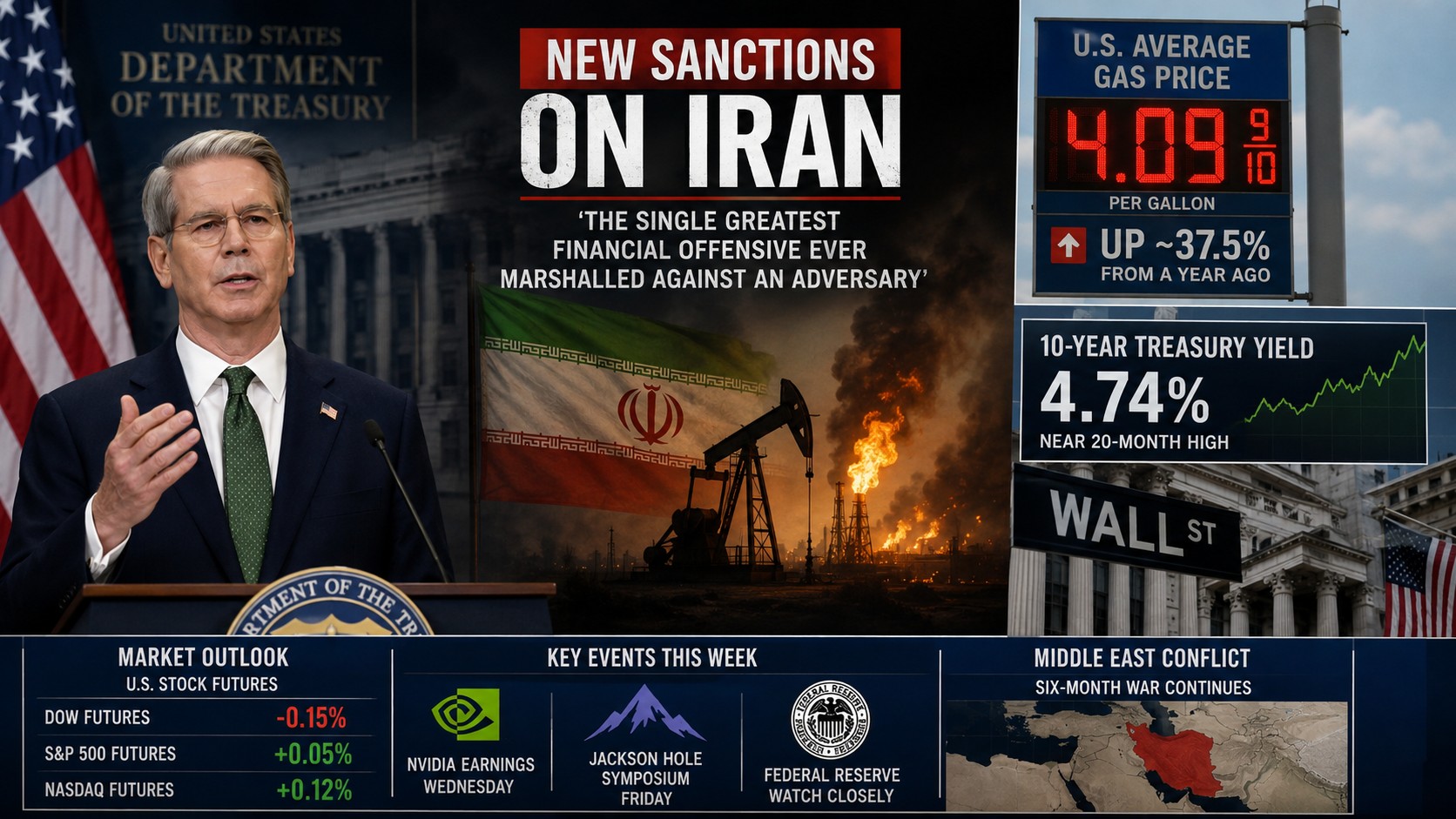
Treasury Secretary Scott Bessent is set to unveil sweeping new sanctions against Iran on Monday, which he has described as "the single greatest financial offensive ever marshalled against an adversary." The move marks a shift in U.S. strategy nearly six months into the war with Iran, aiming to heap economic pressure on Tehran's leadership after ceasefire talks missed a 60-day window.
Bessent framed the coming measures as an "economic D-Day," writing on social media that "at dawn begins an economic D-Day." The new sanctions will add to an already extensive regime targeting Iran's banking, energy, aviation and cryptocurrency sectors, though the administration has not detailed the specific new measures ahead of Monday's announcement.
The escalation comes as Iran has threatened to seize vessels that violate transit rules in the Strait of Hormuz, a critical waterway through which a significant share of the world's oil supply passes. Shipping traffic through the strait has already fallen to roughly 20% of its pre-war average, according to an analysis of maritime tracking data. Talks between Iran and Oman over a new system to manage commercial shipping through the strait, including a proposed fee structure, are set to continue Tuesday.
The prolonged conflict has weighed on consumers at the pump. The national average price for a gallon of gasoline stood at $4.09 on Sunday, according to AAA data, about 37.5% higher than before the war began and roughly $1 more per gallon than a year ago. Elevated energy costs have been a persistent drag on consumer sentiment even as broader inflation readings have cooled elsewhere in the economy.
Markets opened the week on a cautious note. U.S. stock index futures were mixed, with S&P 500 and Dow futures little changed to modestly lower and Nasdaq futures underperforming, as investors weighed the prospect of new Iran sanctions alongside a separate breakdown in U.S.-Canada trade talks over the weekend. The 10-year Treasury yield hovered near a 20-month high of 4.74%, keeping borrowing costs elevated across mortgages, credit cards and business loans. The U.S. Composite Purchasing Managers' Index registered 56 in a preliminary August reading, with services activity at 56.8 pointing to continued economic resilience even as manufacturing growth, at 53.2, moderated.
Investors are also bracing for a pivotal week of catalysts beyond the Iran news. Nvidia is scheduled to report earnings Wednesday, a closely watched read on artificial intelligence infrastructure demand, while Salesforce, CrowdStrike, Workday, Zoom and Intuit round out a busy slate of technology and software earnings. Attention will then turn to the Federal Reserve's annual Jackson Hole symposium Friday, where new Fed Chair Kevin Warsh is expected to deliver remarks that could shape expectations for the central bank's next policy moves.
Iran's leadership has signaled it will not back down. A close ally of Iran's supreme leader said the country "will not submit," while Iran's Islamic Revolutionary Guard Corps has warned it could deploy more destructive weapons if the conflict escalates further. The mix of geopolitical risk, a pivotal earnings week, and a high-stakes Fed gathering leaves markets navigating an unusually dense stretch of potential catalysts in the days ahead.