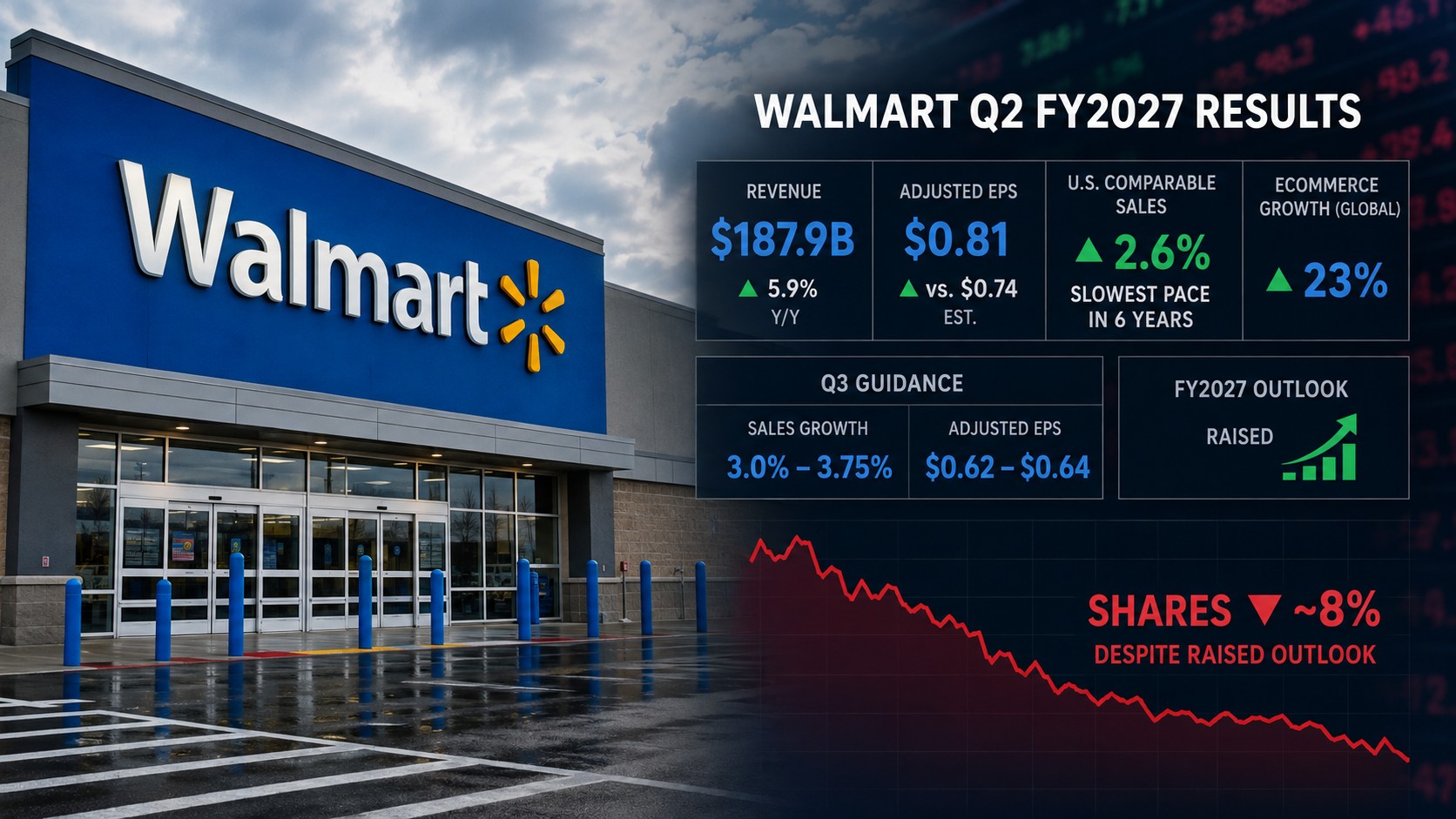
Walmart Inc. delivered a mixed second-quarter fiscal 2027 report that beat top- and bottom-line estimates yet triggered a sharp selloff as investors focused on decelerating U.S. comparable sales and cautious near-term guidance. Total revenue reached $187.9 billion, a 5.9% increase from the prior year, or 5.1% on a constant-currency basis, surpassing Wall Street expectations near $186.8 billion. Adjusted earnings per share came in at $0.81, topping the consensus of approximately $0.74.
U.S. comparable sales, excluding fuel, advanced 2.6%, the slowest growth in more than six years and below many forecasts. Management attributed part of the slowdown to an 80-basis-point headwind from the health-and-wellness category and noted that average ticket growth cooled while traffic gains moderated to 1.5%. Global eCommerce sales jumped 23%, driven by store-fulfilled pickup and delivery as well as marketplace expansion. Advertising revenue rose 38% and membership income climbed 17%.
Operating income grew 28.8%, or 17.4% on an adjusted constant-currency basis after accounting for tariff-refund benefits that management said would be reinvested into pricing. The company raised its full-year fiscal 2027 outlook, now projecting constant-currency net sales growth of 4.0% to 5.0% and adjusted operating-income growth of 7.0% to 8.5%. Adjusted EPS guidance moved to $2.80–$2.87.
However, third-quarter guidance proved the sticking point. Walmart expects net sales growth of only 3.0% to 3.75% and adjusted EPS of $0.62 to $0.64, both below consensus. Shares fell as much as 9% in early trading and remained down roughly 6%–8% as markets opened, pressuring the Dow Jones Industrial Average given Walmart’s large weighting.
Analysts highlighted the tension between long-term structural gains in higher-income households and near-term pressure from elevated fuel prices and selective consumer spending. The results arrive against a backdrop of rebounding Treasury yields, rising oil prices tied to Middle East tensions, and mixed retail reports earlier in the week. For portfolio managers, the print reinforces the need for selective exposure within consumer staples and discretionary names, with particular attention to e-commerce penetration and advertising-margin expansion as potential offsets to softer physical-store traffic.